
Here’s a fact that should stop us in our tracks: of everything people in the United States throw away, food is the single most common thing we send to landfills. It makes up an estimated 24 percent of what’s buried there. That’s an estimated 63 million tons of food every year. And only 2.5 percent of our surplus food gets donated.
When food rots in a landfill, it breaks down into methane, which is a highly potent greenhouse gas. Meanwhile, millions of families struggle to put enough on the table. It’s a lose-lose.
Yet, this is one of the most solvable problems we have. And some of the smartest solutions are happening at city hall.
Your city already has the tools to keep food out of landfills
This September, the Harvard Law School Food Law and Policy Clinic (FLPC) released Waste Less, Feed More: A Local Food Waste Policy Toolkit. It’s a practical playbook for city and county leaders who want to keep food out of landfills and incinerators. It lays out what local governments have the legal power to do, then walks through real policies already working in communities across the country, complete with sample policy language that others can adapt.
For instance in 2019, Ulster County, New York enacted a Food Waste Prevention and Recovery Act that requires large food businesses to donate excess edible food, then send what’s left to animal feed, and only then would it be sent to alternatives to landfills like composting.
When businesses fail to comply, the fees they pay go right back into running and promoting the program. This hierarchy also costs less than traditionally hauling food waste with all other solid waste that is shipped to landfills.
Policies like these can feed more of our neighbors, create local jobs, build healthier soils, and keep more value circulating in local economies. As the toolkit points out, most of the methane from rotting food isn’t captured by landfill energy systems. The smartest move is to keep food out of the landfill altogether.
That’s a win for everyone, no matter where you live.
So here’s our ask. Read Waste Less, Feed More. There are solutions that include ending festival food waste, accessible composting for everyone, improved zoning and more that are actually working in different cities. Send the toolkit to your mayor, county commissioner, or city council member. Ask them one question: which of these ideas could work here?
Curbside Composting is Winning
From Boise, Idaho to Austin, Texas, cities are picking up food scraps right alongside trash and recycling, and doing it in smart, sustainable ways that keep costs low. They’re succeeding, and their success shows any community can do the same.
Reducing food waste is a core part of Natural Resources Defense Council (NRDC)’s work, and their new report with Raftelis, Comparative Cost Analysis for Residential Curbside Organics Collection Programs brings that expertise right to the curb. It digs into eight established programs and two pilots, providing a practical, data-driven playbook for every local leader ready to keep food out of landfills.
The most successful communities treat organics as a core part of their waste system, not an add-on. When establishing a food scraps pick up service, the most successful cities take advantage of the chance to tune up everything, from pickup schedules and routes to contracts and billing. The money saved from streamlining the waste collection process helps pay for the service.
The results show up on residents’ bills. In several cities, households get trash, recycling, and organics pickup for about what their peers pay for trash and recycling alone.
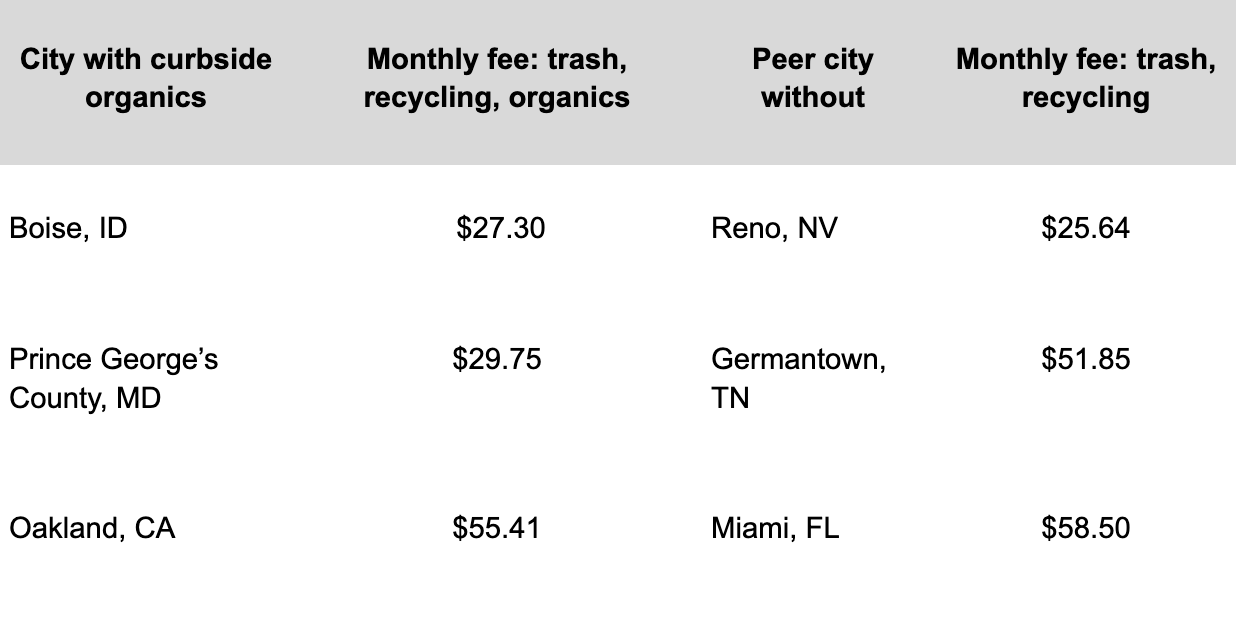
Source: NRDC and Raftelis, Table 3. Peer cities’ fees may also cover services like yard waste or bulky item pickup.
Here’s what the strongest city organics programs have in common:
Make it the default. Boise includes organics as a standard service and reports 97 percent participation. Hamilton, Massachusetts reports a 100 percent set-out rate under its townwide program. More participants means costs are shared across more households.
Rethink the schedule. Once food scraps leave the trash can, so does much of the smell. When the city of Edina, Minnesota, added weekly food scrap pickup, it moved recycling to every other week, and the savings helped fund the new service.
Build on what’s already there. Boise folded organics into its existing hauling contract. In Benson, Minnesota, the same truck and crew collect garbage and organics in one trip.
Line up processing early. Nearby composting capacity is a major advantage. Prince George’s County owns their composting facility, while Austin contracts with two processors so material goes to the closest one.
Give it a dedicated funding stream. A solid waste fee gives programs predictable revenue they can plan around year after year.
States have a role too. The report finds that food waste bans and organics recycling incentives can broaden participation and create the scale and market certainty that make programs cheaper to run.
Good for communities
What happens if instead of feeding landfills, we feed people or we invest in strategies that keep pollution out of our neighborhoods where those who live closest to landfills bear the brunt? Thank you again to the Harvard Food Law and Policy Clinic for giving local leaders such a clear roadmap and NRDC for showing us successful examples. Now it’s time to use these solutions.
At Full Circle Future, we believe in a full circle approach. If your boat were sinking, you wouldn’t just bail out the water, you’d plug the hole. Stronger landfill methane detection and capture standards bail the water. Curbside organics help plug the hole, keeping food scraps out of landfills in the first place.
