
What living near a New York landfill can mean for your health
This is the first post in a two-part series on landfills, health, and environmental justice in New York State. Read the second post here.
More than 6.7 million New Yorkers live within five miles of a Municipal Solid Waste (MSW) Landfill. That's more than a third of the state's population sharing their air and groundwater with a site that generates toxic gases and chemical leachate — the toxic liquid that forms as water filters through waste — every single day.
For some, the health consequences are already in the data. New York's own health agencies have documented elevated rates of cancer and respiratory disease near landfill sites. Researchers across multiple countries have found the same patterns. And our own analysis found that communities near New York's 86 active MSW landfills are disproportionately likely to have above-average rates of cancer, asthma, heart disease, and Chronic Obstructive Pulmonary Disease (COPD).
For too many others, lack of data collection and transparency means that their lived experience isn’t reflected anywhere in academic or scientific research, but should be no less central in determining the rules that landfills have to follow.
New York state regulators currently have the opportunity to rewrite the rules for how these sites operate. This post breaks down what the science says , and what those rules need to require.
Check out our interactive storymap for more on how landfills impact already marginalized communities.
1. New York’s own health agencies found the harm
New York State did not need outside researchers to tell it what was happening near its landfills. Its own agencies have been documenting elevated disease rates for decades.
In 1998, the New York State Department of Health published a landmark study of communities near 38 landfills. Women living within a mile of those sites were four times more likely to develop bladder cancer and nearly four times more likely to develop leukemia than women living farther away.
The New York City Department of Health reached similar conclusions in its long-term study of Fresh Kills, the former Staten Island landfill that was once the largest in the world. Residents near Fresh Kills experienced elevated rates of lung, larynx, and esophageal cancers compared to other New York City communities.
State and local agencies have since conducted additional investigations near other inactive landfill sites, consistently finding patterns of elevated cancer and respiratory disease in surrounding communities.
2. What’s coming out of the landfill and into the body
Landfills are not inert piles of trash. They are active chemical environments that leak into the air, the groundwater, and the soil for decades after they close.
Landfill gas. As organic waste decomposes, it releases methane, carbon dioxide, and dozens of other gases. According to the New York State Department of Health, a landfill can continue producing these gases for more than 50 years after it stops accepting waste. These gases don't stay on site. They migrate through soil and can enter nearby homes through basement cracks, utility entry points, and floor drains through a process called soil vapor intrusion. Once inside, they accumulate in basements, crawlspaces, and other poorly ventilated areas. Community studies near landfills have found that exposure to landfill gases is associated with eye, throat, and lung irritation, nausea, headaches, chest pain, and aggravation of asthma. Older landfills and smaller dumps may have no gas control measures at all.
PFAS and leachate. As water moves through a landfill, it picks up a toxic soup of chemicals and heavy metals called leachate. Landfills are among the largest sources of PFAS — the “forever chemicals” that do not break down in the environment or the human body — entering New York’s groundwater. The state’s own sampling found PFAS contamination in 68 percent of groundwater wells near investigated inactive landfills. The health costs of PFAS in New York alone are estimated at $2.7 billion to $4.4 billion annually. For more on PFAS and leachate in New York waterways, visit The Leachate Loopholeby New York River Watch.
Children and birth outcomes. Research has consistently found elevated rates of birth defects and adverse birth outcomes in communities near landfills. A 1998 European study of 8 million people found a 33 percent increased risk of congenital anomalies for those living within three kilometers of a hazardous waste landfill. A 2001 UK study found elevated rates of birth defects near landfill sites, and a 2009 systematic review found consistent associations between landfill proximity and low birth weight across multiple studies. Children's developing bodies and organs are especially vulnerable to the chemical exposures landfills generate.
These patterns are not unique to New York. A 2009 systematic review found consistent associations between residents near solid waste landfills and increased risk of cancer, low birth weight, and other adverse health outcomes. A 2016 Italian cohort study found that living within five kilometers of a landfill was associated with increased mortality from multiple causes. Together, the evidence is consistent, substantial, and troubling.
3. The harm is not distributed equally
Across New York State, the communities that live closest to landfills are disproportionately low-income communities of color. That is not an accident. Developers and regulators have historically sited landfills in communities with less political power to resist them, and the health consequences have followed. In New York, half of the people living within five miles of a landfill are Black, Indigenous, or people of color.
In North Bellport, a small hamlet on Long Island, residents live within a mile of the Brookhaven landfill. North Bellport is majority Black and Latino, with a poverty rate more than three times the state average. The community has elevated rates of asthma, and residents have spent years raising concerns about the landfill’s proximity to their homes, their schools, and their children.
Environmental justice requires that we name this clearly: the unequal distribution of landfill-related harm is a product of choices made over decades, and reversing it requires deliberate policy action, not just better monitoring.
4. What this actually costs families and the state
The health effects of landfill proximity are not abstract. They translate directly into medical bills, lost wages, and years of life cut short.
For families managing landfill-related illness, the costs are relentless. Asthma alone costs the United States $81.9 billion per year in medical expenses and lost productivity — across the more than 25 million Americans living with the disease. That burden falls hardest on the communities with the least resources to absorb it. Cancer and heart disease, the two conditions most consistently elevated near landfill sites, together cost the United States more than $320 billion per year in healthcare and lost productivity. For the families living nearest these sites, that burden is not a statistic. It is a bill. Meanwhile, asthma alone accounts for 13.8 million missed workdays among adults and 13.8 million missed school days among children every year — costs borne by employers, families, and school systems alike.
PFAS contamination from landfills carries its own price tag. A 2025 NRDC analysis estimates that the social cost of PFAS exposure in New York — including healthcare, lost productivity, and reduced quality of life — ranges from $2.7 billion to $4.4 billion annually. That cost is largely borne by the residents living nearest the sources of contamination.
5. We can’t fix what we can’t see — and right now, we can barely see anything
Despite clear and documented evidence of the health impacts of landfills, perhaps the most troubling fact in this entire picture is how little we actually know.
New York has no requirement for systematic air quality monitoring at the fenceline of landfills, where residents’ exposure is highest. There is no routine testing of private wells near landfill sites. Nearly all of the evidence that does exist comes from retrospective studies that look backward at communities where harm has already occurred.
That means communities are being harmed before the data exists to document it. By the time a cancer cluster gets studied, a generation has already been exposed.
The absence of monitoring is not a neutral condition. It protects landfill operators from accountability and leaves communities without the information they need to protect themselves. Mandatory fenceline air monitoring, routine private well testing near active and inactive landfill sites, and real-time public disclosure are not optional features of good regulation; they are baseline requirements for protecting public health.
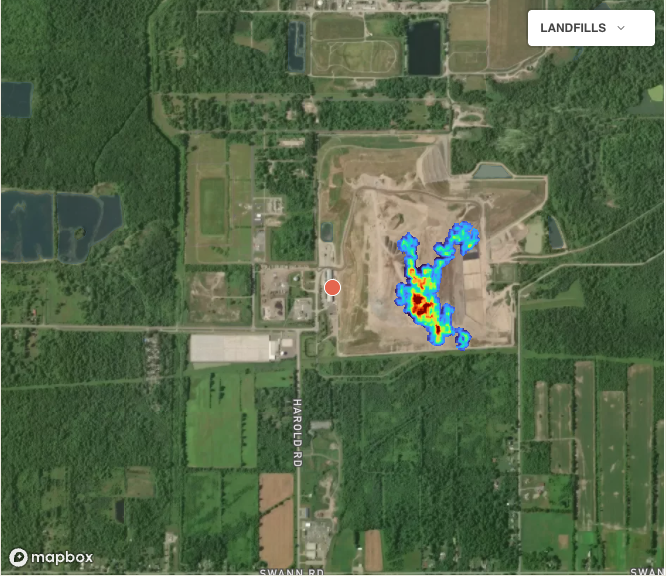
A methane plume detected from a landfill in Youngstown, New York. Large methane emissions can indicate the presence of other health-harming pollution. Learn more about this plume in Carbon Mapper’s data portal.
6. New York has a chance to act right now
New York’s Department of Environmental Conservation (DEC) is currently considering updates to two sets of weak, outdated regulations — one that regulates air emissions and one that regulates landfill leachate. The window to act is now, and impacted communities are watching. You can get involved by:
Emailing DEC and urging them to draft the strongest possible standards for landfill operators
Telling DEC and Governor Hochul that their proposed rules on landfill leachate aren’t good enough
