
Experience is Evidence: The real impact of living near New York’s landfills
This is the second post in our series on landfills, health, and environmental justice in New York State. Read the first post here.
As you read in the first blog in our series, there’s already documented scientific research showing the potential for serious health consequences for residents living near one of New York’s 86 municipal solid waste landfills. The state’s own health agencies have consistently found patterns indicating higher rates of cancer and respiratory disease in the communities nearest landfills
But data can only take us so far. Numbers don't capture what it's like to watch a young man walk into an emergency room unable to breathe and not walk out. They don't capture what it's like to count the cancer diagnoses at your child's elementary school. They don't capture the deep exhaustion that comes from raising concerns for decades and being told, again and again, that there's nothing to see.
And when monitoring is inadequate, when studies are never commissioned, and when health departments redact their own findings under industry pressure, the data doesn't just fail to tell the whole story. It actively obscures it.
New York’s air regulators The New York State Department of Environmental Conservation is currently considering updates to its landfill emissions regulations, which can and must include provisions to increase transparency for those living in the shadows of the state’s most noxious waste facilities. In this process, it’s critical to remember that community voices are evidence in their own right.
Read on to hear from two leaders at the forefront of New Yorkers' fight for safe water and protection from toxic chemical emissions as they challenge a $100 billion waste industry.
"There's No Escape": North Bellport and the Brookhaven Landfill
Monique Fitzgerald, co-founder of Brookhaven Landfill Action and Remediation Group (BLARG), has lived in North Bellport her entire life and is now raising her own son there. The Brookhaven Landfill — a municipal landfill operated by the Town of Brookhaven — has been there since before she was born and has loomed large over the community since her childhood. In fact, her aunt was one of the first people in the community to advocate against it.
Growing up, Monique was an active kid and self-described tomboy who wanted to play every sport. But at Frank P. Long School — the only elementary school in the North Bellport community — too many of her classmates couldn't play outside due to asthma flare-ups. As a child, Monique knew asthma was everywhere in the community, but what she didn’t yet understand was why.
"It was always framed as a construct of our own genetics," she said. "Never framed as a consequence of the environment we live in."
As an adult, Monique worked for 17 years at a local hospital, including five years in the emergency room. The patients she saw coming in with asthma were almost always Black or Indigenous residents from Bellport or the neighboring community of Mastic. That discrepancy isn’t a coincidence. North Bellport was designed entirely by white supremacy, through racist housing practices like blockbusting.
One particular case from Monique’s time at the hospital has stuck with her: a young man, barely in his twenties, who walked from Bellport to the hospital because he couldn't breathe. He didn't make it.
"All I can remember is him saying he couldn't breathe," she said. "Those were his last words."
The patterns she witnessed in the ER were later borne out in statistics: North Bellport has the highest emergency room visits for asthma in all of Suffolk County. But when Monique and her team at BLARG asked for studies on whether the landfill was contributing to these outcomes, they were refused.
The cancer numbers in the community are also staggering, including at the Frank P. Long School, where a shocking thirty-five teachers have developed cancer. Eighteen have died. In 2023, a 13-year-old student tragically died of non-Hodgkin's lymphoma.
Once again, the town of Brookhaven has refused to consider any connection with the landfill. "They say it's not a cancer cluster," she said. "And they refuse to study it ... .We constantly ask for studies that we don't get."
The threat isn't only in the air. A groundwater contamination plume has been spreading beneath North Bellport for decades. State regulators have confirmed the groundwater contains levels of PFAS — also known as "forever chemicals" — above New York's standards, as well as elevated levels of 1,4-dioxane, an industrial solvent the EPA has linked to higher cancer risk in drinking water. New York’s Department of Environmental Conservation (DEC) has explicitly urged the Town of Brookhaven to acknowledge that the landfill is "the only conclusively identified source of emerging contaminants" for the affected area. The town's own proposed response? Expand monitoring and connect the handful of homes on private wells to the municipal supply.
For Monique, that kind of response is exactly the problem. Suffolk County Water Authority tells residents their drinking water is safe, while simultaneously installing granulated activated charcoal treatment systems on some wells and fundraising to expand them to others.
"On one hand, there's no problem. On the other, you're fundraising for more treatment," she said. "We can't get them to make it make sense."
As is often the case, the landfill has also attracted other polluting infrastructure, including an asphalt plant and a fracking gas power plant The cumulative burden on the community is immense.
"People who live here have no escape," Monique said. "There's no going home and turning on air purifiers or water filters. That's not something a community like this can afford. We're here 24 hours a day, seven days a week." Case in point: also in the North Bellport community is one of the largest family homeless shelters in Suffolk County, full of families with children and nowhere else to go.
The Town of Brookhaven fills approximately a third of its budget with landfill revenue. It takes what Monique describes as an "adversarial approach" to community concerns, and has used the potential tax implications of closure as a political tool for years. A corrective measures report submitted by the Town of Brookhaven to the DEC includes a planned landfill closure in 2028 and capping in 2029. But the town has also requested a permit extension through 2031. For Monique and her neighbors, the alarm bells don't stop ringing until closure is real.
"This is not planning," she said. "This is pushing this off into the future."
In addition to pushing back against the landfill and nearby incinerator, BLARG has launched zero-waste initiatives like the Anti-Landfill Composting Collective and supported the Chris Hobson Bill Neal Community Garden. Still, as Monique says, “people are afraid to grow vegetables and garden here because they’re afraid that their soil is contaminated.”
A David and Goliath Situation: Geneva and the Shadow of Two Landfills
Jackie Augustine, Executive Director of BluePrint Geneva, has lived in or around Geneva her whole life. Geneva is nestled in the Finger Lakes, a region known for its wine, lakes, and picturesque landscapes. It is also bracketed by two major landfills: Seneca Meadows, one of the largest active landfills in the state, and the Ontario County Landfill. Jackie grew up near both.
Her civic education began at home. As a teenager, she watched her parents put an anti-incinerator sign in their yard when Casella proposed one near the Ontario County Landfill. She wanted to understand why that mattered — and that curiosity never left her. She went on to earn a PhD in philosophy, teach at local colleges, serve 16 years on Geneva's City Council, and founded BluePrint Geneva, an organization with environmental justice at the center of its mission.
From the council, Jackie was immersed in questions about leachate — the toxic liquid that seeps through landfills and can contaminate groundwater. Geneva's wastewater treatment plant, the largest in the area, receives leachate from both Seneca Meadows and the Ontario County Landfill. She also started hearing something else: questions from community members about whether Geneva was a cancer cluster.
"I started hearing people asking about it, and I didn't really understand what that meant. I needed to look into it."
The data, when it has been allowed to surface, is striking. The New York State Department of Health (DOH) identified a lung cancer cluster centered on the area around Seneca Meadows. According to reporting by journalist Peter Mantius, the 70,226 residents within the cluster had 50 percent more lung cancer than statistically expected during the years 2011–2015. In the following five-year period, 2016–2020, Seneca County lung cancer rates were 31 percent above the state average and 34 percent above the national average. The census tract where Seneca Meadows sits — a state-designated disadvantaged community — had lung cancer rates 63 percent above expected levels in 2013–2017, the highest of any census tract in the cluster. Seneca Meadows and an adjacent gas-to-energy plant are among the county’s leaders for emitting volatile organic compounds (VOCs), including known human carcinogens benzene, formaldehyde, vinyl chloride, and trichloroethylene.
And then the data was taken down. After the DOH published census-tract-level cancer data, Seneca Meadows — a subsidiary of industry giant Waste Connections — hired two public health doctors to reinterpret the findings and reassure the community. The company released public relations materials and offered alternative explanations for the high lung cancer rates, like low household incomes, potential smoking rates, and industrial work. All the while, they’ve continued to insist that the landfill is in full compliance with all regulations. After pressure, the DOH stopped providing cancer data at the census tract level entirely.
To Jackie, the industry's response doesn't answer the question communities are actually asking.
"They didn't say, 'We do not contribute to this,'" she said. "They simply said there could be lots of things that contribute. And that is not a satisfactory response. I think people would like to get to the bottom of it and fundamentally answer the question: are our families safe in this area?"
For many, the answer seems to be no. Health impacts are deeply felt in the community, with people reporting debilitating odors, respiratory problems, unusual cancers, and aggressive diagnoses at young ages. But there’s simply not enough tangible, accessible data to help residents draw a causal line between the landfill and their own experience.
"There doesn't seem to be any granular level data that any of us can get our hands on."
Jackie has worked to close that gap through community air monitoring, using industrial sensors placed near the fence line of the landfill. The monitoring infrastructure that does exist is deeply compromised. New York State's DEC requires landfills to have a monitoring response plan — but that plan at the landfills near Geneva amounts to a landfill employee who comes out to investigate complaints. That employee, Jackie notes, either doesn't smell anything, says conditions have changed, or attributes the odor to agriculture. As far as Jackie can tell, the landfill has rarely if ever validated a complaint.
"In many ways," Jackie said, "it was like gaslighting people. They come out and say, 'No, you don't smell anything.'"
Blueprint Geneva created a website, itstinks.org, so residents could log odor complaints and see that they weren't alone. The site was recently updated to better capture the type, intensity, and duration of odors. But the tool still has real limitations: it's a tool for community solidarity, not a substitute for real scientific monitoring.
Hydrogen sulfide is the suspected compound behind the rotten-egg smell that residents report, but Jackie wants people to understand the smell alone is not the point.
"People complain about it because of the smell, and they don't think about the chronic exposure profile that might be occurring," she said. "Methane might not cause a detectable odor, but serves as a carrier gas for a lot of other toxic emissions."
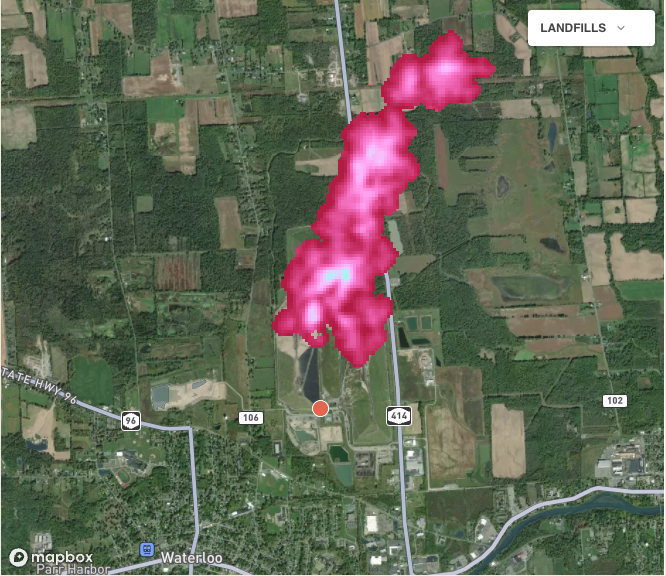
A methane plume observed coming from Seneca Meadows Landfill. Learn more about this plume in Carbon Mapper’s data portal.
Political dynamics have compounded everything. The Town Board has approved another host agreement with Seneca Meadows, signaling to the state that the community consents to expansion — even though, Jackie says, it doesn't reflect community sentiment. Seneca Meadows has invested heavily in local political races through firms and intermediaries, shaping elections decided by a hundred votes or fewer.
"The amount of money they've poured into local races has skewed the political landscape," she said. "It makes it easy to have an outsized influence on a small community."
And the waste problem is bigger than any single landfill. New York State, Jackie argues, sees Seneca Meadows as a large part of its waste management solution — which means that without a serious commitment to alternatives, underresourced communities will continue to pay the price for everyone else's trash.
"It's no secret that landfills go to communities where land prices are low, incomes are low, civic engagement is low," she said. "It's the perfect storm. And it does feel a bit like David and Goliath."
What Justice Looks Like
For Monique, justice begins with the 17 Principles of Environmental Justice, including reparations for harms already done. That should include comprehensive studies and action plans around health, water, air, and soil, including a zero-waste action plan.
Jackie agrees, and adds that both communities deserve the truth. "Justice begins with transparency and telling the truth about the community impacts of these operations," she said. "To the extent that regulators or industries have been trying to shield or obscure those impacts, that's the first injustice that needs to be corrected…The industry is always going to figure out how to maximize their profit and minimize their potential liability. But their potential liability is people's lives. So at some point, we just need somebody to take lives more seriously than the dollars.”
The Evidence They Refuse to See
The communities near these landfills are not asking us to take their word for it in lieu of evidence. They are asking why relevant evidence is hidden behind closed doors, why studies aren't being commissioned, why health data gets pulled down, and why monitoring systems are designed in ways that make it nearly impossible to validate the harms people are experiencing every day. As DEC drafts urgently-needed updates to the state’s landfill operating standards, data accessibility and transparency must be a top priority.
The absence of data is not neutral. It is a choice. And it consistently serves the interests of the industry, not the communities. When those in power refuse to investigate, the burden falls on residents to prove what they already know: something is wrong.

