

Too Hot to Ignore
America’s preventable landfill fire problem
Underground landfill heat can lead to disaster.
When waste buried deep inside a landfill becomes unusually hot, it can lead to an underground fire. These are more like chemical reactions than regular house fires, and are incredibly difficult to control once established.
While unusually high temperatures don’t automatically indicate a fire, they should be taken seriously, investigated thoroughly, and quickly mitigated when needed.
A subsurface landfill fire can:
Increase unchecked emissions of methane and toxic pollutants: Concentrations of hazardous pollutants like benzene and other volatile organic compounds (VOCs) can double for every 18°F increase in waste temperature.
Increase leachate sevenfold, the contaminated and foul smelling “garbage juice” that forms when liquid passes through the landfill, which can threaten ground water aquifers and rivers that we rely on for our drinking water.
Cause nauseating odors, and health impacts such as persistent headaches, nose bleeds or dramatic decreases in quality of life for residents living miles away from the site.
Cause sudden and severe settlement that damages landfill infrastructure and can increase the risk of slope failure.
Destroy its own air and water pollution control systems, allowing pollution to go unchecked.
Require hundreds of millions of dollars in clean-up and remediation costs over many years.
Continue burning or smoldering for decades.
An alarming pattern
A Bloomberg news investigation found a pattern of elevated-temperature landfills, underground fires, and large methane releases that often persist for months or years with limited government oversight. That led us to a simple question: what do we actually know about what is happening inside the 2,600 MSW landfills across this country? To find out, we obtained more than 400 public records across 20 states (see Appendix D for detailed results and methodology). Here’s what we learned:
Regulators tasked with overseeing landfills are not doing nearly enough due diligence before giving landfill operators the green light to operate at high temperatures or increased oxygen levels — both of which raise the risk of fire significantly.
Millions of people live, work, and play within just miles of landfills where there may be warning signs — and they likely have no idea.
There is often little to no follow-up to ensure that risk is mitigated.
The majority of approvals for higher operating temperatures or oxygen levels were issued to landfills operated by enormous waste companies: WM, Republic Services, GFL Environmental, and Waste Connections.
Read on for more on why high landfill operating temperatures are a big deal, case studies showing how the current system fails, and what better oversight and transparency should look like.
Buried Consequences: The Chiquita Canyon Story
People living near landfills with subsurface elevated temperature (SET) events can lose their homes, their health, and sometimes their livelihoods. One particularly heartbreaking example is the community of Val Verde, California. On the surface, Val Verde seems idyllic, home to picturesque foothills, ranches , and year-round sunshine. But the area is also home to the notoriously noxious Chiquita Canyon Landfill, where an underground chemical reaction has been raging for years, spewing toxic air emissions and geysers of toxic leachate. Nearby residents have been begging policymakers for relief for years, sharing their harrowing experiences with asthma attacks, nosebleeds, vomiting, miscarriages, and cancer.
These dire consequences are largely preventable, but only if landfill operators and regulators recognize warning signs, investigate what is causing them, and act before a manageable problem becomes a disaster.

More than 5.5 million people live within 5 miles of a landfill with approval to operate at a high temperature.
That’s more than enough to fill every NFL stadium in the country twice.

When operators don't address the cause, heat can become a disaster
Elevated temperatures are not part of routine landfill operations. They are a warning sign that conditions inside the landfill have changed and require attention. Not every elevated temperature means a subsurface fire or elevated temperature event is already underway. But every elevated temperature requires landfill operators to investigate the cause and actively manage conditions before they worsen. When landfill operators fail to maintain the landfill or create conditions that trap heat or introduce oxygen, they can increase the risk of a subsurface fire.
See Appendix A for details on how landfill SET events can happen.
Four ways landfill operators create dangerous conditions:
-
Over-pulling on gas collection wells draws oxygen into the landfill.
-
Unrepaired erosion and cracks in the landfill cover allow oxygen into the landfill.
-
Waste like slag or incinerator ash can cause exothermic reactions.
-
Leachate recirculation accelerates biochemical reactions.

Source: Thalhamer, Todd, Navid H. Jafari, and Timothy D. Stark. 2025. "Subsurface Elevated Temperature (SET) Events in Landfills." Webinar, FGI, July 17, 2025.
A Hot Well is a Symptom, not a Diagnosis
Subsurface elevated temperature (SET) events develop underground, out of sight, so they must be diagnosed the same way physicians diagnose a patient: by looking at multiple indicators together and, critically, how those indicators change over time. Well-head temperature is only one piece of the picture. Landfill operators and regulators should evaluate solids temperatures from borings inside the landfill, gas trends including methane, carbon dioxide, oxygen, carbon monoxide, hydrogen, volatile organic compounds (VOCs), gas well pressures and vacuum but also physical and operational conditions that can help explain why temperatures are changing. These include odors, smoke, settlement, cracking, changes in leachate levels, the integrity of the landfill cover, evidence of air intrusion, changes to gas collection operations, whether leachate recirculation is occurring, whether reactive materials such as incinerator ash or slag have been disposed of in the affected area, and what types of waste and cover materials are present A single measurement rarely provides the answer, but changes across several indicators can reveal whether a landfill is operating normally or beginning to transition toward abnormal and potentially dangerous conditions.
Just as important as the values themselves are the trends. For example, a well that slowly reaches 140°F over several years presents a different situation than one that jumps from 100°F to 140°F in a few weeks. Knowing what is inside the landfill is also important. What is the temperature of the solids inside of the landfills? Are there reactive wastes like slag? The goal should not be to document that a hot well has remained stable enough to justify a higher operating temperature. The goal should be to identify the root cause of the abnormal conditions and return the landfill to stable operation before temperatures continue to rise and the risk of more severe subsurface reactions increases.
Regulators are consistently failing to provide basic oversight
Federal rules (National Emission Standards for Hazardous Air Pollutants: Subpart AAAA Municipal Solid Waste Landfills. 40 CFR 63, and New Source Performance Standards: Sub-part Cf – Emission Guidelines and Compliance Times for Municipal Solid Waste Landfills. 40 CFR 60) establish reporting, corrective action requirements and temperature limits for landfill gas wells because rising temperatures can signal that something is going wrong underground. See Appendix B for a detailed explanation of the federal regulations governing subsurface elevated temperature events and their shortcomings.
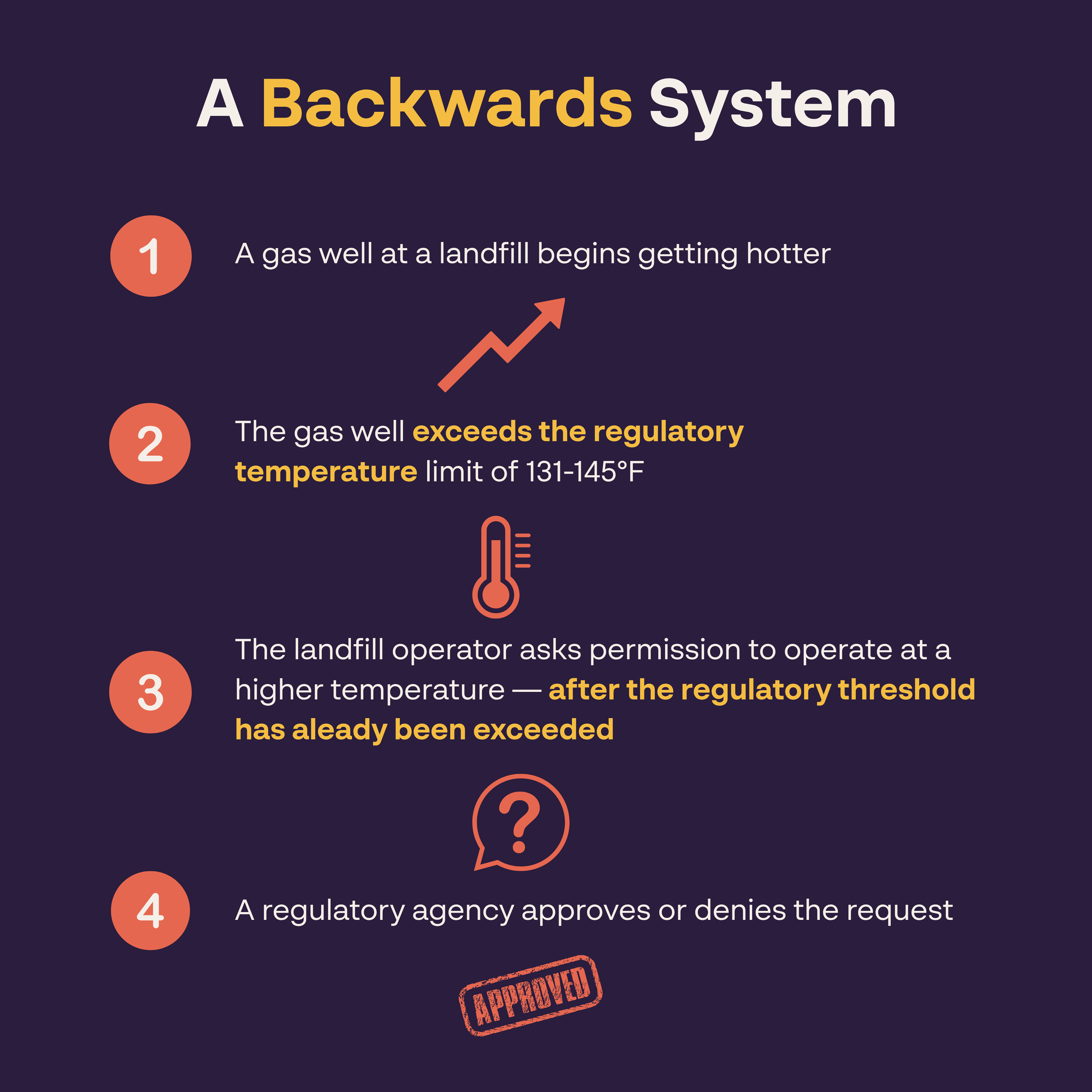
When a landfill wants to operate at a higher temperature, it requests a Higher Operating Value (HOV) approval. The request is then approved or denied by a regulatory agency, often a state Environmental Protection Agency, Department of Environmental Quality, or the state’s equivalent.
When temperatures exceed the applicable default limit, federal regulations allow landfill operators to request a Higher Operating Value (HOV) approval for an individual gas well. To obtain an HOV, the landfill operator must submit a demonstration to the regulatory authority showing that the elevated temperatures do not indicate a subsurface fire and are not significantly inhibiting anaerobic decomposition by killing methanogenic organisms. Federal regulations specifically require supporting data demonstrating that the elevated temperatures "neither cause fires nor significantly inhibit anaerobic decomposition by killing methanogens." It seems logical that a regulator’s review of a HOV request should answer the first order question: Why is the landfill operating above normal temperatures, and how is the landfill addressing the problem?
But our investigation found regulators often approved higher operating temperatures without requiring enough information to confidently answer that question. In practice many approvals relied primarily on review of carbon dioxide, oxygen and methane concentrations and the absence of obvious signs of a fire rather than actually determining what was happening that was triggering this abnormal temperature. Regulators frequently accepted explanations that elevated temperatures reflected benign "elevated temperature landfill" or "subsurface reaction" conditions, even as wellhead temperatures climbed.
A Troubling Pattern Across States
Our analysis revealed the same fundamental problem everywhere: state regulators were not providing adequate oversight of conditions that could develop into catastrophic and costly landfill fires. It is entirely possible that some of these landfills were operating safely. But determining that requires understanding why temperatures are elevated, Regulators typically relied on wellhead gas data, primarily carbon dioxide, oxygen, balance gas, methane, or carbon monoxide readings, to conclude that higher temperatures could be allowed. Yet these measurements do not directly reveal conditions deeper within the waste mass, where temperatures can be much hotter than at the wellhead.
The documentation submitted by landfill operators was, time and again, remarkably sparse. In many of the cases we reviewed, operators did not demonstrate that they had conducted the due diligence of drilling boreholes or otherwise measuring temperatures within the landfill to understand the extent of the problem. Even more concerning, the records rarely documented a root cause analysis - that is, a systematic effort to determine why temperatures had become elevated and to address the underlying cause before requesting permission to continue operating at higher temperatures.
The High Cost of Failure
Underground landfill fires are among the most costly failures a landfill can experience. Once a subsurface reaction becomes established, there is no quick fix. Landfill operators may spend decades trying to contain heat, control odors, rebuild damaged gas collection systems and manage contaminated leachate.
The costs extend far beyond the landfill itself. Communities are left living with the health and economic consequences of a disaster they did not create. Nearby residents can lose the use and value of their homes, businesses can suffer economic losses, and local governments often devote substantial resources to emergency response, public health investigations, and ongoing oversight. One stark example is Virginia's Shoosmith Landfill, where years of mismanagement left the landfill bankrupt, a catastrophic environmental disaster in its wake, and the community holding the $173 million bill.
Preventing subsurface elevated temperature events is far less expensive than responding to them. Finding the root cause of rising temperatures, correcting air intrusion, installing additional wells, removing liquid, fixing gas collection and using modern monitoring technologies cost a fraction of the long-term engineering projects required once a subsurface fire becomes established.
Finding 1: A system that too often substitutes paperwork for actual investigation
Higher operating temperature approvals are supposed to serve a specific function: they allow a landfill to continue operating gas wells above the standard regulatory threshold only when an operator can demonstrate that the elevated temperatures do not indicate harmful conditions. The logic of the HOV process depends on that demonstration happening before the approval is granted. Regulators should understand why temperatures are elevated at a landfill and what the operator is doing about it before they decide that a higher temperature is acceptable.
In practice, across multiple states and at dozens and dozens of landfills, that logic is frequently inverted. Regulators approve the higher operating temperatures without requiring the operator to first identify and verify the actual cause of the heat. Root cause analyses, when they are conducted at all, are often retained at the site rather than submitted to regulators, meaning that the technical basis for an approval is never subjected to independent scrutiny.
Instead, landfill operators generally provided a short description of observations that no smoke, burning odors, or unusual settlement have been seen, along with wellhead monitoring data — usually temperature, methane, carbon dioxide, oxygen and carbon monoxide, balance gas (rarely hydrogen) — along with narrative explanations for the elevated temperature. Requests sometimes included descriptions of operational measures such as gas extraction, dewatering, or leachate management. What they generally did not provide are direct investigations of conditions inside the waste mass, such as downwell temperature measurements, subsurface borings, or other evidence that independently verifies what is actually causing the elevated temperatures. As a result, regulator approvals are frequently based on inferences rather than direct confirmation of conditions within the landfill.
This matters because elevated temperatures in a landfill gas system can have multiple causes, and those causes have very different implications. Heavy rainfall is one possible explanation, but so are chemical reactions within the waste mass, air intrusion triggering oxidation, or developing subsurface elevated-temperature conditions that, if not addressed, can spread and intensify. Without a credible root cause analysis, there is no way to distinguish a benign explanation from a dangerous one.
Oregon Let Landfills Approve Their Own Hot Wells Under Standing Procedures
The Oregon records reveal a concerning regulatory approach. DEQ approved a standing operating procedure at Waste Management’s Riverbend Landfill in 2005, and later approved a similar procedure for Columbia Ridge Landfill. Under that approval, Waste Management, not the state regulator, applied the procedure to determine whether individual wells at Riverbend Landfill could continue operating above the regulatory temperature limit. This protocol did not include a root cause analysis or downwell borings to show the temperature within the waste mass. A 2012 DEQ email later acknowledged that Riverbend had not originally submitted information about specific wells and stated that DEQ did not need to approve updated well lists each time because there was already "general approval" under the permit. By 2012 and again in 2014, Riverbend was periodically submitting lists of dozens of wells operating under the approved procedure, with allowable temperatures up to 166°F. Columbia Ridge adopted a similar approach. In 2010, Oregon DEQ approved a procedure allowing Columbia Ridge to add future wells to its Higher Operating Value (HOV) program when they exceeded the regulatory temperature threshold and met the established criteria. In 2025, the landfill notified DEQ that additional wells had been added under the standing procedure rather than submitting a new technical demonstration for each well.
Separate corrective-action records illustrate the limits of that approach at the Riverbend Landfill. Under the federal rules, landfill operators must perform a root cause analysis and identify corrective actions when wellhead temperature exceedances are not corrected within the required timeframe.
One well remained above the regulatory temperature limit for approximately 232 days and reached 181.1°F, —more than 36°F above the federal operating limit of 145°F and above the temperature at which methanogenic microorganisms are expected to become significantly inhibited. As methanogens are lost, the landfill's gas chemistry can fundamentally change, making it increasingly difficult to distinguish a stable landfill from one experiencing an abnormal subsurface reaction. Yet the 2025 root cause analysis listed the initial assessment simply as "Temperature change – cause unknown," with no further explanation. Rather than requiring the operator to determine why temperatures had reached such an extreme level before allowing continued operation, the records reviewed suggest that the regulatory process shifted from independently scrutinizing individual hot wells to trusting landfill operators to manage them under an approved HOV procedure.
U.S. EPA Approved Hotter Landfills in Illinois, Despite Troubling Gas Composition
Unlike some of the state records we reviewed, U.S. EPA Region 5 generally considered a broader set of information before approving higher operating temperatures at Illinois landfills. The records include approvals at several landfills — Cottonwood Hills, Milam Recycling and Disposal Facility, Quad Cities Phase IV, and multiple requests at Indian Creek Landfill — covering dozens of individual gas wells with approved temperatures ranging from approximately 136°F to 165°F.
Across these approvals, a consistent pattern emerged: the U.S. EPA did not require a documented root cause investigation before approving the higher temperatures. The U.S. EPA typically reviewed gas composition (methane, oxygen, carbon monoxide, and sometimes hydrogen), field observations, and monitoring data to determine whether the landfill showed signs of active combustion or whether elevated temperatures appeared to be inhibiting methane production. In some cases, EPA also reviewed corrective actions the landfill had already taken, such as increased gas extraction, dewatering, or ending leachate recirculation.
At GFL Environmental’s Indian Creek Landfill in Tazewell County, Illinois, the monitoring data provided in the HOV request consistently show abnormal landfill conditions. The wells exhibited sustained elevated temperatures, declining methane concentrations and increasing carbon dioxide concentrations. In fact, the request letter literally says, “A review of landfill gas quality data collected during the October 2023 - March 2024 timeframe indicates that CH4 has often decreased while CO2 has increased. This is indicative of elevated temperature landfill (ETLF) conditions within this small area of the site.” The landfill attributed the elevated temperatures to leachate recirculation and described corrective actions it took, but the request presents that explanation as a suspected cause rather than documenting a formal root cause investigation. This approval demonstrates that U.S. EPA Region 5 conducted a more substantive review than many HOV approvals examined in this report. However, the approval still relies on the landfill's proposed explanation for the elevated temperatures rather than documenting an independent determination of their root cause. The approval explains why EPA concluded the wells could continue operating safely under enhanced monitoring, but it does not establish why conditions developed in the first place or demonstrate that the suspected cause had been verified.
At the Quad Cities Phase IV Landfill, which is owned by Waste Connections and operated by subsidiary Millennium Waste, EPA approved a higher operating value of 165°F without requiring the landfill operator to determine why the well had reached such an unusually high temperature.
“Your letter states that Millennium has struggled to maintain well EW23 below 131 °F since it was installed in December 2013, and that it has become progressively more difficult in recent months. Your letter goes on to say that temperature measurements at the well have been consistently above 131 °F in 2016 and as high as 155 °F. You have provided data showing strong anaerobic decomposition and low levels of carbon monoxide. You request an HOV of 165 T. We are somewhat concerned about this request because 165 °F is higher than most, if not all, HOV requests that come into this office. We will grant the requested HOV of 165 T at this time. However, we request that you maximize vacuum at the well and continue to closely watch carbon monoxide levels to ensure they are below 500 ppm.”
- Excerpt from U.S. EPA approval of HOV request at Quad Cities Phase IV Landfill, August 16, 2016.
A landfill doesn't suddenly reach 165°F for no reason. Without understanding the root cause, regulators cannot know whether they are looking at a stable condition or the early stages of a much more serious problem. Rising temperatures can be caused by operational problems, oxygen intrusion, reactive wastes, or developing underground heat events. Those causes require different corrective actions. Without identifying the root cause, regulators cannot know whether the landfill is experiencing a manageable operational issue or the early stages of a much more serious reaction. Instead, the approvals focused primarily on whether methane production continued, carbon monoxide remained below specified thresholds, and conditions did not appear to indicate an active fire. Those are important observations, but they answer a different question.
The U.S. EPA seems to have asked: "Does this look like a fire today?" They should have asked: "Why is this landfill getting hotter, and what needs to change to stop it?" The regulator's response should have focused on verification rather than acceptance. In many approvals the focus remained on demonstrating that the elevated temperatures did not appear to indicate an active fire, rather than establishing why the landfill had become unusually hot in the first place.
A General Explanation Is Not a Root Cause Analysis
At Republic Services' Sauk Trail Hills Landfill in Michigan, the landfill operator requested approval to continue operating at elevated temperatures, and, along with data points, provided a general explanation that landfills naturally contain different types of methane-producing bacteria and that temperatures between 140°F and 160°F are not uncommon because of thermophilic decomposition. What Republic did not provide was a root cause analysis: Why temperatures at these specific wells had increased and what had changed inside the landfill.
A root cause analysis should answer questions such as:
Why did temperatures increase?
What evidence supports that conclusion?
Could oxygen intrusion, poor cover, reactive wastes, or another operational issue be contributing?
What corrective actions are needed to prevent conditions from worsening?
Modern research and EPA guidance recognize that elevated temperatures alone do not establish that a landfill is simply experiencing normal thermophilic decomposition. Rather, elevated temperatures are recognized as an indicator that warrants a broader investigation into landfill conditions, including changes in landfill gas chemistry, carbon monoxide, hydrogen, methane production, pressure, settlement, and temperatures within the waste mass.
Every elevated-temperature event results from underlying landfill conditions. Regulators cannot determine whether the reason for the elevated temperature is benign or developing a dangerous underground reaction without requiring landfill operators to identify and document that cause.
Republic Services’ Broadhurst Landfill in Georgia’s records reveal concerns about gas composition. In the January 2017 HOV request, monitoring data for three wells showed methane had collapsed from the normal ~50 percent to as low as 0.4 percent, replaced almost entirely by "balance gas," the catch-all for gases that aren't methane, carbon dioxide, or oxygen. At 50 percent to 62 percent, that balance gas is at very concerning levels. A fourth well showed methane drop over just ten weeks from 42 percent to 11 percent while balance gas climbed toward 50 percent. The regulator denied the HOV requests for the three worst wells, and required an expansion of the gas collection system per the permit conditions. But what it did not do, and was not required to do under the regulatory framework, was require any investigation. No root cause analysis explaining why methane had effectively disappeared from those portions of the landfill. No assessment of whether the abnormal gas zone was spreading. Instead, on the same day the three worst wells were denied, five others with CO readings up to 600 ppm were approved at 180°F — a temperature where normal methogenic activity has ceased — and the process moved on.
The Loophole: The problem is compounded by the way the regulatory framework is structured. Under federal landfill rules, operators must submit detailed root cause and corrective action analyses only when temperature exceedances persist for more than sixty days. But because many exceedances are resolved administratively through HOV approvals that raise the threshold rather than reduce the temperature. As a result, those root cause analyses are never triggered. For example, a well operating at 200°F becomes "compliant" before the sixty-day clock runs out, and the underlying causes of the excess never enter the public record.
Ohio EPA now expects the kind of investigation we found missing
In 2026, The Ohio Environmental Protection Agency issued guidance for municipal solid waste landfills experiencing elevated temperatures that entails far more than a simple review of wellhead gas data before approving higher operating temperatures. Ohio's guidance requires landfill operators seeking a HOV approval to submit a detailed technical demonstration explaining why temperatures increased, not simply evidence that a fire has not yet occurred. At a minimum, operators must provide:
A Root Cause Analysis and Corrective Action Analysis for the elevated temperature.
A description of the steps already taken to correct the problem before requesting a higher operating temperature.
A physical evaluation for evidence of fire or subsurface oxidation, including observations for smoke, odors, steam, rapid settlement, damaged wells, char, ash, or other warning signs.
Historical trend data for temperature, methane, oxygen, carbon dioxide, pressure, flow, and carbon monoxide, along with supporting graphs.
Information about well construction, waste characteristics, leachate recirculation, liquid levels, and whether a downwell camera inspection or downwell temperature monitoring has been performed.
A discussion explaining why the elevated temperatures do not indicate a fire and will not significantly inhibit anaerobic decomposition.
Ohio EPA also states that every HOV request must demonstrate that the operator made appropriate efforts to correct the exceedance before seeking approval, and HOV approvals come with additional monitoring, reporting, corrective action, and re-evaluation requirements if conditions change.
Finding #2: Regulators Approve Higher Temperatures Based Only on Surface Measurements, Without Ever Looking Inside the Landfill
Wellhead temperatures only measure the temperature at the landfill’s surface. They do not measure what is happening ten, twenty, forty, or eighty feet below the surface, inside the waste mass where many fires actually originate. EPA's own guidance on elevated-temperature landfills explicitly recognizes that temperatures within a landfill can be substantially higher than what registers at the wellhead, yet in the documents provided to us, regulators routinely failed to require landfill borings.
Looking only at the wellhead is like checking a house fire from the mailbox
Imagine that you accidentally leave your oven on for hours. Maybe your kitchen starts to feel warm. Maybe you even start to see smoke seeping out of the oven door, or the smoke alarm starts to go off. All the warning signs are there that a fire could start at any moment. But when the fire department comes to investigate, they don’t even step foot inside. All they do is look at the outside of your house, declare everything fine, and leave. You're still at risk of a disastrous fire — the only difference is that, now, the people who are supposed to oversee fire risk have told you there's nothing to worry about.
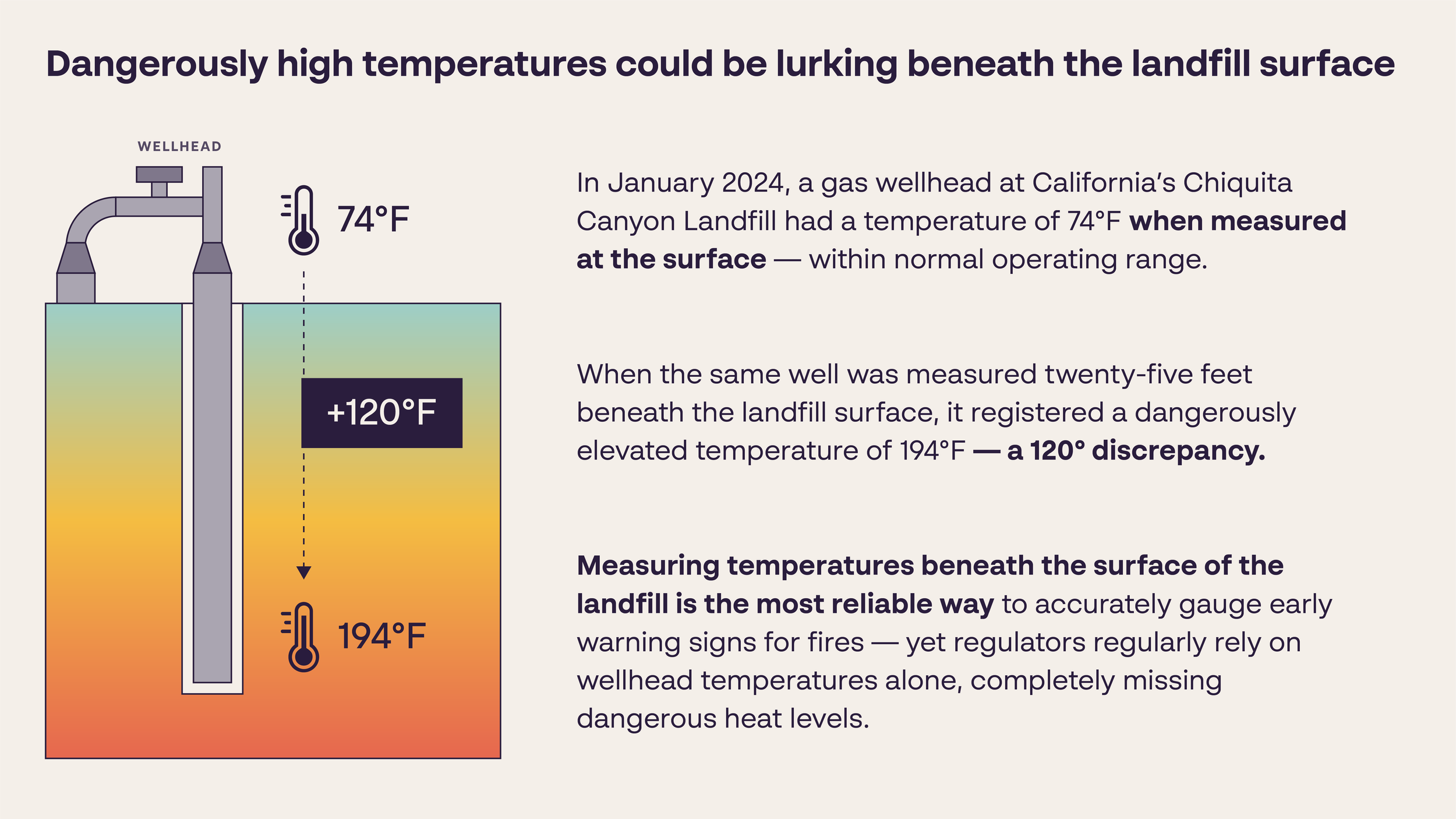
Source: March 2025 letter from California Environmental Protection Agency to Los Angeles County Department of Public Health, page 9
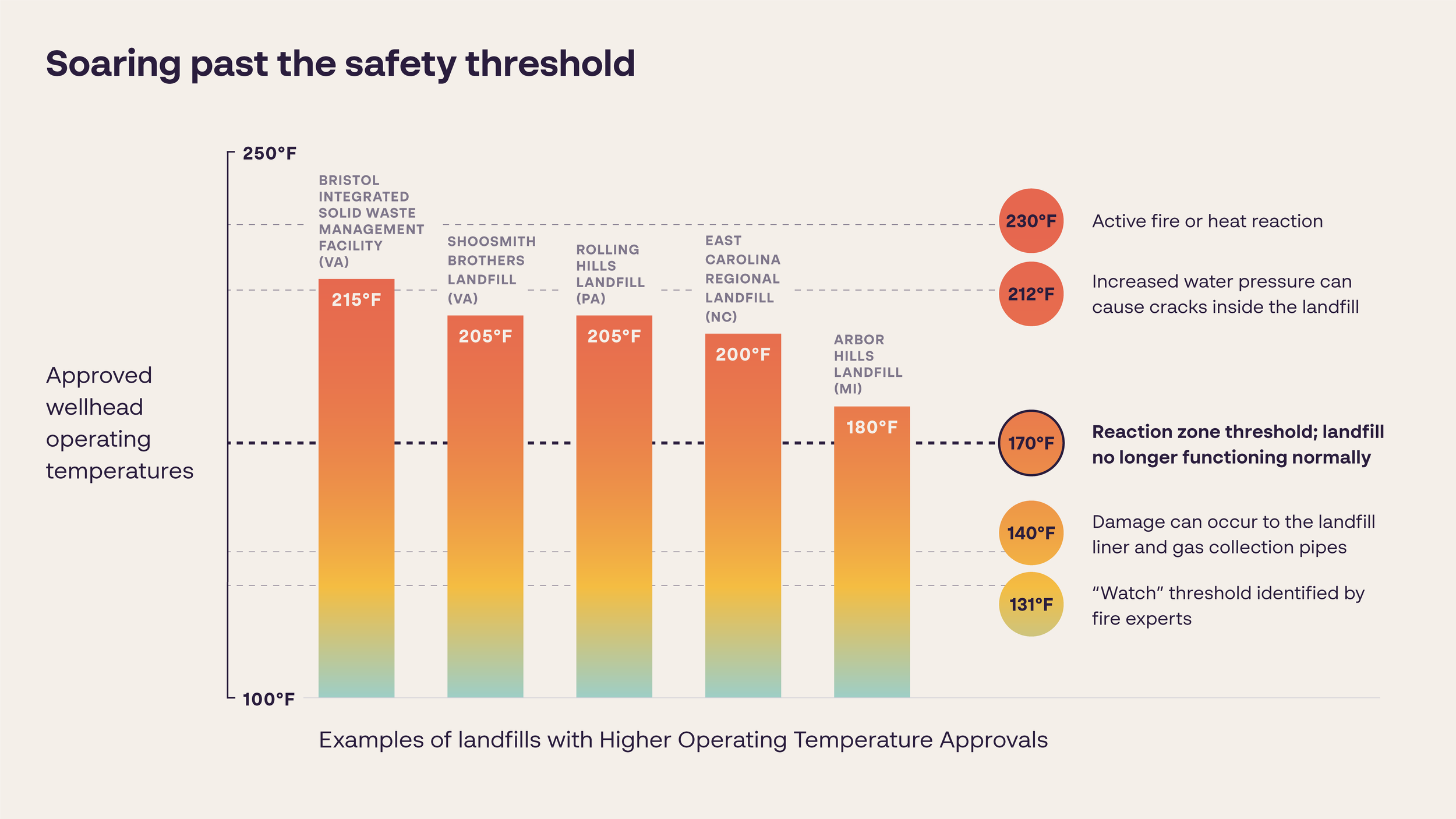
Too often, regulators are approving temperatures of 170°F, 185°F, even 200°F, using temperatures from surface of the landfill.
To put that into perspective, once a landfill reaches an operating temperature of 170°F, the composition and function of the landfill has fundamentally changed and organic waste is no longer decomposing the way it’s supposed to.
Landfills with approved HOVs ≥170°F
Arbor Hills Landfill in Northville, MI (180°F)
Brunswick Waste Management Facility in Brunswick County, NC (175°F)
Broadhurst Environmental Landfill in Screven, GA (180°F)
Chesser Island Road Landfill in Folkston, GA (200°F)
Bristol Integrated Solid Waste Management Facility in Bristol, VA (215°F)
Columbia Ridge Landfill in Arlington, OR (170°)
East Carolina Regional Landfill in Bertie County, NC (200°F)
Modern Landfill in York, PA (170°F)
Rolling Hills Landfill in Boyertown, PA (205°F)
Sampson County Disposal, LLC in Roseboro, NC (170°F)
Shoosmith Landfill in Chesterfield County, VA (205°F)
Wasco County Landfill in The Dalles, OR (170°F)
A temperature boring is a drilled hole used to measure temperatures directly within the landfill waste. Because landfill gas cools as it travels to the wellhead, temperature borings provide a more accurate picture of how hot the landfill is below the surface than wellhead temperature measurements alone.
Oregon and Michigan Regulators Approved Elevated Wellhead Temperatures Even Though the Landfill Could Be Much Hotter Inside
At Wasco County Landfill in Oregon, records do not show DEQ requiring direct measurements of conditions inside the waste mass before approving temperatures as high as 170°F. Multiple wells exceeded the federal 145°F threshold, including wells reaching 179.4°F. DEQ's approval relied on factors such as low carbon monoxide, active methane production, low oxygen concentrations, and the absence of visible signs like smoke, burning odors, settlement, or melted infrastructure. The records reviewed do not show that DEQ required or received borings on temperatures within the landfill, or a root cause analysis, before approving the high temperatures. Separate annual reporting records show that the landfill later documented corrective actions, enhanced monitoring, down-well temperature profiling, and a tentative explanation of the higher temperatures, attributing the heat primarily to “older waste”, with magnesium chloride identified as a possible contributing factor. The records reviewed do not show those analyses being submitted to DEQ as part of the HOV approval request.
At WM’s Woodland Meadows Landfill in Wayne County, Michigan, the landfill had more than forty gas wells operating under approved temperature variances in 2015. By 2020, that number had grown to more than fifty. Yet the approvals were granted repeatedly based on wellhead gas chemistry — the same measurements coming out of the same wells — without requiring what the situation most fundamentally called for: direct measurement of what was happening inside the waste mass. At no point in the records does the question appear to have been formally asked: if the wellhead is reading 160°F, how hot is the waste ten feet below? Forty feet? Michigan's environmental regulator, the Department of Environment, Great Lakes, and Energy (EGLE), required corrective-action analyses, gas collection expansion, and surface methane monitoring, which represents more oversight than some states provide. But the records do not show requirements for downhole temperature profiling before dozens of wells were approved to operate above normal regulatory limits year after year.
Michigan’s Arbor Hills Landfill: A Landfill with Decades of Red Flags and Elevated Temperatures Misses an Elevated Temperature Event
Arbor Hills Landfill, now owned by GLF Environmental and straddling Wayne and Washtenaw Counties in Michigan, has had numerous allegations and legal actions over several decades, involving allowing methane to reach explosive levels, odors that harm quality of life, failure to control leachate and more. In April 2019, state inspectors found what they called an "Elevated Temperature Landfill event" that had likely been building for over a year and was already damaging the site's gas collection system. Instead of requiring the company to fix the underlying heat, regulators started doing something else: approving waivers that let individual wells run hotter than the standard regulatory limit.
In 2020, as odor violations continued to mount, the state sued the landfill operator. The resulting 2022 court settlement covered a laundry list of problems: odors, a leachate system overflowing its limits, methane again crossing the explosive threshold at the property line, and concerning well temperatures. Ultimately, it resulted in a $355,000 fine plus nearly $2 million in required community projects. But the settlement did not end the practice of operating wells above the regulatory temperature limit. EGLE continued approving and extending Higher Operating Value waivers after the settlement. Months later, a state inspector's own site photo described cracked ground near one of the wells as caused by "a subsurface chemical reaction that is charring the waste.”
The problems have remained concentrated on the north side of the landfill, the same area where the company has proposed building a new facility. Between 2022 and 2024, Arbor Hills installed 20 replacement gas wells, replacing 21 abandoned wells in the Well of Interest area and the surrounding 250-foot zone. At the same time, GFL began planning its next landfill expansion on the north side of the facility, submitting a conceptual expansion plan to EGLE in November 2024. One of those replacement wells showed increasingly concerning conditions in early 2025: methane fell from about 30 percent in mid-January to single digits by February and March, carbon monoxide reached 150 ppm, and the wellhead temperature climbed to 177°F in March. Even as those warning signs emerged, EGLE approved the company's request to allow the well to operate at temperatures up to 180°F through May 2026 after reviewing the company's submission and requesting carbon monoxide sampling data. The approval does not document a root cause analysis explaining why the well had deteriorated before authorizing continued operation at the higher temperature, or the broader suite of investigations and supporting documentation that Ohio EPA guidance now recommends.
Finding #3: Lack of Transparency and Fragmented Authority Leaves Residents in the Dark
Additionally, we found that authority can be divided among numerous federal, state, regional, and local agencies, contributing to uncertainty around who’s responsible. At Chiquita Canyon, at least nine agencies — including the U.S. EPA, CalRecycle, the State Water Resources Control Board, and the South Coast Air Quality Management District — making it difficult to identify who leads as conditions worsen.
Regulators cannot effectively oversee elevated-temperature landfills if they do not maintain a complete inventory of which wells or facilities have received exemptions, when those exemptions were granted, how long they remain in effect, or what monitoring requirements apply. Colorado's system demonstrates why formal tracking of HOV approvals is essential. When we requested records identifying which landfills had received HOV approvals, the Colorado Department of Public Health and Environment responded that it does not track such approvals and suggested searching for landfill gas collection system applications and approval letters individually. That proved extremely difficult. A regulatory program that allows exceptions to a key safety and compliance threshold should, at minimum, maintain a searchable record of those exceptions.
Louisiana illustrates the same gap. LDEQ said in an email that it doesn't capture HOV requests in its data systems and pointed us to its public document databases, but those databases appear incomplete. A search for River Birch, the state's second-largest methane emitter, returned over 100 documents requesting elevated-temperature approvals, but corresponding approval letters or final determinations were often absent. A search for "higher operating temperature" turned up only a handful of documents despite evidence more requests had been filed over time. The public can see what operators requested, but not how regulators responded, whether requests were approved, denied, modified, or conditioned on further monitoring. Mississippi was unable to provide electronic records identifying which landfills had received higher temperature approvals. They informed us that decades of paper files would need to be manually searched on-site, effectively putting the information out of public reach.
Obtaining the documents necessary to conduct this analysis required months of time-consuming and sometimes costly records requests, something most people simply don’t have access to. In most states, none of the information we received was easily available. What’s even more concerning about this is how much we don’t know even after receiving information, as it was often incomplete. The Florida Department of Environmental Protection was very responsive to our request, providing a spreadsheet of dozens of HOV or oxygen requests. But the spreadsheet had numerous blank fields and no accompanying documentation. When we asked for the underlying records, we were referred to a central public database that proved time intensive to search with incomplete records.
When the System Fails
Republic Services’ Countywide Landfill
Countywide Recycling and Disposal Facility in East Sparta, Ohio, which is owned by Republic Services, provides one of the clearest examples of how an early-2000s elevated-temperature reaction can become a decades-long problem. Roughly 600,000 tons of aluminum-process waste were disposed of there between 1993 and 2006. By 2006. By 2006, the landfill documented rapidly increasing temperatures in multiple gas wells, forceful leachate outbreaks, accelerated settlement, odors, declining methane concentrations, increasing hydrogen concentrations, and carbon monoxide generation. Temperatures were later reported as high as 280°F.
The Ohio EPA declared the facility an air pollution nuisance in September 2006 and, in 2007, found that Countrywide had violated the state’s rule prohibiting landfill fires.
The reaction also physically altered the landfill. A Countywide investigation concluded that a portion of the south waste slope had moved as much as twenty feet outside the permitted waste-disposal limits. Regulators required Countywide to stop filling portions of the landfill, expand dewatering, install deeper remediation wells, cap and contain the reaction area, redirect reaction gases and construct a physical Isolation Break. Completed in 2009, that barrier separated the 88-acre remediation unit from the landfill’s remaining 170-acre operating unit and was intended to prevent the reaction from spreading.
Nearly two decades later, the remediation continues. The landfill’s October 2024 submission states that Countywide is still generating roughly times the leachate of a typical landfill, and no one knows how long the reaction will persist. Critically, the remediation plan doesn’t rely on wellhead temperatures alone. It also tracks gas chemistry, methane-to-carbon-dioxide ratios, settlement, and leachate volume together, with defined triggers for further investigation.
Waste Connections’ Chiquita Canyon Landfill and Avenal Landfill
Since 2022, Chiquita Canyon Landfill has been in a crisis. The reaction zone has grown to roughly 90 acres, more than triple the operator’s original estimate. Inside Climate News found the landfill emitted nearly 30,000 pounds of carcinogens between 2000 and 2022, including about 6,000 pounds of benzene. In a rare action, the U.S. EPA invoked “imminent and substantial endangerment,” citing the risk of hazardous leachate releases, and multiple state agencies have issued violations for gas control and hazardous waste failures.
The surrounding community is predominantly Latino, and the landfill sits near multiple K-12 schools and faces ozone levels worse than nearly 97 percent of the country. Over 29,000 residents have filed odor complaints, reporting nosebleeds, breathing difficulty, brain fog, and cancer diagnoses.
The same question applies to both Chiquita Canyon and Countryside: if this is the investigation regulators know is necessary once a crisis is recognized, why isn’t anywhere near that level of scrutiny required when landfills first show warning signs?
At the Avenal Landfill in central California, Waste Connections' 2024 response to abnormal landfill temperatures focused on managing the symptoms rather than investigating the problem. The Avenal Regional Landfill sits just 500 feet from the nearest residence, with the entire town of 14,000 people living within 1.5 miles of the site. As temperatures increased and landfill gas chemistry deteriorated, the company repeatedly adjusted the gas collection system, increased vacuum, installed well skirts, and sought approval to operate at higher temperatures. But the record does not show that it determined the root cause - why multiple wells were heating up. Waste Connections did not collect down-well temperatures because its internal trigger had not been reached, did not explain the large "balance gas" fraction that appeared in the gas analyses, and did not demonstrate that it had identified the underlying cause of the elevated temperatures. Meanwhile, temperatures continued to climb, methane concentrations declined, and carbon monoxide increased dramatically in several wells—all warning signs that EPA's own guidance associates with an elevated-temperature landfill reaction.
In a move different from most reported in the records examined, U.S. EPA Region 9 was not persuaded (although it is notable the EPA did not respond to the landfill’s July 2024 request until April 24, 2025 — a delay of almost a year). Instead of simply approving higher operating temperatures, the EPA concluded that several wells showed evidence of an anaerobic subsurface exothermic reaction. The agency denied HOV requests for four wells and required Waste Connections to do what it had not yet done: investigate the problem. It directed the landfill to collect down-well temperature data, improve cover integrity, evaluate whether additional extraction wells were needed, replace wells that could not safely withstand the temperatures being encountered, and submit revised root cause and corrective action analyses. The EPA also rejected the company's request for more time, emphasizing that an HOV request is not a substitute for corrective action.
Despite those actions, the problems at Avenal Landfill have continued. Public records show wellhead temperatures exceeding 160°F, methane concentrations falling into the single digits in some wells, and carbon monoxide concentrations reaching levels that California guidance identifies as strong evidence of a subsurface fire. Residents living just hundreds of feet from the landfill continue to report odors and have called for an emergency, multi-agency response, air and leachate testing, down-well temperature monitoring, and regular public updates. Through a rule loophole, the Avenal Landfill continues to operate on an air permit that expired in 2021. The San jJaquin Valley Air District refuses to public notice the permit as directed, and both the California Air Resources Board and U.S EPA. refuse to pursue enforcement action.
The Avenal case demonstrates the consequences of failing to investigate elevated temperatures early: by the time regulators recognized the seriousness of the problem, the community was already living with the impacts of what appears to be an ongoing subsurface reaction.
We know how to stop disasters
Underground landfill fires or elevated temperature disasters are not inevitable. They happen when warning signs are missed, ignored, or explained away instead of investigated and corrected.
Regulators should be asking: Why is this landfill getting hotter and what needs to change before people are put at risk? Today's federal regulations often allow warning signs to persist without requiring operators to determine why a landfill is getting hotter or to correct the underlying problem.
States should not wait for the federal government to act to fix flawed regulations. They can update their landfill regulations now to require earlier investigation, stronger monitoring, faster corrective action, and greater transparency. California has already adopted stronger landfill methane regulations that require earlier monitoring, faster corrective action, and greater accountability when warning signs emerge. Ohio has gone even further in its guidance for higher operating temperature requests. Following the Countywide Landfill disaster, the Ohio EPA now instructs operators seeking approval to exceed federal temperature limits to submit a detailed root cause analysis, corrective action analysis, implementation timeline, and maps identifying the affected well, other approved higher operating value wells, and more. Other states can do the same.
Legislators can also enact safeguards to prevent and respond to landfill fires. For example, California’s Assembly Bill 28 (Schiavo) outlines clear steps that landfills must take in the event of persistent high temperatures and holds them accountable for complying. As of this writing, the bill has already seen bipartisan support in legislative committees.*
*Update: AB28 was signed into law by Governor Newsom on September 20, 2026, and will take effect on January 1, 2027.
Five ways to prevent the next disaster
Preventing subsurface elevated temperature events is far less costly, less disruptive, and more protective of public health and the environment than attempting to control them after they have become entrenched. Appendix C summarizes the full range of policy fixes needed.
State regulations should require:
-
When temperatures rise or oxygen enters a landfill and a landfill operator requests a higher operating temperature approval, state regulations should require landfills to provide far more than a few wellhead readings. As the Ohio EPA details, HOV requests should include a documented root cause analysis, corrective action analysis and implementation timeline, historical monitoring trends, mapping of affected and surrounding wells, and information on waste characteristics, liquid and leachate conditions, physical evidence of abnormal subsurface conditions, mitigation measures already taken, and enhanced monitoring to demonstrate that elevated temperatures do not indicate a developing subsurface fire or failure of anaerobic decomposition (See Appendix C for more details).
-
Regulations should require direct temperature measurements of borings inside the waste mass when warning signs appear. Wellhead temperatures alone cannot tell regulators what is happening where underground heat develops.
-
State regulations should require investigation and corrective action as soon as warning signs emerge.
-
Communities have a right to know when a landfill is operating outside normal conditions. Regulations should require higher operating temperature approvals, monitoring data, investigations, and corrective actions to be publicly available in searchable online databases.
-
States should provide environmental agencies with the funding, staffing, technical training, and authority needed to independently evaluate higher operating temperature requests, verify landfill operators' claims, conduct inspections, and require additional investigation when the available information is insufficient. Strong regulations are only as effective as the agencies responsible for enforcing them.