
Responsible Gas Management
Protecting public health through reliable combustion and treatment of recovered gas

Once landfill gas is captured, it must be destroyed, recovered, or treated in a manner that minimizes venting and leaking to the atmosphere. The safe and effective combustion of landfill gas is essential not only to reduce climate pollution, but to protect nearby communities from toxic air contaminants released when methane is poorly controlled. Landfill gas contains a mixture of methane and hazardous co-pollutants, including volatile organic compounds (VOCs), hazardous air pollutants (HAPs), and odorous compounds that can cause respiratory irritation, headaches, nausea, and longer-term health risks for people living and working near landfills.
The Problem: Open Flares Fall Short — and Threaten Public Health
Roughly two-thirds of landfill flares in the U.S. are still open, according to EPA’s analysis. Open flares are much less effective at destroying methane than enclosed flares. Their combustion efficiency is lower and highly unpredictable because it depends on changing gas flow, landfill gas composition, and weather conditions.
Open or “candlestick” flares allow direct exposure to the elements. Wind shear, moisture, and inconsistent gas flow can disrupt the flame, leading to incomplete combustion. Because federal rules require only occasional performance checks, these devices can operate below efficiency for months undetected, meaning harmful gases and methane are not destroyed. Unlike enclosed flares, open flares cannot be safely or reliably tested, and while they can handle a wide range of gas flows, they do so at the cost of significantly reduced methane destruction.
From a public-health perspective, this matters because:
Incomplete combustion increases emissions of VOCs and hazardous air pollutants, including compounds linked to respiratory illness, cancer risk, and neurological effects.
Poorly performing flares are a known contributor to persistent odor events, which state agencies associate with increased community complaints, stress, and reduced quality of life
Federal rules require only periodic checks, meaning sub-standard flare performance can persist for months without detection, prolonging exposure for nearby residents.
Open flares were designed decades ago to dispose of unwanted gases—not as pollution control devices for modern air-quality or human-health standards. Their continued use reflects regulatory lag, not technical necessity.
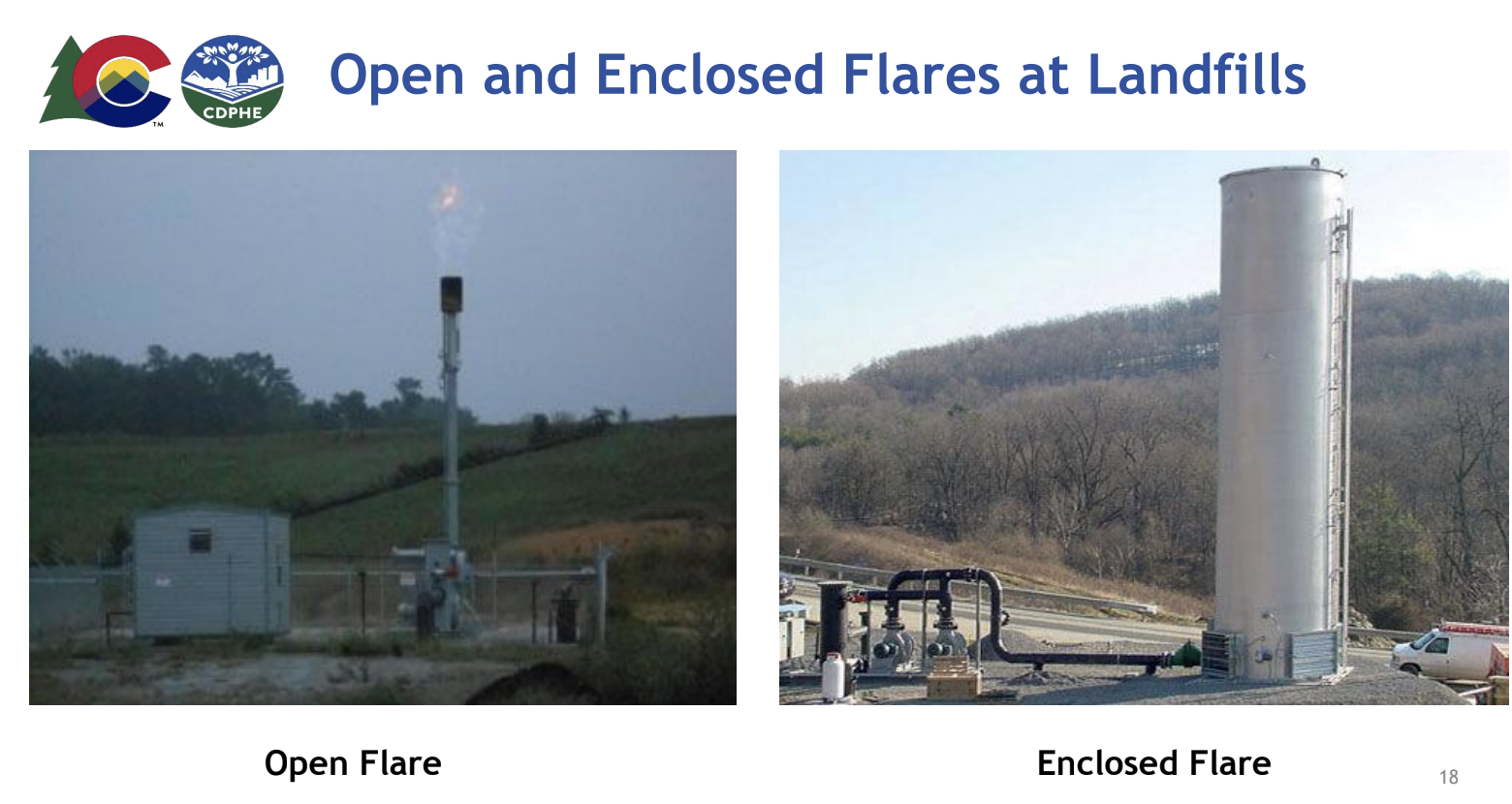
Image from Colorado Air Pollution Control Division, Colorado Landfill Methane Rule AQCD Regulation 31 Rulemaking Hearing, August 21, 2025
The Fix: Enclosed Combustion, Verified Performance, and Reduced Toxic Exposure
Enclosed flares are a proven and highly effective way to destroy landfill methane, even when gas quality is low. They consistently achieve very high methane destruction efficiency, perform reliably under changing weather conditions, can be designed to handle a wide range of gas flows and compositions, and can be safely tested to verify that they are working as intended. Enclosed flares and other advanced combustion devices burn landfill gas in a controlled environment, maintaining stable temperatures (typically 1,400–1,800°F) and optimized air-to-fuel ratios. This design supports near-complete methane destruction and far more reliable destruction of toxic co-pollutants.
State regulations should:
Use best available technology: Require that all destruction devices and energy recovery devices at landfills achieve a methane destruction efficiency of at least 99% by weight and that any flares used at the landfill are enclosed. For landfills that route collected gas to a treatment system, they should require continuous monitoring to ensure venting or leaking does not occur.
Ensure continuous monitoring and performance tests to ensure flares are working correctly: All flares, recovery devices, and treatment systems should be equipped with a gas flow rate measuring device that is installed, calibrated, and operated according to the manufacturer’s specifications, and records at least every 15 minutes. Automated alarms and corrective action requirements when performance deviates. Landfills should conduct twice-a-year performance tests for all energy recovery, destruction, and treatment systems should be required.
Human Health and Safety Protections for Open Flares: Open flares should only be used only as backup or secondary gas control devices, and be strictly prohibited within 1 mile of a residential community, mobile home park, daycare facility, school, or hospital in a disproportionately impacted community.
Maintaining high destruction efficiency is critical to actually controlling methane and other hazardous air pollutants from landfills and minimizing harm to the climate and communities.
Landfills can also take advantage of modern technology solutions such as Qnergy, a company providing mobile, modular methane destruction devices. These devices can destroy early methane from new cells that operators might otherwise isolate to prevent dilution of aggregate gas quality. These modular devices can operate effectively at methane concentrations as low as 30% and can be connected to early GCCS infrastructure while remaining isolated from the main beneficial use facility intake.
Examples from Leading States
Several states have requirements to phase out open flares and replace them with enclosed combustion devices that achieve a minimum 99% destruction rate and can be more easily monitored and tested. European and Canadian landfill standards similarly require continuous monitoring of flare temperature, flow, and oxygen. Their provisions include:
California (LMR 2010 and 2025): Enclosed flares required at all landfills >450,000 tons waste in place; 99% destruction efficiency; 15-minute flow-rate monitoring.
Washington (WAC 173-408, 2024): Enclosed flares with ≥99% methane destruction; 15-minute flow-rate monitoring.
Maryland (COMAR 26.11.42, 2022): Requires enclosed flares or energy recovery units meeting ≥99% destruction; mandates annual performance testing and leak monitoring.
Colorado (Reg. 31, 2025): Phases out open flares by 2029; all devices must meet ≥99% destruction efficiency and continuous monitoring. Open flares may be used only as backup or secondary gas control devices, except where an open flare serves as a secondary control device located within 1,000 feet of a residential community, mobile home park, daycare facility, school, or hospital in a disproportionately impacted community/
Costs and Benefits
EPA’s economic analysis shows enclosed flare retrofits cost $250,000–$1 million per unit, depending on site size and existing infrastructure, with minimal O&M cost differences compared to open flares. Energy recovery devices (engines, turbines) can often use the same gas feed, reducing waste and improving cost-effectiveness.
The cost effectiveness of this measure is well documented. State and EPA analyses show that stronger control-device standards deliver direct health benefits by:
Reducing emissions of VOCs and hazardous air pollutants, not just methane.
Cutting odors that drive complaints and disproportionately affect nearby communities.
Improving early detection of system failures that can lead to subsurface heat events, fires, and acute air-quality impacts.
Colorado estimates that its updated landfill emissions standards, which include enclosed flares, will cut 96.3 short tons of Volatile Organic Chemicals per year, and 30.4 short tons of Hazardous Air Pollutants each year.
Industry Claim: Landfill flares already achieve 99% efficiency; further regulation isn’t needed.
Fact: The claim of 99% efficiency from open flares is a design number on paper, not a verified field result. EPA and state testing show real-world destruction efficiencies frequently fall below 90% during variable flow or windy conditions.
Industry Claim: Open flares are cheaper and easier to operate.
Fact: Modern enclosed flare systems are modular, low-maintenance, and comparable in cost over the system lifetime.
Emissions Reductions
EPA modeling shows converting all U.S. landfill flares to enclosed systems could destroy an additional 2.7 million metric tons of methane by 2060, yielding a cumulative reduction of 75 million metric tons CO₂e.
Requiring 99% destruction efficiency with continuous exhaust monitoring and backup flaring can reduce fugitive methane by 30–50% at landfills with energy projects. CARB’s modeling shows that comprehensive monitoring and emission controls will achieve major co-benefits by cutting toxic air contaminants, VOCs, and odors near host communities.
A national shift toward verified combustion efficiency and mandatory flare redundancy could eliminate millions of metric tons of CO₂e per year—the climate equivalent of taking nearly 1 million gas cars off the road.
“Open flares are more susceptible to atmospheric interference, resulting in reduced combustion efficiency… Replacing them with enclosed flares could achieve measurable methane reductions nationwide.
”