
Transparency and Accountability
Holding landfill operators accountable to communities
Overwhelmingly, the landfill operator’s compliance is self-reported: landfill operators collect data, submit reports, and regulators review paperwork. There is limited independent verification that systems are actually working as intended in the field. Very few states send staff out to the landfill to actually double-check or inspect the landfill. This creates an honor system, where problems can persist undetected or unaddressed for long periods of time.
It’s time to move beyond paper compliance toward real accountability. That means three basic components should be incorporated into state regulations:
Publicly accessible information;
Real time notification of the surrounding community so they can make informed choices for their safety;
Ensuring regulators have clear authority and tools when standards are violated.
Without these elements, even well-designed state rules will fall short, because the issue isn’t just what landfill operators are supposed to do, but whether anyone is ensuring they actually do it.
The Problem
A core problem with current landfill air regulations is that they are largely built around an honor system of monitoring and self-reporting. Landfills are typically required to measure methane levels, surface emissions, and gas system performance, and then submit that data to regulators, but the system depends heavily on self-reporting with limited real-time oversight. Even in relatively strong programs like California’s, regulators have acknowledged the need to improve “enforceability,” “clarity,” and “regulatory oversight” after years of implementation experience. In practice, this means violations can persist undetected or unaddressed for long periods, especially when monitoring is infrequent, incomplete, or conducted under favorable conditions that mask emissions. Without continuous oversight or independent verification, operators face little immediate pressure to fix problems quickly.
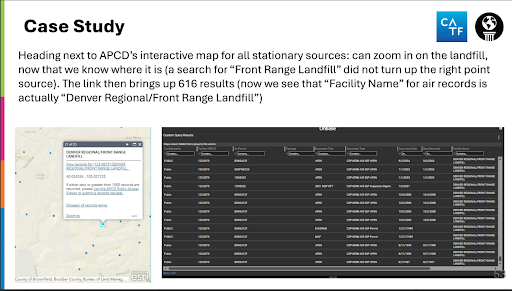
Landfill operators generate large volumes of data about problem spots at their landfill, emissions, monitoring results, system performance, and compliance status. The landfill has critical information that directly speaks to toxic pollution and risks to nearby communities. Yet in most states, this information is not publicly available. It remains buried in reports submitted to regulators, accessible only through formal public records requests. Even in the very few states that do provide some information online, like Colorado, it is provided in an arcane and hard-to-find way, as seen in the examples below provided by GreenLatinos.
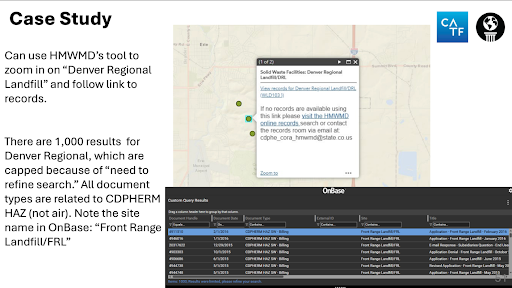
Source: GreenLatinos
When information is submitted to regulators but not made publicly accessible, affected communities are left in the dark about conditions that may influence their health and quality of life. Transparency ensures that communities, local governments, and other stakeholders can understand what is happening at facilities that operate in close proximity to homes, schools, and workplaces.
The situation at the Avenal Landfill in central California, owned by Waste Connections, additionally demonstrates why transparency is essential. In 2019, gas wells at Avenal began exceeding 131°F, signaling potential underground combustion and serious operational issues. From 2020-2022, residents filed numerous odor complaints, and even during a public hearing for the landfill’s federal Title V air permit renewal, the problem of high landfill gas temperatures was never disclosed to the community. In 2025, a former air district air permitting employee working with the community of Avenal learned about the high landfill gas temperatures. Despite submitting over five public records requests to the local air district and the US EPA in 2025, they still have very little information about what is occurring underground at the Avenal Landfill.
Avenal community members are aware people have gotten sick, been diagnosed with cancer, and pregnant women have miscarried. Despite local non-profits sharing information about the high landfill gas temperatures with community members and regulatory agencies, almost many days passed without air monitoring or updates regarding what has been done or what is happening. Data accessibility must be structured with ordinary residents living near landfills in mind– the people who live, work, and raise families near these facilities. Community members deserve better.
Worse, most state regulators do not have the staff capacity or tools to meaningfully enforce regulations. For example, in Illinois, the Illinois Environmental Protection Agency is responsible for enforcing the Clean Air Act regulations, and receives reports from the landfills that must comply with those regulations. But it does not have the capacity to conduct inspections, like the U.S. EPA, or conduct independent surface emissions monitoring. Instead, it is solely reliant on the information that is provided to them by the landfill operator. If the landfill operator misses leaks, system failures, and fire risks, they could turn into prolonged emissions, emergencies, or community harm.
The consequences for noncompliance are often too weak to change behavior. When penalties are low, operators can rationally treat violations as a routine business expense rather than a serious compliance issue. This dynamic is compounded by regulatory gaps that allow operators to delay action even when problems are clearly identified. Similarly, widespread compliance failures documented by the U.S. EPA, such as extremely high methane exceedances and improper monitoring practices, demonstrate that existing rules are not consistently enforced or deterrent. Together, these structural weaknesses create a system where compliance is often reactive, inconsistent, and economically optional. Without stronger enforcement mechanisms such as real-time public notification and independent verification, landfill operators have little incentive to prioritize emissions reductions. The result is a regulatory framework that, on paper, requires control of methane emissions, but in practice allows ongoing violations to be absorbed as just another cost of doing business.
The Solution
Publicly Accessible Information
We must close long-standing information gaps that should never have existed. Transparency is essential for enforcement, for public trust, and for ensuring that compliance is based on reality, not assumptions.
After violating environmental regulations, in Michigan the Arbor Hills Landfill and Smiths Creek Landfill are required to post or share air monitoring data:
The state of California took a basic step forward in its 2025 update to their Landfill Methane Regulation (LMR) to improve transparency:
Creates a public-facing data platform. The website must be updated as new information is submitted, meaning data is not static but continuously refreshed.
Remote methane plume detections and follow-up findings must be reported, and once reported, CARB will make that information publicly available through its online database.
Standardizes and streamlines reporting requirements: CARB digitizes reporting so regulators can more effectively monitor compliance and identify issues.
In addition to the basic improvements in the LMR, state standards should include an accessible, one-stop landing page that would allow a member of the public to find basic information about the landfill and how well it is operating is critical. Key data should include:
What’s the closest landfill to my home;
What are the actual emissions from that landfill (methane, HAPs, VOCs);
What are the operating temperatures, oxygen and methane balance for the landfill, does the landfill have a temperature or oxygen waiver;
What type of gas collection equipment is operating and how well has that gas collection equipment been operating (Downtime? Emergencies?);
Emissions destruction efficiency;
Surface monitoring results, methane exceedances found on the landfill, corrective actions taken, what parts of the landfill were monitored and not monitored;
What future action is planned for that landfill (For example, is there a Title V permit proceeding? Will an existing open flare be required to upgrade to an enclosed flare – if so, when?)
Enforcement actions, violations notices, etc.
Communities deserve to know when methane or other gases are escaping into the air, what corrective actions are being taken, and whether those actions are effective.
Real Time Notification
State regulations should require real-time public notification of emissions exceedances or significant odor or super emitter events. Residents should not have to rely on social media rumors, month-old data on third party provider websites, or news reports to learn that methane or toxic compounds are being released nearby.
Communities must have access to real-time alerts, online dashboards, or public portals that allow residents to stay informed about local air quality conditions.
Costs and Benefits
CARB concluded that their updated reporting and recordkeeping requirements, which includes data published for the public, impose minimal to modest costs, largely rely on information operators already collect, and are offset by efficiencies gained through standardized electronic reporting—while significantly improving regulatory oversight and public accountability.