
Fire Prevention and Mitigation
Protecting Communities from Preventable Disasters
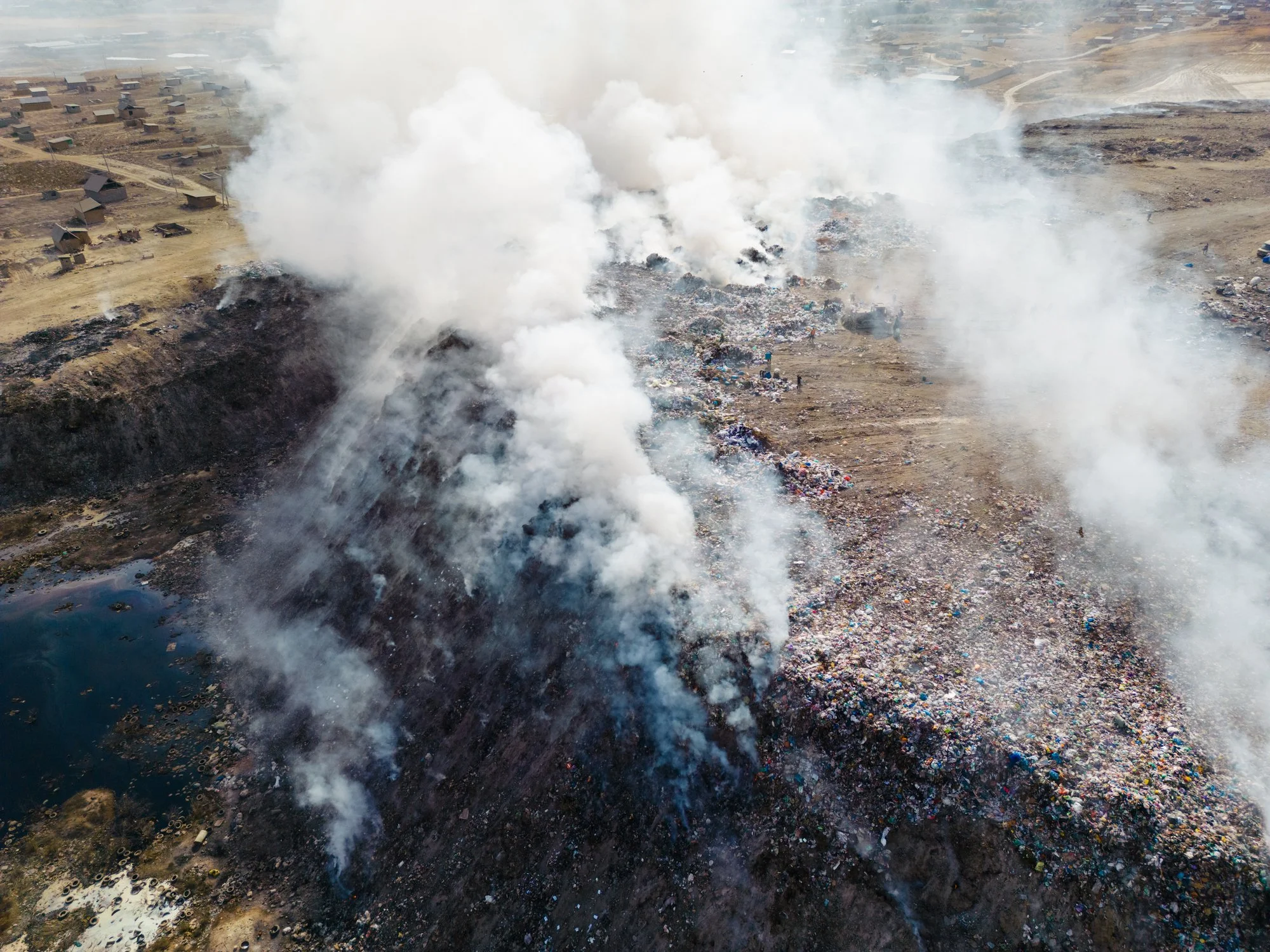
The Problem: Landfill Fires Are Preventable Disasters to Communities
Across the United States, landfills are increasingly becoming sources of dangerous heat, toxic pollution, and uncontrolled odors and methane emissions, exposing major gaps in current regulatory systems. A Bloomberg news investigation found a pattern of elevated-temperature landfills, underground fires, and large methane releases that often persist for months or years with limited government oversight.
The EPA itself reports that “402 landfills with gas collection systems had a fire incident between 2004-2010, and 151 had more than one incident.”
Landfills are complex, poorly monitored systems where conditions can deteriorate rapidly. Subsurface reactions and smoldering fires can generate extreme heat, damage gas collection systems, and release a mix of methane and hazardous air pollutants, such as benzene and other Volatile Organic Compounds (VOCs). In general, a landfill contains 50–55% methane (CH4), 45–50% carbon dioxide (CO2), and less than 1% non-methane organic compounds (NMOCs). NMOC concentrations from landfills double for every 18°F (7.7°C) increase in waste temperature. Some NMOCs are known or suspected carcinogens and are classified as hazardous air pollutants (HAPs). Once these events begin, they are notoriously difficult and expensive to control, making prevention and early detection critical. Communities living near landfills bear the brunt of these failures, including toxic exposures, odors, evacuations, and long-term health concerns.
Landfill fires and their harms are preventable but federal regulations are not designed to detect or respond to these problems in real time. The most recent federal regulation even removed the maximum oxygen requirement for interior gas wells. Monitoring is often limited, infrequent, and reliant on outdated methods, meaning major emission events can go unnoticed or unaddressed. Even when warning signs like rising temperatures or gas imbalances are detected, rules often do not require timely corrective action, allowing problems to escalate. Yet available technology, such as real-time wellhead monitors and other best management practices, now makes proactive, real-time oversight possible - if regulations are fixed. Preventing them is far cheaper, safer, and more effective than trying to put the fires out after the fact.
How Landfill Subsurface Elevated Temperature Events and Subsurface Fires Happen
Subsurface Elevated Temperature (SET) events, also referred to as elevated temperature landfills (ETLFs), are a distinct and growing problem across the country. These exothermic reactions are caused not by traditional flames but by anaerobic chemical reactions that can reach temperatures of 180 °F (82 °C) or more, destroying landfill liners, gas pipes, and collection systems. This spells catastrophe for controlling harmful emissions.
The EPA and independent experts have identified leading triggers for subsurface elevated temperature events:
Over-pulling on gas collection wells, which draws oxygen, a key ingredient to trigger fires or elevated temperatures, into the waste mass.
Poor sealing or cracks in the landfill cover, which lets oxygen into the landfill, which is a key ingredient in fires.
Reactive materials in the landfill like slag or incinerator ash, or cover materials that use ashes or slags - these materials can catalyze exothermic reactions. This means it’s critical that landfill operators track what is actually being dumped in the landfill.
Experts warn that the “watch” threshold for an elevated-temperature event is 131 °F (55 °C), and that by 140 °F, plastic pipes and HDPE liners can exceed their maximum design temperatures and begin to deform. Once temperatures exceed 170 °F (77°C), pyrolysis and smoldering reactions can accelerate; above 212 °F (100°C), water expands over 1,700 times, driving pressure, cracking, and boosting emissions.
Why Current Regulations Fail to Prevent Landfill Fires
Despite clear scientific warning signs and decades of experience, today’s federal landfill fire regulations that most states rely on are fundamentally misaligned with how subsurface fires actually start and spread, with a number of critical flaws, including:
-
EPA’s original landfill standards recognized that subsurface fires begin far earlier than visible flames. The 1996 federal rules required corrective action at 131°F (55°C), with limits on oxygen (5%) and nitrogen (20%) as early indicators of air intrusion and combustion risk. Over time, those protections were quietly dismantled: The temperature threshold was raised to 145°F (63°C), and oxygen and nitrogen limits were eliminated entirely. Corrective action requirements were stripped out, leaving monitoring without enforcement. These changes were not driven by new science - they were driven by industry pressure. The result is a regulatory system that tolerates known fire conditions instead of preventing them.
-
Under current federal rules, landfill operators can elect to comply with the more lenient National Emission Standards for Hazardous Air Pollutants, or NESHAP, provisions instead of stricter New Source Performance Standards/Emission Guidelines requirements. In practice, this means the most protective standards are optional.
-
Federal landfill rules require operators to measure oxygen and temperature monthly at wellheads but they do not require corrective action and a root cause analysis when oxygen or nitrogen increases - only temperature. In fact the only true notification something is wrong is the wellhead temperature threshold of 170 (F°) as defined by the NSPS in Title 40 of the Code of Federal Regulations (40 CFR) Section 63.1981(k), where if the temperature reading hits 170°F (77°C), and carbon monoxide is at or above 1,000 ppmv the operator must notify the US EPA within 24 hours). Landfill operators can document increasing oxygen intrusion and deteriorating gas chemistry month after month without being obligated to change operations. This is the regulatory equivalent of installing a smoke detector that’s allowed to blare indefinitely, with no requirement to investigate.
-
Regulations do not require actual waste temperature to be collected using downwell temperature monitoring or permanently installed monitoring probes, instead the landfill operators rely on wellhead readings, even though regulators and EPA researchers have repeatedly documented that subsurface temperatures can be 100°F (38°C) or more hotter at depth than the wellhead temperature. For example, at sites like the Chiquita Canyon Landfill in Los Angeles County, downwell temperatures exceeded 190 °F but surface readings appeared only moderately elevated. Without required downwell monitoring data, regulators are effectively blind to dangerous reactions happening in the waste mass. where fires originate.
-
Once a smolder or pyrolysis occurs, temperatures above 200°F can persist for decades. s. Successful suppression efforts are costly, complex, and disruptive to landfill operations. Current regulations are structured around detecting problems late, allowing prolonged non-response, and escalating what landfills are required to do only after irreversible damage has occurred. Current regulations do not value preventive measures such as limiting oxygen/nitrogen concentrations, applying substantial soil cover, or conducting a proper root cause. The industry and regulatory process does not value best management practices until a SET occurs. Once a SET is established guarantees higher costs, greater emissions, and more harm to surrounding communities.
-
Federal regulations allow landfill operators to request waivers to operate at higher temperatures and higher oxygen/nitrogen levels, without requiring a root cause analysis as to why it was caused in the first place (they require “supporting data to show it’s not causing a fire or inhibiting methane). Those waivers are usually granted without time limits.
Faulty regulations are a basic public safety issue. Without stronger standards, families living near landfills can be left breathing toxic emissions while operators are allowed to ignore flashing warning signs.
Communities Pay the Price for Regulatory Gaps
Landfill fires are crises for the people who live nearby. While operators are allowed to “monitor and wait,” nearby residents bear the consequences: toxic air pollution, evacuation orders, school closures, property damage, and long-term health risks.
Case Study: Chiquita Canyon Landfill, California
Located in the communities of Val Verde and Castaic in Los Angeles County, since 2022 Chiquita Canyon Landfill has had a prolonged subsurface elevated temperature event that regulators and operators are struggling to control. What began as internal overheating has escalated into a years-long crisis affecting thousands of people, young and old.
The large-scale subsurface exothermic reaction has continued to expand in both size and impact, generating odors, excess leachate, and environmental concerns for nearby communities. Regulatory analysis determined that the reaction area has grown to approximately 90 acres, or more than three times larger than originally reported by the operator, indicating a significant and uncontrolled progression of the event.
Inside Climate News found that from 2000 to 2022, the landfill emitted nearly 30,000 pounds of cancer-causing substances, including about 6,000 pounds of benzene. It also released over 11,600 pounds of toluene - a chemical linked to damage of the nervous and reproductive systems, as well as miscarriages and birth defects -and more than 5,700 pounds of hydrogen sulfide, a foul-smelling gas that can lead to fatigue, headaches, dizziness, and breathing problems.
The EPA took the unusual step of declaring that conditions at the site pose an “imminent and substantial endangerment,” specifically citing the risk of a release of hazardous leachate that could harm public health and the environment. This is one of the highest legal thresholds regulators can invoke. The reaction is producing leachate containing contaminants such as benzene, which must be managed as hazardous waste.
The reaction has also begun to threaten critical infrastructure, including a tank farm storing large volumes of leachate on top of the waste mass, raising concerns about structural instability and potential release scenarios, which could harm nearby water ways. At the same time, the event has generated tens of thousands of odor complaints, reflecting widespread offsite emissions and ongoing impacts to surrounding communities.
Multiple agencies, including EPA, CalEPA, DTSC, and local authorities, have issued numerous violations and enforcement orders related to inadequate gas control, hazardous waste management, and site maintenance, demonstrating systemic operational failures.
Suffering Residents, Water Supply Threatened
Within just 1 mile of Chiquita Canyon landfill, 67% of residents are Black, Indigenous, or People of Color. Residents face ozone levels worse than 96–97% of the U.S, meaning they breathe more ozone pollution than almost anyone in the country.
Chiquita Canyon Landfill is located within just miles of homes, schools, parks, and other community gathering spaces. Within five miles of the landfill you’ll find a range of early-childhood and K-12 schools. For example, Trinity Classical Academy alone enrolls over 500 students from TK through 12th grade. This means children are living, learning, and playing just minutes from the landfill, facing daily exposure to its pollutants.
The state water board found that the Chiquita Canyon Landfill violated environmental rules by failing to properly control and report a leak of contaminated liquid, which risked mixing with surface water and threatening water quality.
Over 29,000 residents have reported odor complaints, and others have reported health complaints such as:
Persistent, noxious odors forcing families to seal homes, flee their home;
Physical symptoms including headaches, nosebleeds, nausea, skin irritation, eye, ear and nose irritation, ringing in the ears;
Coughing, breathing difficulties, vomiting, nausea;
Anxiety, depression, brain fog, sleep disruption;
“Steven Howse moved in 1998 with his wife and four kids to a house less than a mile from the landfill. In March, Howse told the committee that in 2023 his neighbors started suffering from trouble breathing, bloody noses, headaches, nausea and “brain fog.”
“Over 10 of my very close neighbors developed various types of cancer, including my next door neighbor,” Howse said. “In February of 2024, my wife was diagnosed with stage 3 breast cancer. In July, my 19-year-old daughter was diagnosed with a rare autoimmune disease.” - Source: https://www.thenewlede.org/2025/12/postcard-from-california-the-literal-dumpster-fire-burning-under-an-la-suburb/
Meanwhile, Carbon Mapper found frequent and significant “super emitter” events at Chiquita Canyon Landfill - 153 methane plumes (bursts of methane pollution) were detected on 15 different days out of 30 days studied. That means methane was escaping from the landfill on half of all observation days. When leaks were happening, the landfill was releasing an average of 595 kilograms of methane every hour - a large amount of climate-warming pollution.
Key Regulatory Provisions Needed for Fire Prevention
States can update their state requirements to address the many gaps in the federal requirements that some landfills must operate under. States should treat landfill fire prevention as a basic public safety obligation by the landfill operator.
Early Testing Before Connection
CARB’s 2025 Landfill Methane Rule (LMR) mandates earlier installation and operation of gas-collection infrastructure in new waste areas and continuous wellhead monitoring to avoid overdrawing and air intrusion. States can mirror this: require pre-connection pressure testing and phased tie-ins once positive pressure is verified.
Continuous Downwell Temperature Monitoring
Temperature measurements inside the landfill show that heat levels can be much higher below the surface than at the wellhead. At Chiquita Canyon Landfill, in some cases temperatures deep in the waste were 40–120°F higher, indicating significant internal heat buildup.For example, On June 28, 2023, CV-1902S had a wellhead temperature of 141°F (60°C), and forty feet below, a downhole temperature of 188°F (87°C) indicated a difference of 47°F (27°C). That’s because those wellhead readings were at the surface - downwell is where you can actually begin to understand what is truly going on. EPA’s 2024 white paper on Increasing LFG Collection Rates highlights that downwell sensors are needed to give “essential early-warning diagnostics” for localized reactions. State regulations should require continuous or representative downwell boring probes with action thresholds at 110 °F (43°F) and 140 °F (59°C) .
Action Thresholds for Temperature and Oxygen
California’s AB 28 (2025) codifies the needed escalating response tiers, to prevent landfill subsurface fires. If the temperature is:
≥ 131 °F for 60 days → require a collection-system and cover assessment.
≥ 146 °F → require a mandatory multi-agency corrective-action coordination.
≥ 170 °F → enforcement penalties up to $1 million per week until temperatures subside.
Rapid-Response Protocols
When temperatures exceed 140 °F, the landfill must take action including:
Stop vacuum draw on affected wells.
Install additional temperature and CO sensors in adjacent wells
Map heat migration via gas-composition and subsurface probes.
Submit a corrective-action plan within 30 days, publicly posted.
Costs and Benefits
Preventing landfill SET Event and subsurface fires is dramatically cheaper than fighting them. It costs a few thousand dollars per well for temperature probes and monitoring equipment. In addition, upgrading state regulations to include continuous monitoring and early-action frameworks means using equipment already standard in the industry.
The cost of inaction is not theoretical: SET Events have closed regional waste assets, bankrupted operators, displaced families, and polluted entire regions. Preventing even one SET Event avoids tens of millions in damage, as the Bridgeton landfill fire in Missouri, with over $450 million in losses, demonstrated.
Industry Claim: Our landfill operates normally at elevated oxygen levels.
Fact: Oxygen should not exist within a landfill. It is not normal and it is never a good sign — full stop. It may be that a landfill detects oxygen and does not have an elevated temperature event, but the bare minimum a landfill operator should be required to do when it detects oxygen is determine the cause and take action to stop further issues that could lead to serious problems.
Industry Claim: We can’t safely operate gas systems at lower temperature limits.
Fact: Lower operating temperatures are what a landfill needs to remain stable, and for safe and steady collection of methane. EPA’s elevated-temperature landfill study shows that once internal temperatures exceed 55 °C (131 °F), methanogens begin dying off, CO and hydrogen rise, and methane output drops sharply.
FGI experts Jafari, Thalhamer, and Stark confirm that “lowering heat is the only way to reduce risk” and that “SET events start at 131 °F - not 145 °F”. Cooler wells capture more methane, maintain liner integrity, and avoid the shutdowns that come when systems overheat.
Industry Claim: Our landfill operates fine at an elevated temperature.
Fact: Elevated temperatures are not normal and cannot be assumed to be benign. Without understanding the cause, operators cannot credibly claim conditions are fine. Temperature differentials of 50 °F or more between the wellhead and subsurface are common, and without downwell data, the true conditions inside the landfill may be very different from what surface measurements suggest.
Most importantly, an elevated temperature is a signal of a problem that must be explained. Operators should be required to conduct a root cause analysis to determine whether the heat is driven by air intrusion, subsurface reactions, or system failures—and then take corrective action to address it
Simply monitoring elevated temperatures without diagnosing and fixing the underlying issue allows dangerous conditions to persist unchecked.