
Finding Methane Leaks
Embracing Modern Technology to Find and Control Methane Leaks at a Landfill
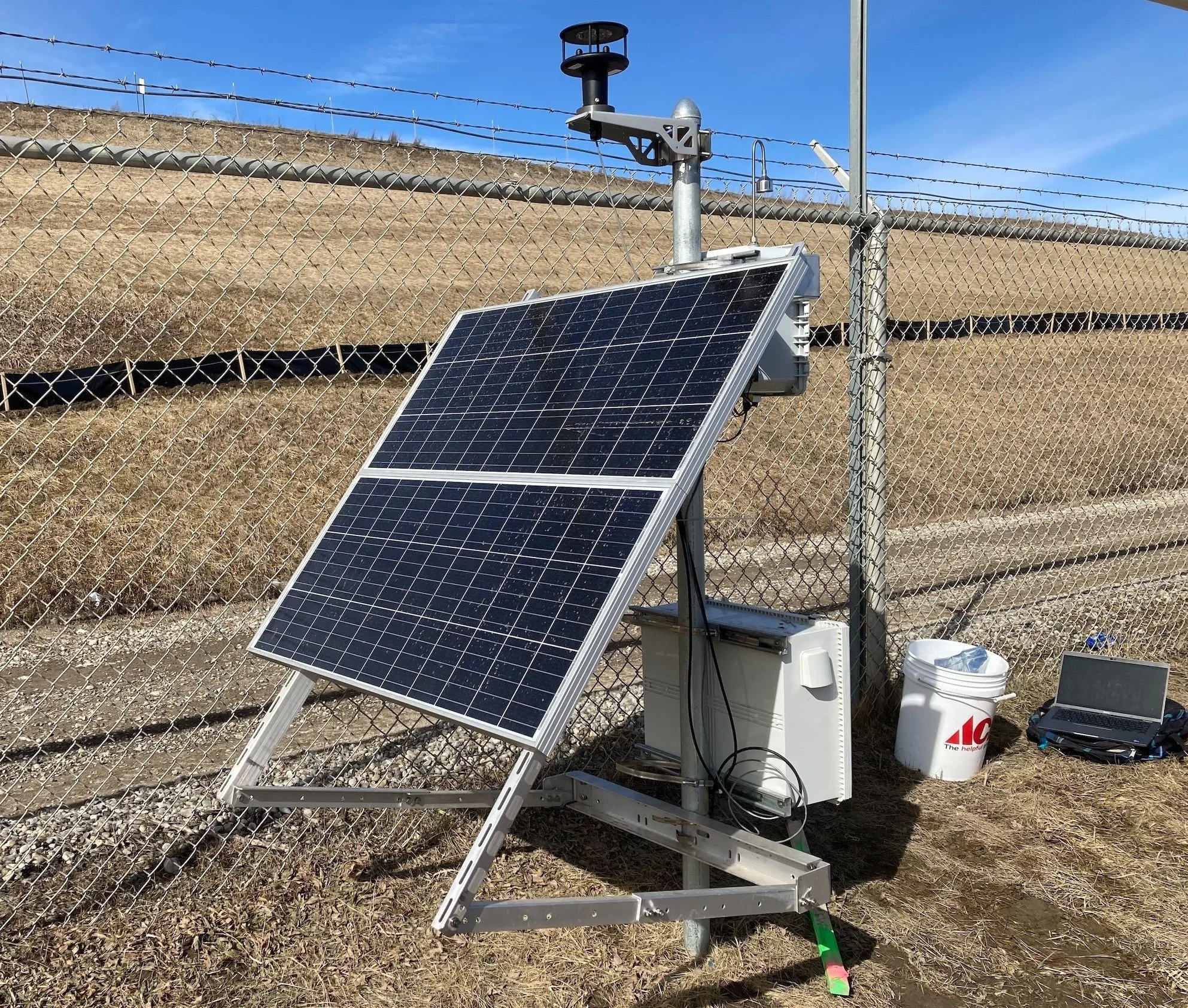
Photo from The Conservancy Initiative
The Problem: Manual Detection Has Failed
The federal surface emissions monitoring (SEM) method that landfills are required to follow, known as Method 21, is labor-intensive, incomplete and prone to human error.
Key failures include:
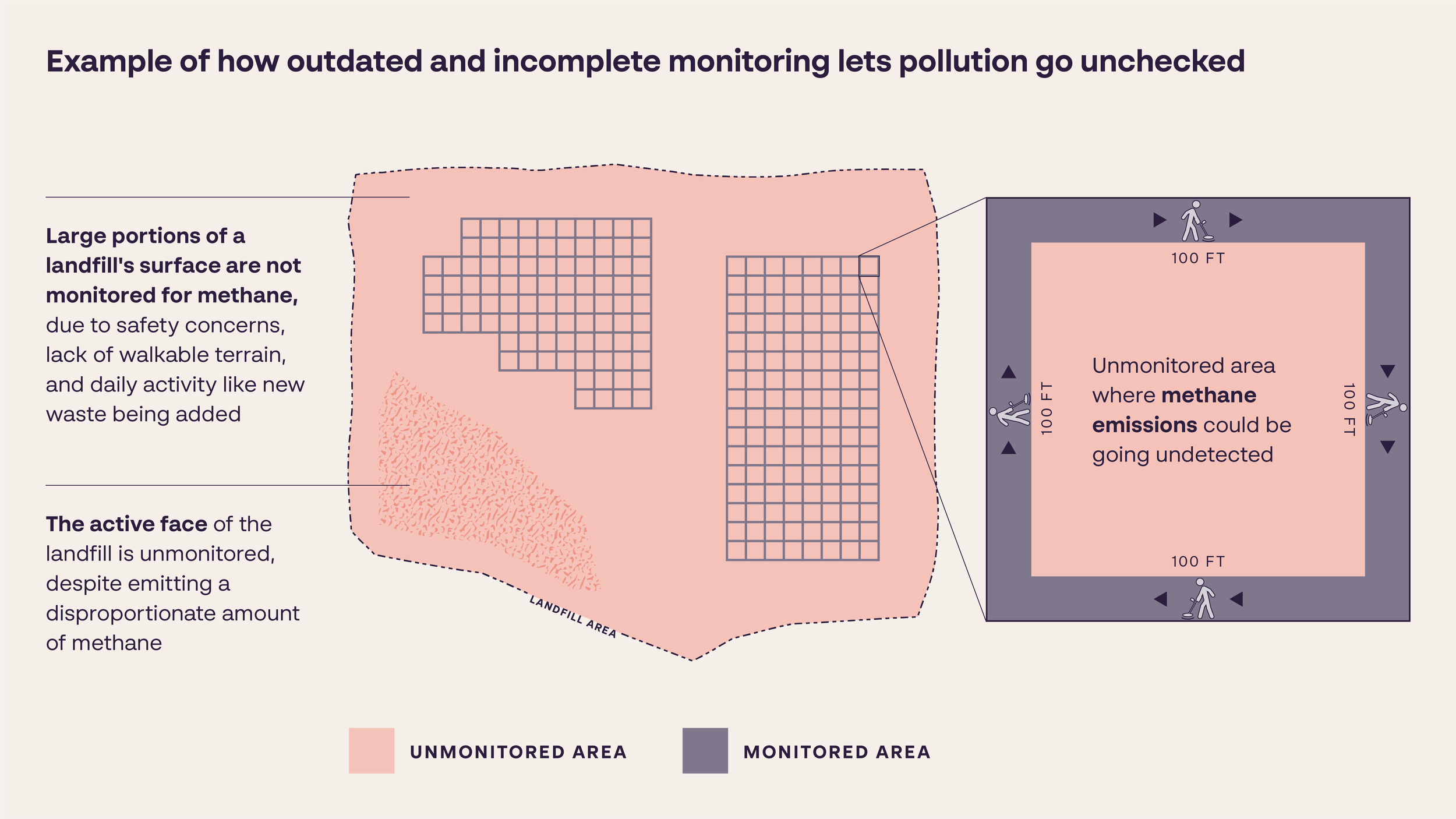
Large gaps: Under federal regulations, each quarter, a technician walks the landfill using a handheld gas analyzer once per quarter to measure methane escaping from the surface. The technician follows a grid pattern with monitoring paths spaced about 100 feet apart, leaving large sections of the landfill unmonitored.
Infrequent detection: Quarterly checks can’t capture the dynamic, rapidly-changing nature of landfill emissions.
Widespread human error: EPA’s September 2024 nationwide enforcement alert found “widespread” compliance failures: technicians moving too quickly, excluding areas from monitoring, using expired calibration gases, and failing to fully inspect their work.
No monitoring at place with most emissions: Research shows that 60-79% of all landfill methane comes from the active working face, yet this area is typically exempt from SEM entirely. The means manual SEM can only ever detect up to 40% of total site emissions, even when performed correctly.
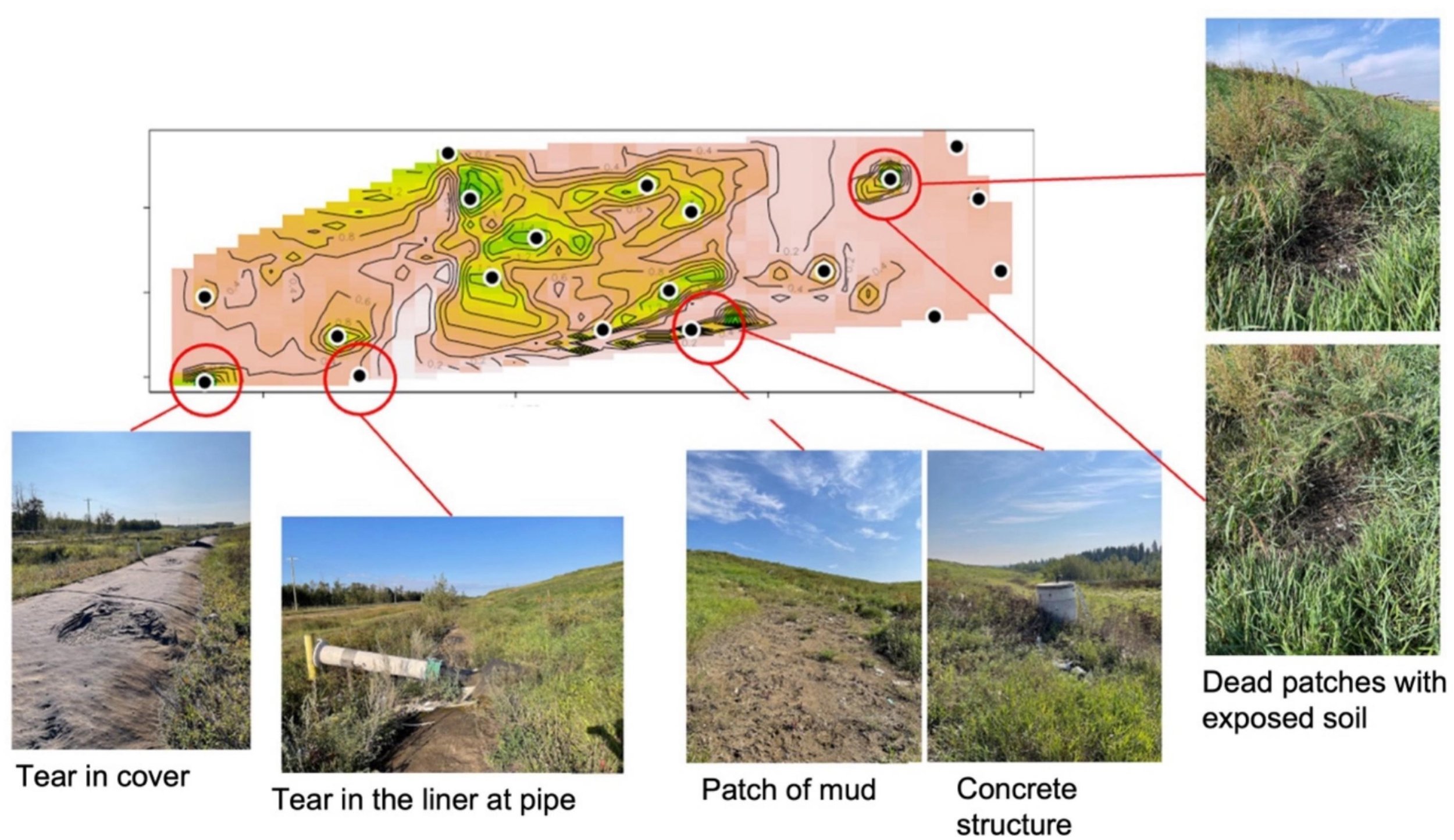
Examples of places where methane can escape through the surface of a landfill.
Source: Waste Management, Volume 207
The Evidence: Operators aren’t finding their own leaks
There are unfortunately many examples of problematic emission detection practices at landfills in the U.S. Industrious Labs’ Circular Economy Campaign (now Full Circle Future), analyzed EPA inspection reports from 29 landfills across eight states and found 711 methane exceedances over the legal threshold of 500 parts per million (ppm). There was at least one methane exceedance at 96% of sites where EPA conducted monitoring. Further, at nearly half (48%) of these sites, EPA inspectors found multiple exceedances where landfill operators had previously reported few or no exceedances.
LRI 304th Street Landfill near Tacoma, Washington: Inspectors detected explosive concentrations of methane, despite the landfill reporting no exceedances in the previous five years.
Prairie Hill Landfill in Morrison, Illinois: EPA inspectors found 51 methane exceedances and noted audible bubbling, strong odors, and leachate seeping out of the landfill. The landfill itself reported few to no exceedances in monthly SEM.
Coffin Butte Landfill in Corvallis, Oregon: Inspectors found 61 exceedances, including 21 above 10,000 ppm. The landfill operators reported no more than six exceedances in previous reports, with some showing zero.
Beyond Toxics Oregon spent hundreds of hours analyzing 32 Surface Emissions Monitoring (SEM) reports from eight Oregon landfills in 2023 to assess compliance with state methane monitoring rules. Researchers evaluated monitoring coverage, exemptions, and reporting completeness, converting the data into GIS-based maps to identify gaps and unmonitored areas across landfill surfaces. They found that privately owned landfills excluded an average of 48.6% of their surface area from monitoring. Publicly owned landfills excluded about 10% on average. One landfill exempted 69% of its surface area from monitoring without explanation. Another landfill claiming vegetation prevented monitoring, despite operators being responsible for maintaining cover.
Closing Monitoring Gaps: Ending Exemptions and Modernizing Surface Emissions Monitoring with Available Technologies
Integrating advanced technologies into SEM, such as drones equipped with methane sensors, dramatically improves the feasibility, efficiency, and accuracy of enhanced monitoring requirements. Unlike manual walking SEM, which is labor-intensive and exposes personnel to hazards such as steep slopes, heavy equipment operations, construction zones, and unpredictable weather, fixed sensors or drones can rapidly and systematically survey the entire landfill surface. There are dozens of companies that provide equipment and/or services for methane detection at landfills. Drone-based methane monitoring is already commercially available from providers such as ABB, Aerometrix, Bridger Photonics, Project Canary, Scientific Aviation, SeekOps, and SnifferDrone.
RMI, with WM as a contributor to the report, provides a comprehensive playbook on how advanced methane detection technologies can be used.
CARB has found that these next-generation technologies outperform traditional monitoring by expanding surface coverage, increasing monitoring frequency, improving worker safety, and reducing operator error—making them better suited for comprehensive methane emissions management.
Key upgrades to state landfill regulations to ensure proper detection of pollutants include:
-
Exemptions from surface emissions monitoring (SEM) for the working face and areas deemed unsafe to walk must be removed. Allowing broad exemptions for the most emissions-intensive areas of a landfill fundamentally undermines the effectiveness of SEM. Monitoring cannot meaningfully drive emissions reductions if the largest sources are systematically excluded.
-
Remote detection technologies should be required to monitor the entire landfill surface, including the working face and areas historically excluded from SEM. Landfills emit methane continuously—365 days a year—and monitoring frameworks must reflect this reality. Limiting advanced monitoring tools to select portions of a site perpetuates known blind spots and allows substantial emissions to persist undetected.
-
Monitoring should be conducted at least every other month rather than quarterly. Landfill emissions fluctuate daily due to operational practices, waste placement, cover conditions, GCCS performance, and meteorological factors. Quarterly inspections provide only a narrow snapshot and routinely miss intermittent or short-lived but high-impact emissions events. Advanced technologies enable more frequent monitoring with less labor intensity, making increased frequency both practical and necessary. Continuous monitoring tools can also identify methane exceedances in real time, without needing to wait weeks.
-
All monitoring must occur under normal, representative barometric pressure conditions, with atmospheric pressure recorded and reported. Gas collection and control systems are operated relative to atmospheric pressure, and because vacuum settings are typically adjusted on a monthly basis, short-term pressure changes can significantly affect surface emissions. Rising pressure suppresses emissions, while falling pressure increases them. Monitoring conducted during atypically high pressure systematically understates emissions and misrepresents system performance. If monitoring results are intended to represent emissions over a day, month, or quarter, they must be collected under average atmospheric conditions for that period.
-
Landfills with a school, health care facility within 1 mile, or with over 5,000 people within 2 miles should install perimeter monitors to identify and minimize the impacts of climate- and health-harming pollution, with action thresholds.
Fenceline monitoring is a method of measuring air pollution using sensors placed around the perimeter (or “fence line”) of a facility, such as a landfill. These monitors continuously or frequently sample the air for gases like methane or hydrogen sulfide to detect emissions escaping the site. When concentrations exceed preset thresholds, the system alerts operators so they can investigate and identify the source of the leak or emission event. Because the monitors sit at the facility boundary, they measure pollution where it leaves the site and may reach nearby communities.
Transparency and Verification is Essential
Amazingly, regulators cannot verify whether monitoring rules are actually followed because the landfill operators do not give them the information needed to do so. Federal requirements have no requirement to provide GPS paths of monitoring surveys. Monitoring data often submitted in non-spatial formats, making verification difficult. And worse, operators are not required to report all monitoring grid results, only exceedances. This makes it impossible for regulators to verify whether monitoring actually occurred as required.
In Beyond Toxics Oregon’s analysis of SEM reports from Oregon landfills, they were not able to locate information on three of Oregon’s 11 large municipal solid waste landfills and whether they even complied with methane monitoring rules in 2023.
Examples from Leading States and the Private Sector
Many landfill operators — both large private companies and municipalities — are already integrating satellite, near-ground, and continuous emissions monitoring into their operations to monitor for areas of elevated methane concentration and inform leak repairs and operational decisions.
Michigan-based Sniffer Robotics deploys its technology at more than 150 landfills, and the methodology has been approved by the EPA as an alternative test method for SEM.
Orange County Waste & Recycling Smart Landfill Program, deploys drones and robots to detect methane.
After over 4,000 odor complaints from residents, the South Coast Air Quality Management District ordered the Sunshine Canyon Landfill in California to deploy advanced methods like drones and robotic vehicles to identify problem areas and collect real-time data.
Federal regulations are stuck in a “Windows 2000” framework. Several states have updated their regulations to reflect the current reality and availability of advanced technologies:
Colorado, Regulation 31: Enables use of advanced technology to find methane leaks:
Moves beyond walking-only monitoring: The rule allows landfill operators to use alternative monitoring methods in place of traditional walking SEM (Method 21), rather than requiring exclusive reliance on grid-based handheld surveys.
Creates a formal approval pathway for new technologies: Operators can propose Division-approved alternative monitoring approaches, as long as they demonstrate emissions detection that is comparable to or better than standard SEM requirements.
Explicitly enables advanced technologies: The rule recognizes and allows drone-based monitoring (e.g., OTM-51), optical gas imaging, and other EPA- or Division-approved technologies for surface emissions monitoring and leak detection.
Allows hybrid monitoring approaches: Operators can combine traditional SEM with advanced technologies to improve overall coverage and detection performance across the landfill surface.
Shifts to a performance-based framework: Instead of prescribing a single method, the rule focuses on achieving equivalent or better emissions detection outcomes, allowing flexibility as technologies evolve.
Improves coverage of hard-to-monitor areas: By enabling aerial and remote tools, the rule makes it more feasible to monitor areas that are unsafe or difficult to access on foot, improving overall detection of methane leaks.
California, Landfill Methane Rule (2025): Requires use of advanced technology to find methane leaks:
Requires tools such as handheld or drone-mounted laser scanners to identify leaks in inaccessible areas that are currently excluded from monitoring.
Creates a formal approval pathway for alternative monitoring technologies: Allows any entity to apply for approval of new tools (e.g., drones, aerial surveys, laser-based sensors, continuous monitors) to be used in place of traditional quarterly walking SEM.
Enables broader, standardized use of advanced technologies: Moves beyond case-by-case approvals to allow approved methods to be used across landfills, increasing consistency and uptake.
Provides flexibility to adopt emerging tools: Establishes a voluntary, forward-looking process so operators can use the latest technologies as they develop, rather than being locked into outdated methods.
Industry Claim: Advanced monitoring technologies are experimental and unproven.
Fact: Modern sensing technologies have already successfully applied to landfills. These tools can rapidly identify emission sources and help regulators and operators target mitigation efforts.
Costs and Benefits
Modern methane detection technologies are much more cost-effective than manual SEM, widely available, and already being deployed by leading states and operators to identify and reduce emissions. Satellite, aircraft, drone, and mobile truck methods range from $3,000 to $14,000 per survey, and fixed sensors that take continuous measurements cost between $7,000- $30,000 annually.
Meanwhile, manual monitoring utilizing Method 21 costs at least $70,000 in equipment costs alone, and conducting the actual monitoring itself walking across a landfill is $73 per acre - for a typical 500 acre landfill, that is over $36,000 per survey.
Emissions Reductions
CARB estimates that improved methane detection and faster repair enabled by enhanced monitoring will reduce landfill methane emissions by approximately 17,000 metric tons of methane per year (about 450,000 metric tons of CO₂-equivalent annually). These reductions are attributed to improved gas capture, more comprehensive surface emissions monitoring, and prompt identification and repair of leaks detected through modern sensing technologies.