Smart Landfill Cover
Minimizing emissions through effective cover materials and practices
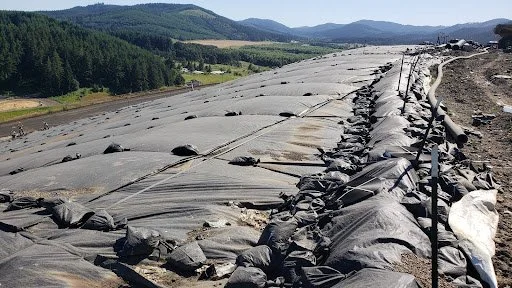
Inflated tarps due on a landfill surface due to high levels of methane
Proper design, type, installation, and maintenance of landfill cover prevents gas from escaping through cracks or weak spots and instead directs it toward the gas collection system. This increases the amount of gas that can be captured and controlled. Some advanced cover systems can also help regulate pressure inside the landfill so gas flows more consistently toward collection points.
The Problem: Active Face and Cover Type and Timing Goes Unregulated While Generating the Most Emissions
Landfills Can Ignore Active Face Emissions
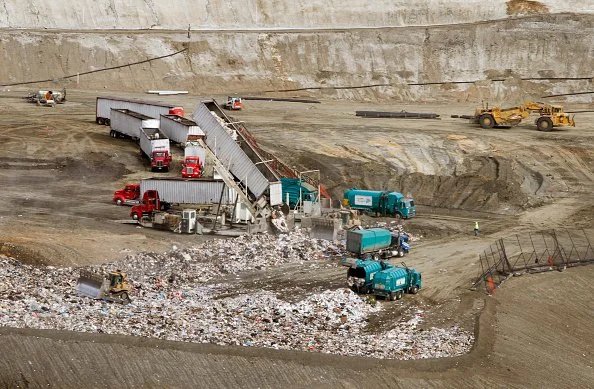
Studies show that the working face of a landfill is often a major source of methane emissions. Satellite observations and field measurements have found that methane can leak from several parts of a landfill, but the working face frequently produces the highest emission rates. In one study, measured emissions from the working face were far higher than previous estimates and exceeded emission levels reported at other landfills. Recent remote sensing surveys and research from Xavier University pinpointed the working face or active face as the largest source of air emissions from the landfill as the working face.. Yet it’s exempt from federal clean air act regulations, in terms of methane detection or mitigation.
A field investigation of all landfill operational parameters recommended limiting the working face and concentration of wet waste as much as possible and because daily cover had the most emissions potential. Dr. David Risk and researchers at St. Francis Xavier University in Canada tested current federally approved manual surface emissions monitoring at ten landfills and found that over 80% of methane went undetected. Much of the methane that manual surface detection missed was found to be coming from the active face of the landfill, or where trash is being dumped. These findings highlight that the working face is a key area where better management and controls could significantly reduce methane pollution.
Landfills Using Ineffective Covers
Even though landfill cover plays a major role in preventing emissions, federal air emission rules are silent on type and timing of landfill cover. Landfill cover standards are set through solid waste regulations under RCRA. In general, there are three types: daily, intermediate, and final cover. Daily cover is placed at the end of each operating day to reduce odors, fires, pests, scavenging, and litter. Under federal RCRA rules, this cover must typically consist of at least six inches of soil unless an alternative material is approved. The use of insufficient daily cover, like alternative daily cover such as “auto fluff” and fine grained covers can contribute to oxygen intrusion and thus SET event risk. In addition, there is nothing stopping landfills from delaying final cover, which is the most effective at limiting emissions.
Final cover is installed once a landfill stops receiving waste. Installation must begin within 30 days after a landfill unit receives its final waste and closure must be completed within 180 days. The final cover must then be maintained for at least 30 years and typically consists of an impermeable soil layer about 18 inches thick topped with six inches of soil to support vegetation, though alternative designs may also be approved.
Cover Integrity Failure
Current landfill cover integrity requirements rely too heavily on operator self-reporting without sufficient verification, specificity, or enforcement. Although rules require monthly monitoring and repairs, they do not clearly define minimum inspection rigor, documentation standards, or timelines for corrective action. That’s likely why the U.S. EPA found that many operators are not complying with the Clean Air Act’s applicable regulatory requirements, including “failure to maintain adequate MSW landfill cover integrity.”
In its notice of a $3 million civil penalty for air quality violations, the Oregon Department of Environmental Quality found that despite permit requirements to conduct and report monthly landfill cover inspections and repairs, the Coffin Butte landfill consistently reported “no issues” from 2021 through 2025. However, EPA inspections in 2022 and 2024 directly contradicted these claims, documenting numerous holes, defects, and even trees growing through the landfill cover - clear signs of long-term neglect. Only after regulatory pressure did a third-party inspection in January 2026 reveal widespread problems, identifying maintenance needs in 30 out of 130 areas, including holes, vegetation intrusion, and exposed waste. This pattern shows that the Respondent failed to accurately monitor, report, and maintain landfill cover integrity over several years, allowing significant deterioration to go unaddressed.

An EPA inspection of the LRI Landfill in Washington found a methane exceedance over 2,000 parts per million (ppm), marked by the yellow flag. The tarp edge and auto fluff seen here constitutes landfill cover under current regulations.
The Solution: Minimize the Active Face, Verify Cover Integrity and Deploy Effective Cover Practices
Minimize the Active Face
A practical way to reduce methane releases is to keep the working face as small as possible, minimizing the exposed area where emissions often occur. Alongside requiring gas collection in the active face, to reduce emissions from the active working face and areas under daily cover, state landfill emissions standards should limit the size of the landfill working face relative to the incoming annual tonnage of waste. Minimizing the working face reduces methane emissions, litter, and pest activity while making daily cover easier to manage. A smaller, well-organized working area also improves efficiency by reducing truck delays and idling, lowering fuel use and emissions.
At sites with persistent issues at the working face, state standards should require further corrective action, such as application of an enhanced daily cover material to boost oxidation.
Verify Cover Integrity
Strengthening state regulations should focus on requiring standardized, grid-based inspection protocols; mandatory photographic and geospatial documentation; and clear, enforceable repair timelines. These changes would ensure cover integrity inspections are consistent, verifiable, and tied directly to timely maintenance actions rather than being treated as a procedural formality.
Regulations should require periodic third-party inspections, certification of reports by responsible officials, and meaningful penalties for false or misleading submissions. In addition, integrating cover integrity monitoring with other regulatory tools, such as surface emissions monitoring, would create cross-checks that help identify problems earlier.
Deploy Effective Cover Practices and Materials
States should require landfills to implement robust cover design plans, emphasizing the timely placement of protective covers designed to slow methane emissions. A Cal Poly field investigation of methane gas emissions from a representative set of California landfills analyzed all operational parameters at landfills and emissions measured on the ground. The researchers found that the type of cover on a landfill was the most significant factor impacting the flux of emissions. Not surprisingly, a final cover, which is thickest, yields the highest collection efficiency, followed by intermediate cover, followed by daily cover, which yields the lowest collection efficiency. Studies have found that landfills with a well-designed final cover liner and a gas collection and capture system can have a gas collection efficiency as high or above 90%. The EPA notes “not only enhances gas collection efficiency but also facilitates the oxidation of methane.” Gases from a landfill are always looking for a route to escape, and if cover is poor, it has a route of least resistance out of the landfill and into the air.
State should also require shorter use of daily covers to minimize methane escape during active landfill operations. The Cal Poly research found higher methane emissions with the use of intermediate and daily covers and lower methane emissions as the percentage of the landfill area with final cover increased. The report recommended limiting the working face and concentration of wet waste as much as possible and because daily cover had the most emissions potential, that intermediate cover should be installed within days — not weeks — of waste placement.
State standards should consider banning or greatly limiting Alternative Daily Cover (ADC). The use of ADC has not been proven to reduce emissions and can also increase the risk of ires and SET events. If ADC is to be allowed, only non-flammable, low-porosity materials should be used. Organic material should not be used as ADC, as it contributes to methane generation.
Cover Installation Timeline
Every day for up to one month: Daily cover: Barrier applied at the end of the operational day with six inches of required earthen cover, encouraging the use of enhanced materials such as organic soil, compost, and biochar.
Within one month: Intermediate cover: Barrier used until the final cover is installed with twelve-inch required cover.
After six months: Strengthen intermediate cover: Add a thicker and/or methane oxidizing layer or bio cover to intermediate covers in place for over six months to better reduce methane activity.
On an ongoing basis as landfill cells reach capacity: Final cover: Permanent, multi-layered system once landfill reaches capacity. To minimize leaks, require final cover on a rolling per cell basis, do not wait until the entire landfill closes.
State Regulations Should Include
-
A practical way to reduce methane releases is to keep the working face as small as possible, minimizing the exposed area where emissions often occur. Alongside requiring gas collection in the active face, to reduce emissions from the active working face and areas under daily cover, state landfill emissions standards should limit the size of the landfill working face relative to the incoming annual tonnage of waste. Minimizing the working face reduces methane emissions, litter, and pest activity while making daily cover easier to manage. A smaller, well-organized working area also improves efficiency by reducing truck delays and idling, lowering fuel use and emissions.
At sites with persistent issues at the working face, state standards should require further corrective action, such as application of an enhanced daily cover material to boost oxidation.
-
Strengthening state regulations should focus on requiring standardized, grid-based inspection protocols; mandatory photographic and geospatial documentation; and clear, enforceable repair timelines. These changes would ensure cover integrity inspections are consistent, verifiable, and tied directly to timely maintenance actions rather than being treated as a procedural formality.
Regulations should require periodic third-party inspections, certification of reports by responsible officials, and meaningful penalties for false or misleading submissions . In addition, integrating cover integrity monitoring with other regulatory tools, such as surface emissions monitoring, would create cross-checks that help identify problems earlier.
-
Require thicker or more protective intermediate cover to better control methane emissions. Use materials with demonstrated oxidizing capacity for intermediate cover and establish requirements related to permeability, including the compaction of soil.
-
Require a final or enhanced cover once a landfill cell reaches its final height or after a set number of years, rather than allowing intermediate cover to remain indefinitely. This could be implemented by requiring landfill design plans to include timelines for filling each cell and clear schedules for installing the final cover after waste placement ends.
Include specifications for cover thickness and material composition to optimize conditions for methanotrophic bacteria.
-
Ensure that any materials approved for use as alternative daily cover (ADC) meet minimum standards for methane and nonmethane organic compounds mitigation. Incinerator ash should not be allowed as alternative cover. Colorado’s Regulation 31 contains the common-sense requirement to not allow petroleum contaminated soils or soils containing volatile organic compounds to be used as final cover, and requires larger landfills to implement a formal cover integrity program to ensure covers remain effective over time. A study on landfill gas movement through cover soils found that standard soil covers tended to release the least gas. Alternative covers made from highly porous materials like autofluff or green waste had significantly higher emissions.
Example from a leading state
Colorado strengthened landfill cover requirements to better control methane emissions. For landfills with gas collection systems, long-term intermediate cover should use biocover materials that rely on methane-eating bacteria, or alternatively a thicker layer of earthen material, to reduce emissions, where methane emissions can be particularly high and often escape even when a gas collection system is in place. Biocovers rely on the presence of methanotrophic bacteria to naturally convert methane into less-potent carbon dioxide and are considered “highly cost-effective”climate solutions. Methane oxidation efficiencies can exceed 90% in well-functioning biocover systems, and research has also shown that biocovers can support the biodegradation of NMOC, including a reduction in harmful volatile organic compounds (VOCs). These systems rely on naturally occurring bacteria that convert methane into CO₂ as the gas passes through the material. They can also help reduce other pollutants like hydrogen sulfide, ammonia, and hazardous compounds.
Industry Claim: Improving landfill covers is expensive or technologically difficult.
Fact: The technologies needed to improve landfill cover systems—such as engineered soils, geomembranes, biocovers, and improved structural designs—are already widely available and used in modern landfill operations. The main barrier is not technology, but updating standards to require their use more consistently.
Industry Claim: Landfills are already regulated under federal waste laws, so additional air quality rules would be duplicative.
Fact: Solid waste rules under the Resource Conservation and Recovery Act (RCRA) primarily focus on waste management issues such as groundwater protection, landfill stability, and daily operations. Air pollution, including methane emissions, is regulated separately under the Clean Air Act federally and separate state statutes. Strengthening air rules simply addresses pollution that waste regulations were never designed to control.
Industry Claim: Because landfill design is governed by RCRA and solid waste management, air agencies cannot regulate cover systems or gas collection.
Fact: Air agencies routinely regulate landfill infrastructure when it affects emissions. For example, Clean Air Act landfill rules already require gas collection systems, wellhead monitoring, and surface methane monitoring. Improving cover practices or gas collection timing is simply an extension of existing air pollution controls.
Emissions Reductions
Improved landfill cover systems represent a meaningful methane mitigation strategy. Studies show engineered biocovers can reduce methane emissions by roughly 30 percent, while advanced microbial cover systems have demonstrated 85–90 percent methane removal under optimized conditions. Improved cover design can also significantly increase the efficiency of gas collection systems, helping some landfills achieve gas capture rates exceeding 90 percent.