
Landfill methane is invisible. Experts agree that we can find it.
Last month, researchers, regulators, technology developers, and industry representatives from methane-emitting sectors like landfills and oil and gas gathered at CAN-CH4, one of North America's leading conferences focused on methane measurement and mitigation. We have serious total FOMO from missing this. Fortunately, the presentations are available online, and we’ve been digging through them! The presentations covered a ton of subjects, from drone monitoring to methane-oxidizing biocovers. And several studies presented at the conference pointed to the same conclusion:
The methane detection approaches at landfills mandated by regulations aren’t working.
Better methane detection technologies already exist.
Achieving ambitious methane reduction goals will likely require broader adoption of those tools.
Here’s the geeky low-down:
A surprising messenger on Method 21’s flaws
For many years, federal regulations have relied on a surface emissions monitoring (SEM) method commonly known as Method 21 as the primary way to find methane leaking from a landfill. Under Method 21, a technician walks the landfill using a handheld gas analyzer once per quarter to measure methane escaping from the surface. The technician follows a grid pattern with monitoring paths spaced about 100 feet apart, leaving large sections of the landfill unmonitored. Not surprisingly, this method is labor-intensive, incomplete and prone to human error. For example, EPA’s September 2024 nationwide enforcement alert found “widespread” compliance failures: technicians moving too quickly, excluding areas from monitoring, using expired calibration gases, and failing to fully inspect their work. And now the waste industry is weighing in:
One of the most consequential posters at the symposium came from researchers at St. Francis Xavier University, EREF, and WM - the largest waste company in North America. Using controlled-release experiments and field validation studies, the researchers evaluated the detection performance of Method 21 and found it to be abysmal.
Based on measurements from operating landfills, the researchers concluded that most landfill methane sources outside the active face fall below the regulatory detection threshold and that fewer than 10 percent of sources are reliably detected at many sites.
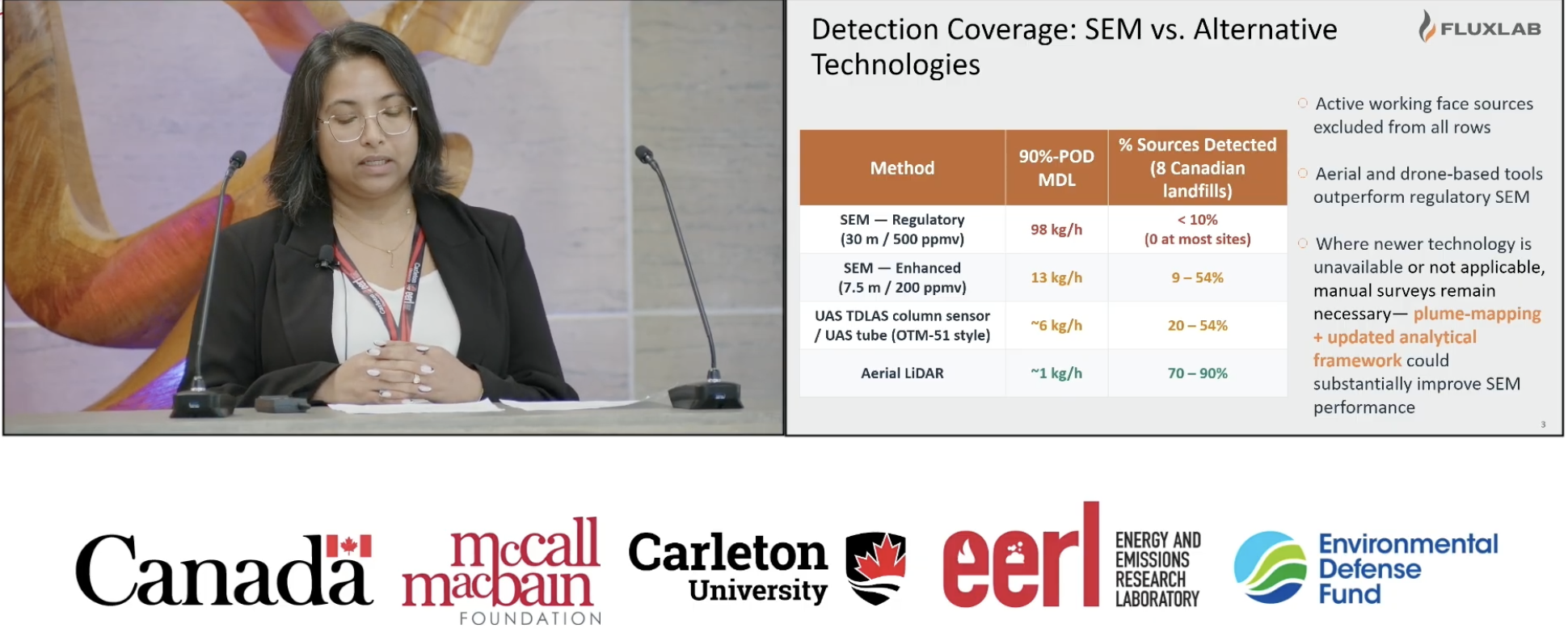
That is a big deal.
For years, fenceline communities and experts have argued that the U.S. regulations landfill monitoring methods miss harmful emissions. What is notable here is that major industry actors are now participating in research that quantifies the problem.
This suggests the conversation is shifting from whether current monitoring has limitations to what should replace or supplement it.
The future isn’t just one technology (but it sure isn’t Method 21)
A panel discussion on waste methane measurement, reporting, verification, and mitigation pushed back on the idea that any single technology will simply replace Method 21 wholesale. Different tools answer different questions: some are built to pinpoint and quantify individual leaks, others to estimate total site-wide emissions; some work well in active disposal areas, others are better suited to broader assessments. For the active working face, where there’s machinery moving around, you want to use aerial LiDAR and UAS-based sensors.
The goal isn't crowning a winner. It's building monitoring frameworks that use the right tool for the right job.
Closing gaps in regulations is the difference between success or failure
A separate analysis at the conference asked a bigger question: will Canada's new landfill methane regulations actually deliver the country's goal of cutting waste-sector methane emissions by 50 percent?
Using measurement data from multiple Canadian landfill studies, researchers Omidi, Lavoie and Risk modeled the likely impact of the new rules under realistic and best-case scenarios. Both showed meaningful reductions and both still landed well short of the 50 percent target, leaving a gap of roughly 23 to 33 percent.
The reason wasn't a lack of available tools. It was that the regulations left some obvious loopholes open. The researchers pointed to specific, achievable fixes that deliver methane reductions (and remind of the lessons learned in the other studies we just summarized):
Improved active-face methane mitigation: Controlling methane coming out of the active face could achieve 30% mitigation at half of regulated sites.
Higher gas collection efficiencies: Boosting has collection to 80% at half of regulated sites could add roughly 33.5% toward the national reduction target.
Expanded collection requirements at sites not currently subject to them: By extending 80% gas collection to currently unregulated sites could add another ~7%.
Better use of existing credit and incentive programs already on the books.
Modeled together, those four improvements to regulations would allow the country to meet or exceed its 50 percent target. The tools and the policy levers both already exist; what's missing is regulations designed around how methane actually escapes from a landfill in practice.
The gaps are getting harder to ignore
Landfill methane is invisible, but at this point it's not unknowable. Across a controlled-release study, an industry-backed validation poster, a multi-method technology panel, and a national policy model, CAN-CH4 painted the same picture from different angles: the tools to find and reduce landfill methane are more capable than the rules currently require. That's not a technology problem anymore. It's a regulatory one, and it's one regulators now have the evidence base to fix.
There’s a lot of great research and presentations to highlight from CAN-CH4, we’ll keep digesting and sharing! The tools to detect and mitigate methane exist. The gaps that stand in the way of methane mitigation are becoming clearer. Now rules and regulation need to be updated.
