
Beyond the Federal Floor
Why New York Needs Stronger Rules
Executive Summary
Other states have already acted. The EPA sets the floor, not the ceiling, when it comes to state landfill air emission regulations. Other states aren’t waiting. EPA sets the floor, not the ceiling, and six states have already raised the bar. Roughly 370 landfills, 70 percent of them publicly owned, already meet more effective state standards. For example, Colorado’s Regulation 31, adopted in December 2025, requires more landfills to collect their gas, uses satellites and aircraft to find big leaks, phases out open flares, and makes companies that receive landfill gas share responsibility for compliance. Colorado expects it to cut up to 12.53 million metric tons of carbon dioxide equivalent by 2050. Washington, Oregon, Maryland, and Michigan have stronger rules, too, and California strengthened its long-standing rules in November 2025 to find and fix leaks faster, crack down on repeat problems, and put methane detection data in public view.
New York has a chance to close this gap right now, by following other states and upgrading its landfill standards. On June 4, 2026, the DEC held a pre-rulemaking stakeholder meeting on amendments to cut greenhouse gas emissions from New York’s landfills. The records in this report show where the federal floor is failing in New York, and point to the upgrades that New York’s rule needs.
The loophole that let a billion cubic feet of gas go unmonitored
The problem: Federal rules set minimum standards for landfill gas collection: wells where the gas is, systems that actually pull it in, regular checks of the surface for leaks, and deadlines to fix them. But a landfill doesn’t have to meet any of those standards until it clears two federal bars. Until then, methane and toxic pollutants like benzene can seep into the air, and no one is required to stop them, or even look. First, it must be permitted to hold at least about 2.75 million tons of waste (2.5 million metric tons). Second, a calculated estimate of its nonmethane organic compounds (NMOC), the smog-forming and toxic gases in landfill gas such as benzene and vinyl chloride, must exceed 34 metric tons a year. That estimate rests on a single round of gas sampling that only has to be repeated every five years. Until the next test, the landfill’s status is effectively locked in, no matter how much gas it is producing.
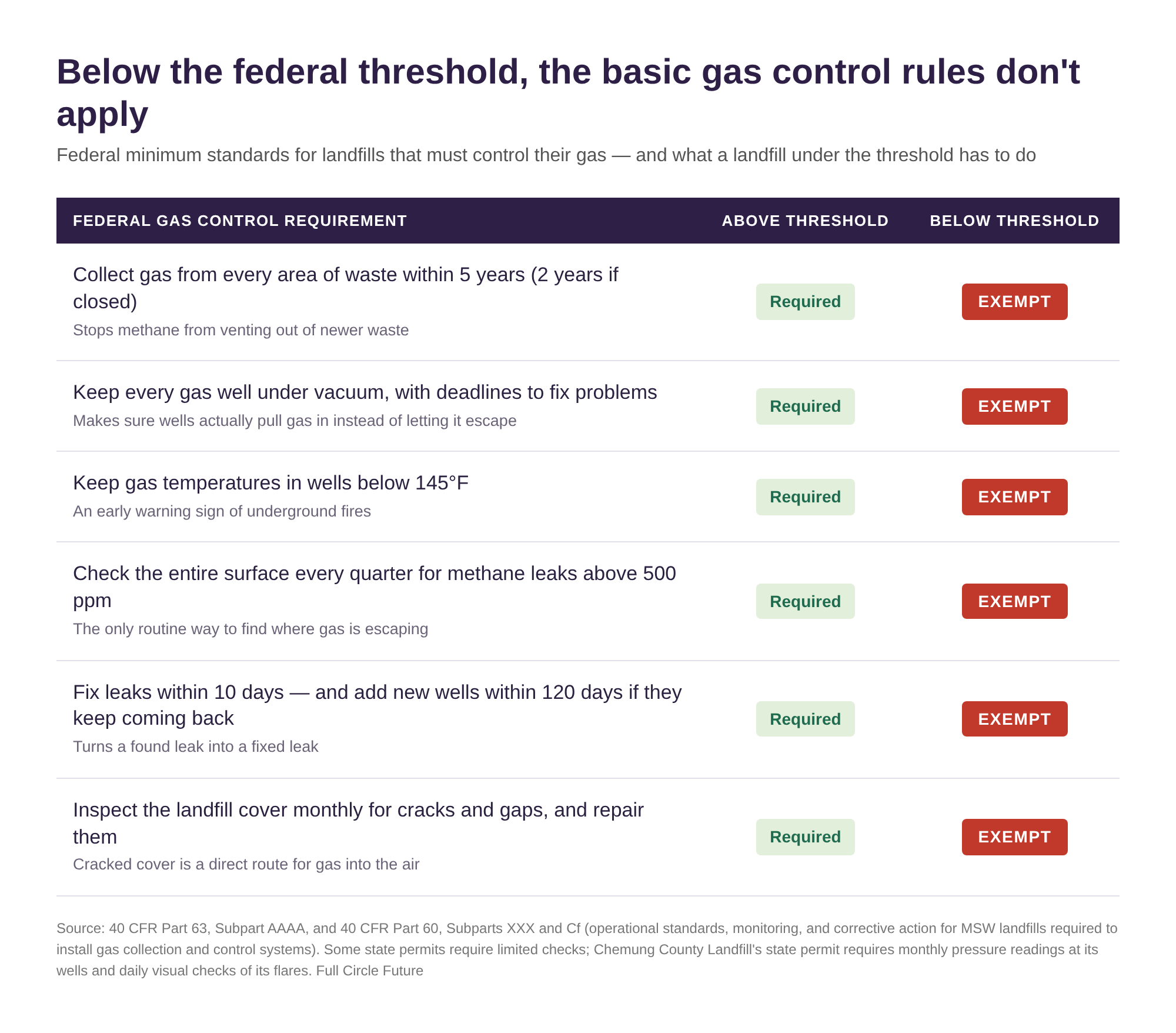
Why it matters: The federal rule has never measured methane, the pollutant landfills emit most and that is one of the most potent. Instead, it relies on an emissions rate for non-methane organic compounds (NMOC) coming from landfills, designed capacity that only includes massive landfills over 2.5 million tons of waste using a five-year snapshot. The result: A landfill can generate enormous amounts of methane and still fall below the federal threshold. States that have updated their rules, like Washington, Maryland, and California, fixed this: they decide which landfills need gas controls based on how much methane their waste actually generates, recalculated every year.
What we found in New York:
Chemung County Landfill: Too big to be a close call: Chemung County Landfill, near the Pennsylvania border, burned nearly a billion cubic feet of landfill gas in 2024. The landfill, owned by Chemung County and operated by Casella Waste Systems, collected 968 million cubic feet of gas that year, almost 46 percent of it methane, and burned all of it in two open flares, a process that releases hazardous pollutants like volatile organic compounds (VOCS) and particulate matter into the air. Chemung is not a borderline case in size. EPA's greenhouse gas reporting puts its design capacity at about 9.1 million metric tons, more than three and a half times the federal size cutoff, and it already holds about 6.5 million tons of waste.
About 15,400 people live within 5 miles of Chemung County Landfill. More than a quarter are low-income, one in five is over 64, and adults have COPD at about 1.6 times the state rate. All of them already live with fine-particle air pollution worse than 90% of New York.
One sample, five years of exemption. Yet a single gas sample from May 2019 kept Chemung below the federal threshold for gas collection and control every year through 2024. Between tests, the operator simply updates its waste tonnage and reuses the old sample. When Chemung finally retested in May 2024, it came in over the NMOC federal limit. Even then, the federal rule gives it until January 1, 2027, to comply.
Chemung holds more than 6.4 million tons of trash, or the weight of nearly 18 Empire State Buildings. Yet its record shows no surface leaks, because no one was required to look.. It does have a gas collection system. The problem is that it doesn’t have to meet any of the federal standards to ensure it is operating properly: no requirements for where its wells go or how well they work, and no one required to walk the surface to find leaks or fix them by a deadline. Its state permit asks only for monthly pressure checks at its wells and daily visual checks of its flares (it’s really bad news when flares stop working).
Under updated state rules, Chemung wouldn’t have been a close call. Based on the gas it reported collecting, its methane output is roughly 17 times the level at which California and Washington require gas controls, controls that come with real operating and monitoring standards.
A large landfill with no federal controls. A single gas test can decide whether a landfill has to control its pollution at all, and the Development Authority of the North Country (DANC) landfill in Rodman, Jefferson County, shows how much rides on it. Because of how its tests came out, DANC still faces no federal requirement to check its surface for leaks, meet standards for its gas wells, or fix problems by a deadline. And DANC is no small operation. The publicly owned landfill has been open since 1992 and expects to keep accepting trash until 2074. It is designed to hold more than 21 million metric tons of waste - more than eight times the federal size cutoff - and already holds 6.7 million. In 2023, its estimated methane emissions reported to the EPA came to about 152,000 metric tons of carbon dioxide equivalent
DANC has run the same site-specific NMOC test six times since 1996. The results, in parts per million, were 129 in 1996, 372 in 2001, 46 in 2006, 80 in 2011, 202 in 2016 and 67 in 2021. Those six results come from the same landfill, measured the same way, five years apart. They range from 46 to 372 parts per million, an eightfold difference, and each one sets the landfill’s regulatory status for the next five years. A measure that swings this widely from one test to the next cannot reliably decide whether a landfill is regulated at all. And at DANC, the calculation had a second problem.
EPA caught DANC landfill undercounting its waste. A new sample let it off the hook. After an October 2020 inspection, EPA found that DANC had been subtracting large amounts of waste from its calculations as nondegradable without the documentation the federal rule requires. Recalculating with that waste included, EPA concluded in September 2021 that the landfill had actually crossed the 34-megagram threshold in 2020 and “became subject to NMOC control requirements as of December 31, 2020.”
However, the timing worked in DANC’s favor. A month before EPA’s letter, DANC had already run its next five-year test, and the result, 67 parts per million, was a third of the 2016 reading. DEC approved it in October 2021. With the new number plugged in, DANC’s calculated emissions for 2024 were 13.89 megagrams, about 40 percent of the threshold, and its consultant reported that no further action was required. DANC still has no federal requirement to control its gas or monitor its surface, and its next test is not due until 2026.
The federal rule allows exactly this. A landfill over the threshold must install controls “unless Tier 2 or 3 sampling demonstrates that the NMOC emission rate is less than 34 megagrams per year.” At DANC, a new sample taken a month before EPA found the landfill over the threshold was enough to put it back under.
Mill Seat: Methane in the air before the rules applied. Mill Seat’s February 2021 emissions report put it over the federal threshold for gas controls, but its 2021 compliance reports state that the federal operating requirements, which include surface monitoring, did not yet apply; its first quarterly surface scan came in early 2022. In between, in August 2021, an airborne survey detected two methane plumes over the landfill.
The fix: States that have updated their landfill rules have replaced the federal formula with what actually drives methane: how much waste is in the ground and how much methane it generates, recalculated every year. California, Washington and Maryland apply their rules to landfills with 450,000 tons of waste or more, and Oregon to landfills with more than 200,000 tons. Each then decides whether a landfill needs gas controls based on how much methane its waste generates, recalculated every year. Once a landfill’s methane crosses the trigger, the question becomes simple: is it leaking? If surface checks find methane at 200 ppm or higher at any point over four straight quarters, it must install a gas collection system that meets state standards, including quarterly leak checks. Only a landfill that proves it isn’t leaking can skip that step. Either way, someone has to look.
Gas Collection Installation and Methane Detection: The Five-Year Exemption
The problem: Methane starts forming soon after waste is buried, but federal rules let landfills wait up to five years before connecting a new area of waste to the gas collection system (two years if the area is closed or at final grade). And the same five-year clock means no one has to check whether new areas are leaking, even if gas collection pipes are already in the ground. Right now, by the time the pipes go in, much of the gas is already gone. EPA estimates that 61 percent of the methane from landfilled food waste is never captured, and that food waste is responsible for about 58 percent of all the methane escaping from U.S. landfills. As EPA itself put it, earlier gas collection “could collect and control significant emissions” from that fast-rotting food waste.
Why it matters: The lack of gas collection systems in the very place where there is the most pollution represents a systemic flaw in standards for landfills: gas collection begins only after the period of peak methane generation has already passed. Leak detection lags just as far behind. Federal rules don’t require surface emissions monitoring, or the walking surveys that find methane escaping through the landfill surface, in active areas until the waste there is five years old. That means the newest areas, where emissions are often highest, go unchecked, even when gas wells are already in the ground. These lag times are among the biggest missed opportunities in landfill methane mitigation.
What we found in New York:
Seneca Meadows: Five years of new waste, never checked. At Seneca Meadows, stage 6 of the landfill’s expansion was scheduled to begin receiving waste in 2018. Waste Connections, the landfill operator and one of the largest landfill companies in the U.S. knew it would produce gas: it planned dozens of gas wells and installed 28 in 2020. But the federal rule doesn’t require anyone to actually monitor for methane leaks on the surface until the waste is five years old, whether or not wells are in place. Those early years are exactly when landfills produce much of their methane. According to the EPA, half the carbon in landfilled food waste breaks down into landfill gas within 3.6 years, and those emissions “often occur before landfill gas collection systems are installed or expanded.” That means stage 6 was not scanned until September 2023, five years after filling was scheduled to begin. On that first scan, 13 locations exceeded the federal limit, two of them at 10,000 ppm: 20 times the limit, and as high as the instrument could read.
Ohio EPA now expects the kind of investigation we found missing
In 2026, The Ohio Environmental Protection Agency issued guidance for municipal solid waste landfills experiencing elevated temperatures that entails far more than a simple review of wellhead gas data before approving higher operating temperatures. Ohio's guidance requires landfill operators seeking a HOV approval to submit a detailed technical demonstration explaining why temperatures increased, not simply evidence that a fire has not yet occurred. At a minimum, operators must provide:
A Root Cause Analysis and Corrective Action Analysis for the elevated temperature.
A description of the steps already taken to correct the problem before requesting a higher operating temperature.
A physical evaluation for evidence of fire or subsurface oxidation, including observations for smoke, odors, steam, rapid settlement, damaged wells, char, ash, or other warning signs.
Historical trend data for temperature, methane, oxygen, carbon dioxide, pressure, flow, and carbon monoxide, along with supporting graphs.
Information about well construction, waste characteristics, leachate recirculation, liquid levels, and whether a downwell camera inspection or downwell temperature monitoring has been performed.
A discussion explaining why the elevated temperatures do not indicate a fire and will not significantly inhibit anaerobic decomposition.
Ohio EPA also states that every HOV request must demonstrate that the operator made appropriate efforts to correct the exceedance before seeking approval, and HOV approvals come with additional monitoring, reporting, corrective action, and re-evaluation requirements if conditions change.
Finding #2: Regulators Approve Higher Temperatures Based Only on Surface Measurements, Without Ever Looking Inside the Landfill
Wellhead temperatures only measure the temperature at the landfill’s surface. They do not measure what is happening ten, twenty, forty, or eighty feet below the surface, inside the waste mass where many fires actually originate. EPA's own guidance on elevated-temperature landfills explicitly recognizes that temperatures within a landfill can be substantially higher than what registers at the wellhead, yet in the documents provided to us, regulators routinely failed to require landfill borings.
Looking only at the wellhead is like checking a house fire from the mailbox
Imagine that you accidentally leave your oven on for hours. Maybe your kitchen starts to feel warm. Maybe you even start to see smoke seeping out of the oven door, or the smoke alarm starts to go off. All the warning signs are there that a fire could start at any moment. But when the fire department comes to investigate, they don’t even step foot inside. All they do is look at the outside of your house, declare everything fine, and leave. You're still at risk of a disastrous fire — the only difference is that, now, the people who are supposed to oversee fire risk have told you there's nothing to worry about.
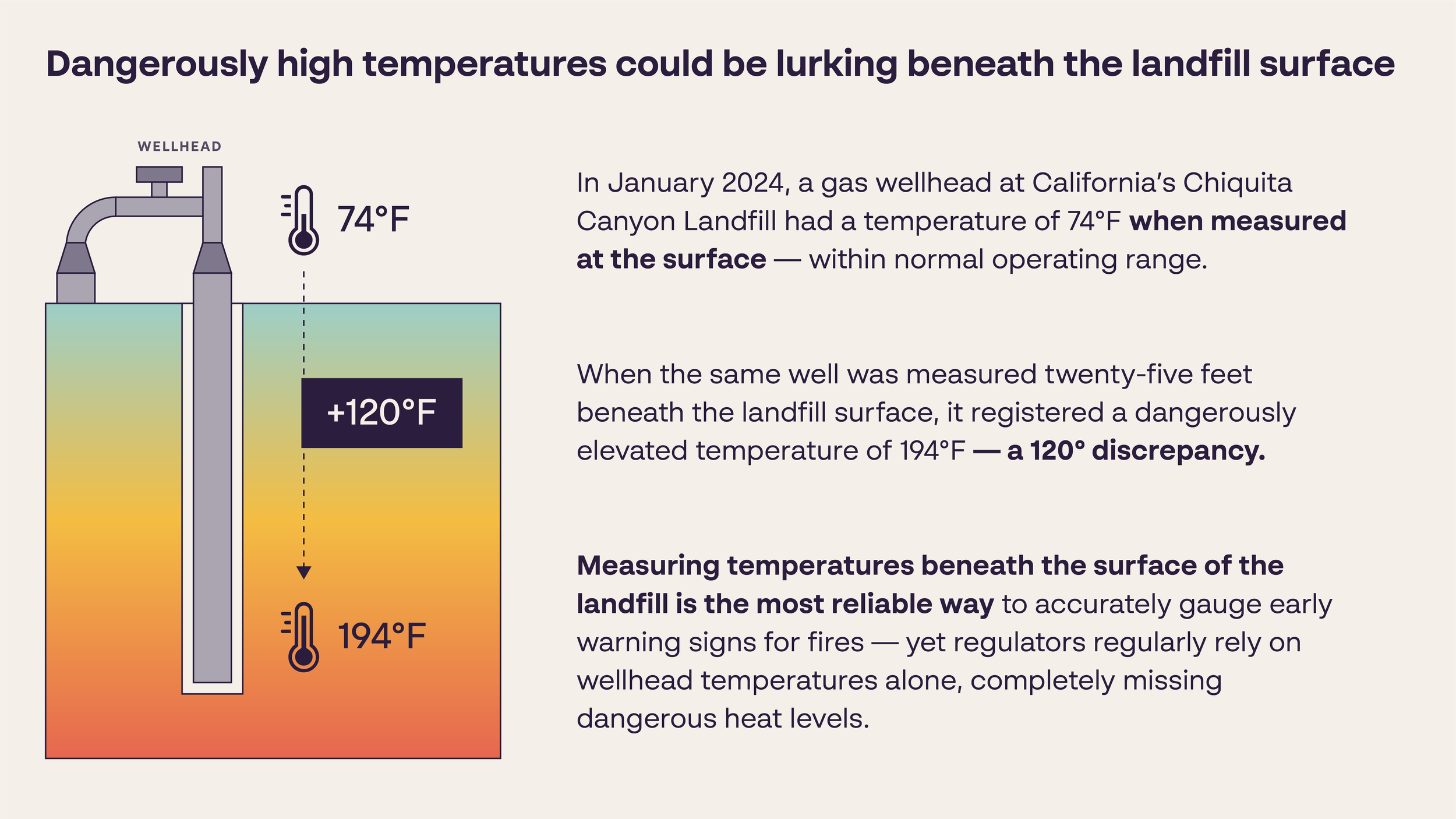
Source: March 2025 letter from California Environmental Protection Agency to Los Angeles County Department of Public Health, page 9
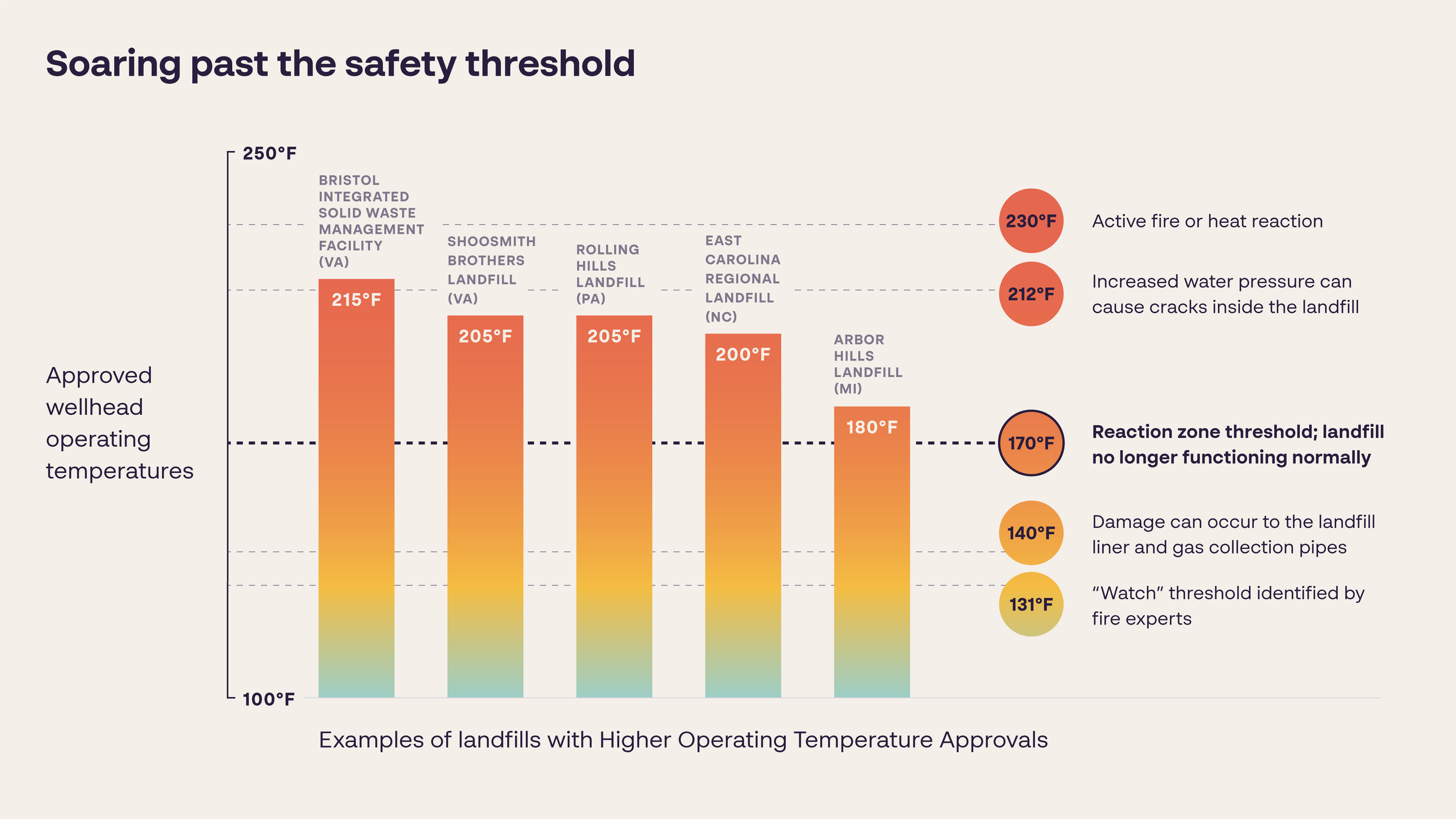
Too often, regulators are approving temperatures of 170°F, 185°F, even 200°F, using temperatures from surface of the landfill.
To put that into perspective, once a landfill reaches an operating temperature of 170°F, the composition and function of the landfill has fundamentally changed and organic waste is no longer decomposing the way it’s supposed to.
Landfills with approved HOVs ≥170°F
Arbor Hills Landfill in Northville, MI (180°F)
Brunswick Waste Management Facility in Brunswick County, NC (175°F)
Broadhurst Environmental Landfill in Screven, GA (180°F)
Chesser Island Road Landfill in Folkston, GA (200°F)
Bristol Integrated Solid Waste Management Facility in Bristol, VA (215°F)
Columbia Ridge Landfill in Arlington, OR (170°)
East Carolina Regional Landfill in Bertie County, NC (200°F)
Modern Landfill in York, PA (170°F)
Rolling Hills Landfill in Boyertown, PA (205°F)
Sampson County Disposal, LLC in Roseboro, NC (170°F)
Shoosmith Landfill in Chesterfield County, VA (205°F)
Wasco County Landfill in The Dalles, OR (170°F)
A temperature boring is a drilled hole used to measure temperatures directly within the landfill waste. Because landfill gas cools as it travels to the wellhead, temperature borings provide a more accurate picture of how hot the landfill is below the surface than wellhead temperature measurements alone.
Oregon and Michigan Regulators Approved Elevated Wellhead Temperatures Even Though the Landfill Could Be Much Hotter Inside
At Wasco County Landfill in Oregon, records do not show DEQ requiring direct measurements of conditions inside the waste mass before approving temperatures as high as 170°F. Multiple wells exceeded the federal 145°F threshold, including wells reaching 179.4°F. DEQ's approval relied on factors such as low carbon monoxide, active methane production, low oxygen concentrations, and the absence of visible signs like smoke, burning odors, settlement, or melted infrastructure. The records reviewed do not show that DEQ required or received borings on temperatures within the landfill, or a root cause analysis, before approving the high temperatures. Separate annual reporting records show that the landfill later documented corrective actions, enhanced monitoring, down-well temperature profiling, and a tentative explanation of the higher temperatures, attributing the heat primarily to “older waste”, with magnesium chloride identified as a possible contributing factor. The records reviewed do not show those analyses being submitted to DEQ as part of the HOV approval request.
At WM’s Woodland Meadows Landfill in Wayne County, Michigan, the landfill had more than forty gas wells operating under approved temperature variances in 2015. By 2020, that number had grown to more than fifty. Yet the approvals were granted repeatedly based on wellhead gas chemistry — the same measurements coming out of the same wells — without requiring what the situation most fundamentally called for: direct measurement of what was happening inside the waste mass. At no point in the records does the question appear to have been formally asked: if the wellhead is reading 160°F, how hot is the waste ten feet below? Forty feet? Michigan's environmental regulator, the Department of Environment, Great Lakes, and Energy (EGLE), required corrective-action analyses, gas collection expansion, and surface methane monitoring, which represents more oversight than some states provide. But the records do not show requirements for downhole temperature profiling before dozens of wells were approved to operate above normal regulatory limits year after year.
Michigan’s Arbor Hills Landfill: A Landfill with Decades of Red Flags and Elevated Temperatures Misses an Elevated Temperature Event
Arbor Hills Landfill, now owned by GLF Environmental and straddling Wayne and Washtenaw Counties in Michigan, has had numerous allegations and legal actions over several decades, involving allowing methane to reach explosive levels, odors that harm quality of life, failure to control leachate and more. In April 2019, state inspectors found what they called an "Elevated Temperature Landfill event" that had likely been building for over a year and was already damaging the site's gas collection system. Instead of requiring the company to fix the underlying heat, regulators started doing something else: approving waivers that let individual wells run hotter than the standard regulatory limit.
In 2020, as odor violations continued to mount, the state sued the landfill operator. The resulting 2022 court settlement covered a laundry list of problems: odors, a leachate system overflowing its limits, methane again crossing the explosive threshold at the property line, and concerning well temperatures. Ultimately, it resulted in a $355,000 fine plus nearly $2 million in required community projects. But the settlement did not end the practice of operating wells above the regulatory temperature limit. EGLE continued approving and extending Higher Operating Value waivers after the settlement. Months later, a state inspector's own site photo described cracked ground near one of the wells as caused by "a subsurface chemical reaction that is charring the waste.”
The problems have remained concentrated on the north side of the landfill, the same area where the company has proposed building a new facility. Between 2022 and 2024, Arbor Hills installed 20 replacement gas wells, replacing 21 abandoned wells in the Well of Interest area and the surrounding 250-foot zone. At the same time, GFL began planning its next landfill expansion on the north side of the facility, submitting a conceptual expansion plan to EGLE in November 2024. One of those replacement wells showed increasingly concerning conditions in early 2025: methane fell from about 30 percent in mid-January to single digits by February and March, carbon monoxide reached 150 ppm, and the wellhead temperature climbed to 177°F in March. Even as those warning signs emerged, EGLE approved the company's request to allow the well to operate at temperatures up to 180°F through May 2026 after reviewing the company's submission and requesting carbon monoxide sampling data. The approval does not document a root cause analysis explaining why the well had deteriorated before authorizing continued operation at the higher temperature, or the broader suite of investigations and supporting documentation that Ohio EPA guidance now recommends.
Finding #3: Lack of Transparency and Fragmented Authority Leaves Residents in the Dark
Additionally, we found that authority can be divided among numerous federal, state, regional, and local agencies, contributing to uncertainty around who’s responsible. At Chiquita Canyon, at least nine agencies — including the U.S. EPA, CalRecycle, the State Water Resources Control Board, and the South Coast Air Quality Management District — making it difficult to identify who leads as conditions worsen.
Regulators cannot effectively oversee elevated-temperature landfills if they do not maintain a complete inventory of which wells or facilities have received exemptions, when those exemptions were granted, how long they remain in effect, or what monitoring requirements apply. Colorado's system demonstrates why formal tracking of HOV approvals is essential. When we requested records identifying which landfills had received HOV approvals, the Colorado Department of Public Health and Environment responded that it does not track such approvals and suggested searching for landfill gas collection system applications and approval letters individually. That proved extremely difficult. A regulatory program that allows exceptions to a key safety and compliance threshold should, at minimum, maintain a searchable record of those exceptions.
Louisiana illustrates the same gap. LDEQ said in an email that it doesn't capture HOV requests in its data systems and pointed us to its public document databases, but those databases appear incomplete. A search for River Birch, the state's second-largest methane emitter, returned over 100 documents requesting elevated-temperature approvals, but corresponding approval letters or final determinations were often absent. A search for "higher operating temperature" turned up only a handful of documents despite evidence more requests had been filed over time. The public can see what operators requested, but not how regulators responded, whether requests were approved, denied, modified, or conditioned on further monitoring. Mississippi was unable to provide electronic records identifying which landfills had received higher temperature approvals. They informed us that decades of paper files would need to be manually searched on-site, effectively putting the information out of public reach.
Obtaining the documents necessary to conduct this analysis required months of time-consuming and sometimes costly records requests, something most people simply don’t have access to. In most states, none of the information we received was easily available. What’s even more concerning about this is how much we don’t know even after receiving information, as it was often incomplete. The Florida Department of Environmental Protection was very responsive to our request, providing a spreadsheet of dozens of HOV or oxygen requests. But the spreadsheet had numerous blank fields and no accompanying documentation. When we asked for the underlying records, we were referred to a central public database that proved time intensive to search with incomplete records.
When the System Fails
Republic Services’ Countywide Landfill
Countywide Recycling and Disposal Facility in East Sparta, Ohio, which is owned by Republic Services, provides one of the clearest examples of how an early-2000s elevated-temperature reaction can become a decades-long problem. Roughly 600,000 tons of aluminum-process waste were disposed of there between 1993 and 2006. By 2006. By 2006, the landfill documented rapidly increasing temperatures in multiple gas wells, forceful leachate outbreaks, accelerated settlement, odors, declining methane concentrations, increasing hydrogen concentrations, and carbon monoxide generation. Temperatures were later reported as high as 280°F.
The Ohio EPA declared the facility an air pollution nuisance in September 2006 and, in 2007, found that Countrywide had violated the state’s rule prohibiting landfill fires.
The reaction also physically altered the landfill. A Countywide investigation concluded that a portion of the south waste slope had moved as much as twenty feet outside the permitted waste-disposal limits. Regulators required Countywide to stop filling portions of the landfill, expand dewatering, install deeper remediation wells, cap and contain the reaction area, redirect reaction gases and construct a physical Isolation Break. Completed in 2009, that barrier separated the 88-acre remediation unit from the landfill’s remaining 170-acre operating unit and was intended to prevent the reaction from spreading.
Nearly two decades later, the remediation continues. The landfill’s October 2024 submission states that Countywide is still generating roughly times the leachate of a typical landfill, and no one knows how long the reaction will persist. Critically, the remediation plan doesn’t rely on wellhead temperatures alone. It also tracks gas chemistry, methane-to-carbon-dioxide ratios, settlement, and leachate volume together, with defined triggers for further investigation.
Waste Connections’ Chiquita Canyon Landfill and Avenal Landfill
Since 2022, Chiquita Canyon Landfill has been in a crisis. The reaction zone has grown to roughly 90 acres, more than triple the operator’s original estimate. Inside Climate News found the landfill emitted nearly 30,000 pounds of carcinogens between 2000 and 2022, including about 6,000 pounds of benzene. In a rare action, the U.S. EPA invoked “imminent and substantial endangerment,” citing the risk of hazardous leachate releases, and multiple state agencies have issued violations for gas control and hazardous waste failures.
The surrounding community is predominantly Latino, and the landfill sits near multiple K-12 schools and faces ozone levels worse than nearly 97 percent of the country. Over 29,000 residents have filed odor complaints, reporting nosebleeds, breathing difficulty, brain fog, and cancer diagnoses.
The same question applies to both Chiquita Canyon and Countryside: if this is the investigation regulators know is necessary once a crisis is recognized, why isn’t anywhere near that level of scrutiny required when landfills first show warning signs?
At the Avenal Landfill in central California, Waste Connections' 2024 response to abnormal landfill temperatures focused on managing the symptoms rather than investigating the problem. The Avenal Regional Landfill sits just 500 feet from the nearest residence, with the entire town of 14,000 people living within 1.5 miles of the site. As temperatures increased and landfill gas chemistry deteriorated, the company repeatedly adjusted the gas collection system, increased vacuum, installed well skirts, and sought approval to operate at higher temperatures. But the record does not show that it determined the root cause - why multiple wells were heating up. Waste Connections did not collect down-well temperatures because its internal trigger had not been reached, did not explain the large "balance gas" fraction that appeared in the gas analyses, and did not demonstrate that it had identified the underlying cause of the elevated temperatures. Meanwhile, temperatures continued to climb, methane concentrations declined, and carbon monoxide increased dramatically in several wells—all warning signs that EPA's own guidance associates with an elevated-temperature landfill reaction.
In a move different from most reported in the records examined, U.S. EPA Region 9 was not persuaded (although it is notable the EPA did not respond to the landfill’s July 2024 request until April 24, 2025 — a delay of almost a year). Instead of simply approving higher operating temperatures, the EPA concluded that several wells showed evidence of an anaerobic subsurface exothermic reaction. The agency denied HOV requests for four wells and required Waste Connections to do what it had not yet done: investigate the problem. It directed the landfill to collect down-well temperature data, improve cover integrity, evaluate whether additional extraction wells were needed, replace wells that could not safely withstand the temperatures being encountered, and submit revised root cause and corrective action analyses. The EPA also rejected the company's request for more time, emphasizing that an HOV request is not a substitute for corrective action.
Despite those actions, the problems at Avenal Landfill have continued. Public records show wellhead temperatures exceeding 160°F, methane concentrations falling into the single digits in some wells, and carbon monoxide concentrations reaching levels that California guidance identifies as strong evidence of a subsurface fire. Residents living just hundreds of feet from the landfill continue to report odors and have called for an emergency, multi-agency response, air and leachate testing, down-well temperature monitoring, and regular public updates. Through a rule loophole, the Avenal Landfill continues to operate on an air permit that expired in 2021. The San jJaquin Valley Air District refuses to public notice the permit as directed, and both the California Air Resources Board and U.S EPA. refuse to pursue enforcement action.
The Avenal case demonstrates the consequences of failing to investigate elevated temperatures early: by the time regulators recognized the seriousness of the problem, the community was already living with the impacts of what appears to be an ongoing subsurface reaction.
We know how to stop disasters
Underground landfill fires or elevated temperature disasters are not inevitable. They happen when warning signs are missed, ignored, or explained away instead of investigated and corrected.
Regulators should be asking: Why is this landfill getting hotter and what needs to change before people are put at risk? Today's federal regulations often allow warning signs to persist without requiring operators to determine why a landfill is getting hotter or to correct the underlying problem.
States should not wait for the federal government to act to fix flawed regulations. They can update their landfill regulations now to require earlier investigation, stronger monitoring, faster corrective action, and greater transparency. California has already adopted stronger landfill methane regulations that require earlier monitoring, faster corrective action, and greater accountability when warning signs emerge. Ohio has gone even further in its guidance for higher operating temperature requests. Following the Countywide Landfill disaster, the Ohio EPA now instructs operators seeking approval to exceed federal temperature limits to submit a detailed root cause analysis, corrective action analysis, implementation timeline, and maps identifying the affected well, other approved higher operating value wells, and more. Other states can do the same.
Legislators can also enact safeguards to prevent and respond to landfill fires. For example, California’s Assembly Bill 28 (Schiavo) outlines clear steps that landfills must take in the event of persistent high temperatures and holds them accountable for complying. As of this writing, the bill has already seen bipartisan support in legislative committees.*
*Update: AB28 was signed into law by Governor Newsom on September 20, 2026, and will take effect on January 1, 2027.
Five ways to prevent the next disaster
Preventing subsurface elevated temperature events is far less costly, less disruptive, and more protective of public health and the environment than attempting to control them after they have become entrenched. Appendix C summarizes the full range of policy fixes needed.
State regulations should require:
-
When temperatures rise or oxygen enters a landfill and a landfill operator requests a higher operating temperature approval, state regulations should require landfills to provide far more than a few wellhead readings. As the Ohio EPA details, HOV requests should include a documented root cause analysis, corrective action analysis and implementation timeline, historical monitoring trends, mapping of affected and surrounding wells, and information on waste characteristics, liquid and leachate conditions, physical evidence of abnormal subsurface conditions, mitigation measures already taken, and enhanced monitoring to demonstrate that elevated temperatures do not indicate a developing subsurface fire or failure of anaerobic decomposition (See Appendix C for more details).
-
Regulations should require direct temperature measurements of borings inside the waste mass when warning signs appear. Wellhead temperatures alone cannot tell regulators what is happening where underground heat develops.
-
State regulations should require investigation and corrective action as soon as warning signs emerge.
-
Communities have a right to know when a landfill is operating outside normal conditions. Regulations should require higher operating temperature approvals, monitoring data, investigations, and corrective actions to be publicly available in searchable online databases.
-
States should provide environmental agencies with the funding, staffing, technical training, and authority needed to independently evaluate higher operating temperature requests, verify landfill operators' claims, conduct inspections, and require additional investigation when the available information is insufficient. Strong regulations are only as effective as the agencies responsible for enforcing them.