
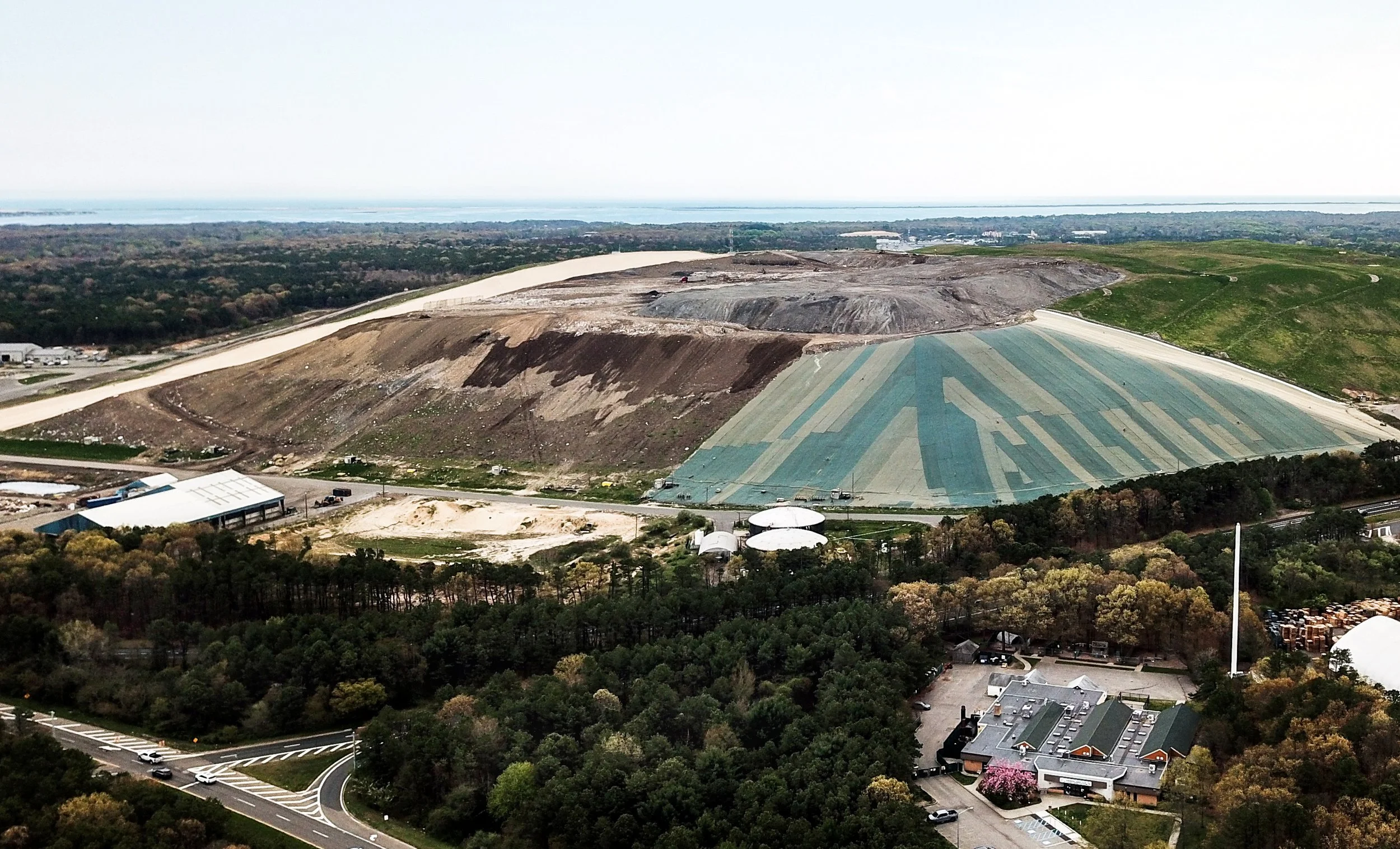
Landfills are New York’s Hidden Problem — and an Opportunity to Protect Health and Slow Climate Change
New York’s 86 municipal solid waste landfills are among the state’s largest sources of methane — a potent climate super pollutant that rapidly warms the planet and escapes alongside hazardous air contaminants. In 2023, estimated methane emissions reported by New York landfills reached over 4.8 million metric tons (MMT) of CO2, on a 20-year global warming potential. That’s the same climate impact as about 1.1 million cars on the road for a year (and it’s an underestimate).
But the good news is, solutions are already within reach. Landfills also represent one of the most immediate and cost-effective opportunities to cut greenhouse gas and other harmful emissions. States have the authority to set the rules for how landfills monitor, capture, and control air emissions. By strengthening these standards, policymakers can deliver a clear and measurable win.
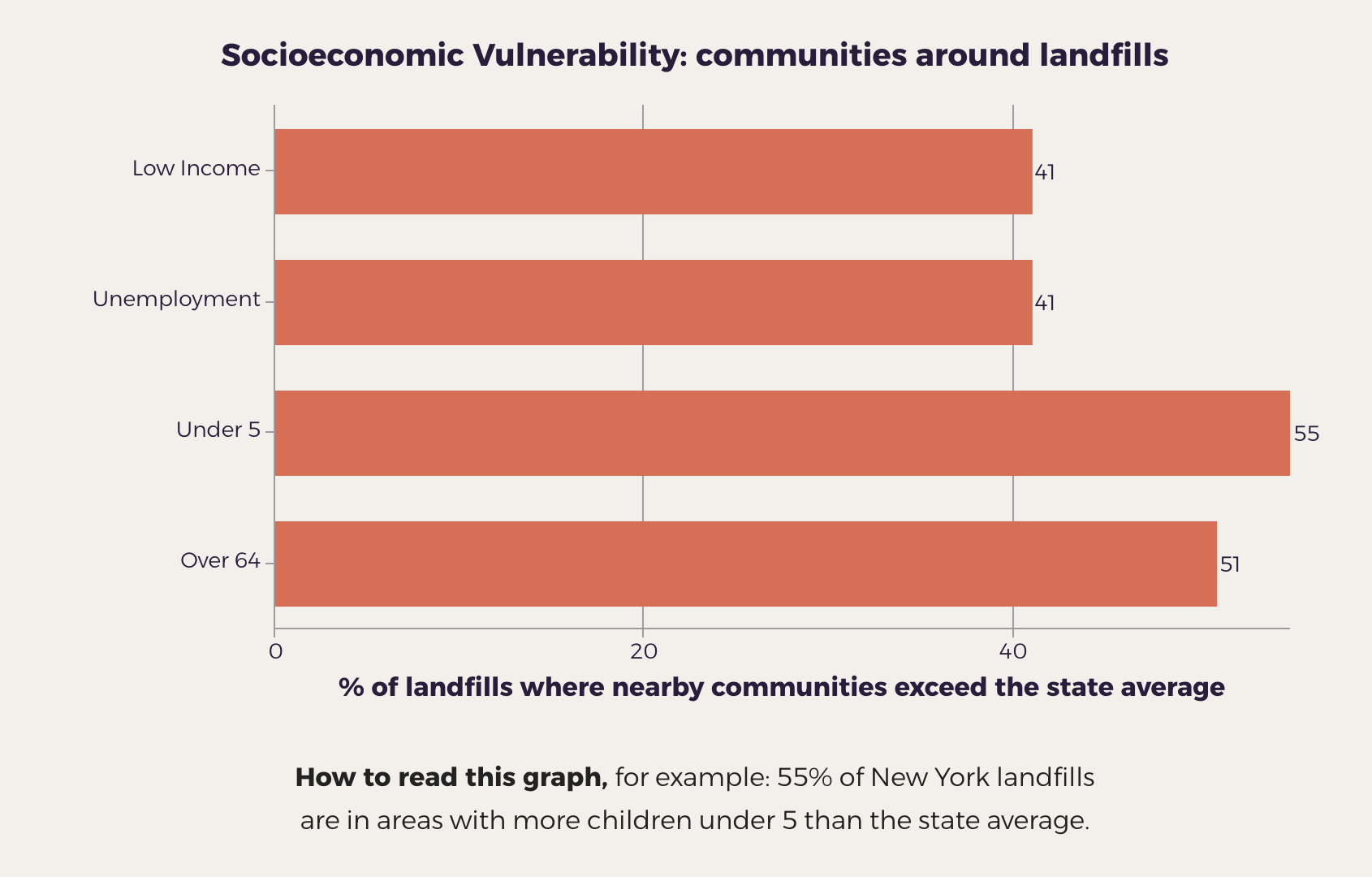
6.7 million people — more than 1 in 3 New Yorkers — live within five miles of a landfill. Half are Black, Indigenous, or people of color, communities also facing disproportionately high health risks and pollution exposure. Many are also environmentally disadvantaged communities, as recognized by the state of New York. In many of these areas, rates of cancer, asthma, and high blood pressure are above the state average. For example, communities near the Seneca Meadows Landfill experience high rates of lung cancer and other serious health conditions like chronic obstructive pulmonary disease (COPD). Young children and older adults, the people most vulnerable to pollution, are often the ones breathing this air and being subjected to the compounding effects of living close to a landfill.
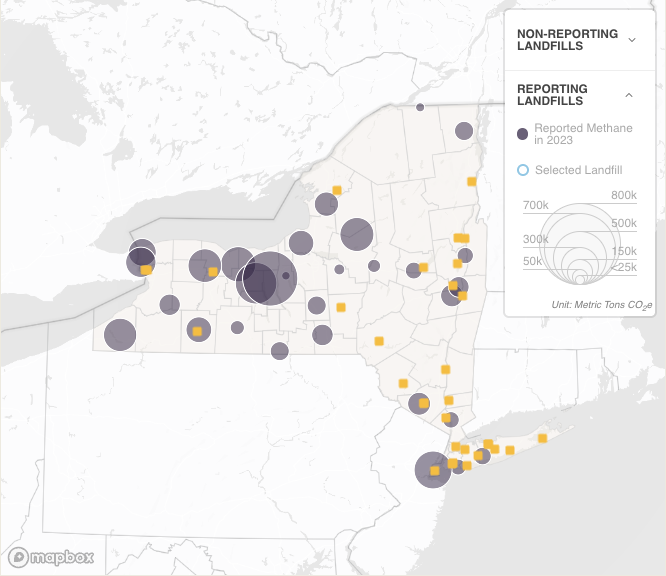
Nearly a third of the population of New York State lives near a landfill, many from already environmentally disadvantaged communities. Learn more in our interactive map.
Despite the scale of the problem, fewer than a third of New York’s landfills were required to report their methane emissions to the U.S. EPA’s Greenhouse Gas Reporting Program in 2023. Outdated and insufficient federal thresholds exempt many smaller or lower-capacity landfills from reporting, allowing huge amounts of methane to go unaccounted for.
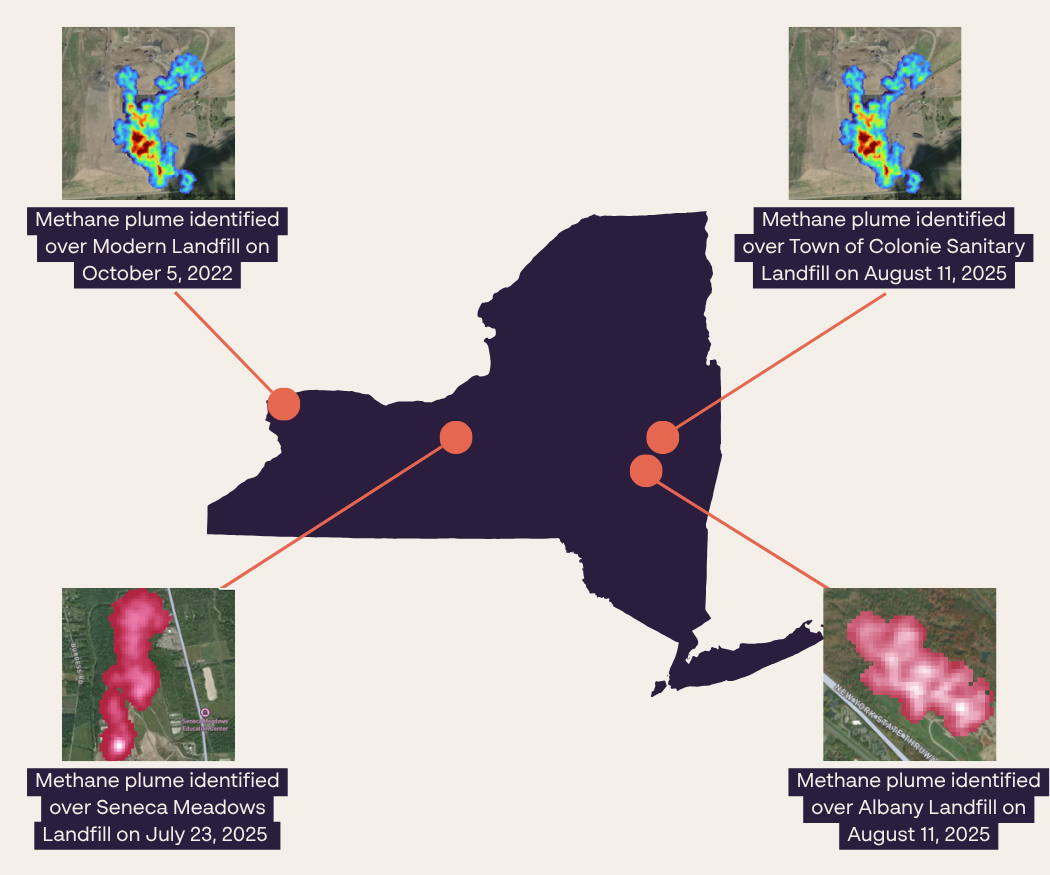
Meanwhile, independent satellite surveys have revealed massive methane plumes at facilities across the state, proving the real problem is far larger than official numbers suggest. This is a fixable problem. With stronger state rules, modern monitoring technology, and earlier requirements for methane capture, New York can protect public health, close reporting loopholes, and take one of the fastest steps available to cut climate pollution
New York is Poised to Close Loopholes — But Must Act Now
New York has already laid the groundwork for stronger landfill oversight, and now must act. The 2023 New York State Solid Waste Management Plan set organics diversion targets and put forward several policy objectives to strengthen landfill regulations, including updating its regulations to reduce methane leaks and incorporating improved methane monitoring technologies to more quickly and accurately detect fugitive emissions. Still, the state’s regulations remain outdated. Instead of embracing available methane-monitoring technology to get an accurate, real-time picture of methane emissions, the state’s regulations rely on manual monitoring practices, where a person walks the surface of a landfill four times a year with a handheld device, often skipping sections entirely. Gases are escaping before gas capture systems are required to be installed, and gas capture requirements leave loopholes. Diversion programs remain limited in scale. The New York Department of Environmental Conservation (NYDEC) must make good on its 2023 plans and swiftly begin the process of updating its landfill emission rules.
Meanwhile, other states — including Oregon, Maryland, Washington, and California — have already adopted stronger safeguards on landfills, such as ensuring landfills that emit a lot of methane install gas capture and collection systems and check for methane leaks, alongside organics recycling policies that keep new waste out of landfills. Without similar reforms, New York is lagging behind its peers, leaving communities exposed to avoidable health burdens and missing one of the state’s most significant near-term opportunities to cut climate pollution.
The benefits of action are clear. Colorado’s proposed landfill methane rules demonstrated a 6:1 benefit-to-cost ratio. By strengthening landfill rules, New York can secure cleaner air, a safer climate, and lasting economic benefits. Failing to act means higher health costs, greater climate damage, and continued harm to communities already carrying the heaviest burden.
Analysis Show Both Short and Long-Term Reductions are Possible
We built a multiphase model, grounded in standard IPCC methods and New York’s own waste data, to estimate how landfill methane emissions could evolve under current state policies — and how much pollution could be avoided with updated regulations. This approach reflects how waste decomposes and, in turn, how methane is generated over decades.
Methane on the Rise — and How to Stop It
Under current policies, New York’s landfills are on track to emit more than 10 million metric tons of methane by 2050 — roughly the same short-term climate impact as putting 189 million cars on the road for a year. Because methane is about 80 times more potent than carbon dioxide in the near term (over 20 years), those emissions are roughly equivalent to 812 MMT CO₂e
Our analysis identifies two key policy opportunities to change course — one that delivers immediate reductions by 2050, and another that drives deep, lasting cuts through 2100.
Immediate Wins from Stronger Landfill Air Emissions Rules (to 2050)
Stronger landfill air emissions rules can deliver fast, measurable progress. By closing loopholes in gas capture requirements, upgrading monitoring technology, and improving landfill cover practices, New York could cut landfill methane emissions by 46 percent or over 4.6 MMT by 2050, equal to taking 30 million cars off the road for a year.
Near-Term Solutions with Big Payoffs
The changes in landfill management and regulation that we modeled include:
Close Regulatory Loopholes in Gas Capture Rules
Many methane-emitting landfills escape regulation because of outdated thresholds and exemptions. The New York State Department of Environmental Conservation (NYSDEC) should close these gaps to ensure stronger, more consistent methane control.
Ensure minimum oversight: Revise current thresholds so landfills that generate large amounts of methane are required to capture and control methane emissions.
Accelerate installation to capture methane before it escapes: Require gas-collection systems to be installed earlier in a landfill’s lifecycle, before large volumes of methane escape. The EPA found that 61 percent of methane generated by landfilled food waste is not captured by landfill gas collection systems and is released to the atmosphere. Because food waste decays relatively quickly, its emissions often occur before landfill gas collection systems are required to be installed or expanded.
Improve performance: Update gas capture system design standards so wells are properly spaced, gas pressure is actively managed, and leaks are detected and repaired quickly.
Replace Outdated Monitoring Methods
Because methane is invisible, leaks often go unnoticed. Major advancements in detection technology mean it’s now easier and more affordable to find and fix large emissions — yet most landfills still rely on manual inspections that miss much of the problem.
Use modern tools: Require landfills to adopt cost-effective methane-monitoring systems, such as drones, satellites, and fixed sensors.
Increase frequency: Replace limited quarterly surface checks with continuous or high-frequency monitoring to catch leaks in real time.
Make methane visible: Standardize the use of technologies that quantify emissions and pinpoint exact leak locations, turning data into action.
Strengthen Cover Management to Stop Leaks
Even with better gas capture, methane can still escape through cracks and weak landfill covers. Stronger cover management practices can dramatically reduce those losses.
Upgrade materials: Require higher-performance daily and intermediate covers to seal methane in.
Adopt biocovers: Use methane-oxidizing biocovers in appropriate conditions to convert methane before it escapes.
Ensure maintenance: Implement routine inspection and repair schedules to maintain cover integrity over time.
Driving Emissions Down for Good
Even at higher gas recovery rates (rising to 75 percent by 2035) and with improved oxidation (up to 35 percent by 2035), landfills will continue to emit methane for decades. That’s because millions of tons of food scraps, yard waste, and other organics already buried will keep decomposing and releasing methane well into the second half of the century. This “methane legacy” means that landfill-management-only strategies lead to a substantial decline and ultimately to a plateau in emissions reductions — underlining the need to also reduce new organic waste going to landfills.
New York has already taken important steps. The state’s Food Donation and Food Scraps Recycling Law requires large food generators to donate edible food and recycle scraps, with thresholds expanding in 2027 and 2029.
New York City has also launched citywide composting through the Zero Waste Act, requiring organics separation for homes and businesses.
If the state expands access to organic waste recycling — cutting 40 percent of organic waste by 2030 and 85 percent by 2050 — landfill methane could fall 80 percent by 2100, avoiding about 27 million metric tons of methane. That’s the same climate benefit as taking more than 176 million cars off the road for a year.
These goals are ambitious but necessary. Without them, New York cannot meet its targets under the Climate Leadership and Community Protection Act. Organics recycling not only slashes emissions, it also eases the burden on landfills, protects public health, and supports a cleaner, more regenerative food system and economy. While not specifically modeled here, advocacy groups are also promoting other innovative solutions — for example, the Packaging Reduction and Recycling Infrastructure Act (PRRIA), which passed in the State Senate last year, but failed in the Assembly.
Put simply:
Updated landfill emissions rules → major near-term methane cuts and critical short-term climate and health benefits — buying us time to act.
Organics recycling policies → deep, sustained methane reductions — a long-term, durable solution.
When we think even longer term, we also need to work toward a future where landfilling is no longer the status quo, and mega-landfills like Seneca Meadows Landfill — the state’s largest landfill, which stands taller than the Empire State Building — are no longer able to expand at their whim.
The Opportunity Ahead
Modernizing landfill emissions rules is one of New York’s fastest opportunities to slow global warming. Earlier and effective gas collection, improved cover, and more effective leak detection can slash methane emissions quickly and improve community health. A long-term, sustainable solution comes when these operational upgrades to landfill standards are paired with at-scale organics recycling. Together, they deliver deep, durable reductions.
New York’s Waste Reaches Beyond Its Borders
It is also important to recognize what is not captured in these emissions estimates. New York exports a significant share of its waste, and the methane generated from that exported material, which is landfilled in other neighboring states, is excluded from our results. We estimate that this exported waste will generate 5.9 million metric tons of methane between 2025 and 2050 under federal rules, equal to making New York City completely car-free for 18 years. This highlights a simple truth: methane from waste knows no boundaries. Whether landfilled in New York or elsewhere, it fuels the same climate crisis and harms communities just the same. Waste is everyone’s problem — and the way we generate and manage waste must improve everywhere, not just within one state.
A Moment for Leadership
This is New York’s chance to protect public health, meet its climate commitments, and close one of the most dangerous gaps in landfill standards. By combining stronger landfill methane emissions rules with bold organics recycling, the state can lead the nation in showing what’s possible when we turn waste into opportunity.