
Partner Spotlight: Californians Against Waste
Californians Against Waste (CAW) is a pioneering environmental advocacy organization committed to safeguarding communities by eliminating pollution from resource extraction and disposal. Since 1977, CAW has championed upstream climate solutions, emphasizing waste prevention at its source and holding producers accountable throughout a product's lifecycle to foster a thriving circular economy. Through initiatives like advancing composting, reducing food waste, and promoting producer responsibility, CAW leads efforts to mitigate climate change and build a sustainable California.
Read this Q&A with Erica Parker, Policy Associate at Californians Against Waste, to learn more about their pathbreaking work to advance a circular economy in California and beyond!
What prompted you or your organization to get involved in advocacy around organic waste and landfills?
Californians Against Waste has long recognized that landfilling is not an environmentally, economically, or socially sustainable waste management strategy. From our founding, we’ve focused on reducing reliance on landfills by advancing policies that prioritize waste prevention, recycling, reuse, repair, and circular economy principles.
Food scraps and other organic materials are central to that mission. These materials make up a significant portion of what Californians throw away, and when landfilled, generate methane. That’s why preventing wasted food is such a critical priority for us. The most effective climate strategy is ensuring edible food is never wasted in the first place, whether through clearer expiration date labeling on food products, stronger food recovery systems, or smarter upstream policies.
At the same time, for materials that do enter the waste stream, we view them as a resource – not a waste! When properly managed, food scraps and other organic materials can be transformed into beneficial products – from compost and mulch that build healthy soils to renewable energy through anaerobic digestion. A core part of our mission is shifting the perspective from disposal to resource recovery.
What success or accomplishment in food waste reduction or organics diversion are you most proud of?
Three accomplishments stand out:
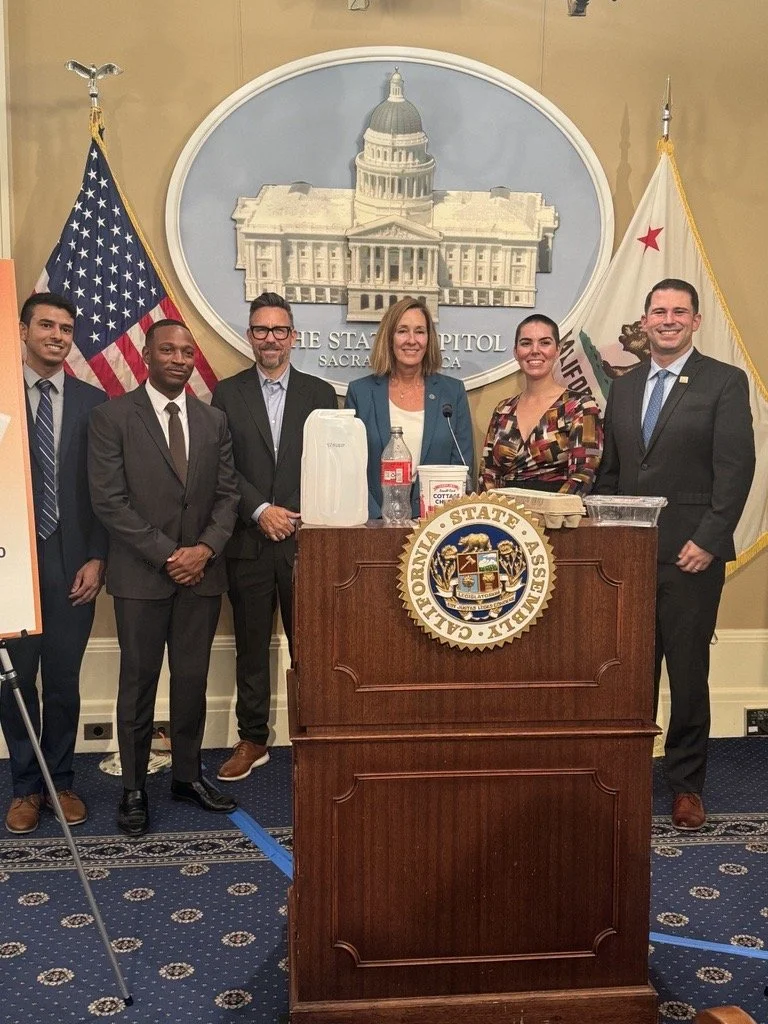
CAW staff attend the signing of AB 660
SB 1383 (Lara, 2016): California’s landmark Short-Lived Climate Pollutant law, which sets targets of 75% reduction in organic waste sent to landfill and 20% of edible food sent to food recovery organizations to feed people instead of landfills. This law fundamentally shifted how the state manages these materials and we’re starting to see meaningful behavior change and significant strides towards organics management infrastructure across the state. This landmark policy has also served as an example for other states!
AB 660 (Irwin, 2024): California’s Food Date Labeling Law, which standardizes “best if used by” and “use by” labels on food products to reduce consumer confusion and prevent perfectly good food from being wasted. This bill set the stage for other states to follow suit and to bring industry groups to the table to negotiate on the Federal Food Date Labeling Act.
Updated landfill methane regulations adopted by the California Air Resources Board. These updated regulations strengthen monitoring and mitigation requirements to better detect and reduce emissions from landfills. These updates also integrated data transparency, giving communities greater access to landfill emissions and operational information and a clearer understanding of what is happening in their neighborhoods.
What keeps you doing this work? Has there been a moment or story that reinforced why this is important to you?
This work is so motivating because it delivers tangible environmental, economic, and community benefits. When food that would have been wasted instead feeds families, when California-made compost enriches our soils, or when stronger methane rules reduce greenhouse gases and harmful pollution in frontline communities, these outcomes are real and measurable!
One moment that sticks out was in November 2024 when CARB adopted the strongest landfill methane regulation in the country. It was the result of years of advocacy, consistent engagement, and most importantly, persistent organizing by community members and environmental justice groups fighting for (and winning!) public transparency and better emissions monitoring. During the board meeting, members explicitly thanked community advocates and acknowledged that their voices had shaped the outcome. Hearing state regulators publicly recognize residents who had been fighting for cleaner air and accountability was incredibly powerful. I think we’ll remember that moment for the rest of our lives, and to have been part of such a significant win is truly an honor.
What is the biggest barrier right now to achieving your mission or vision?
One of the biggest barriers is the misalignment of incentives in our current system. We have all witnessed first-hand the significant societal and environmental impacts of disposal practices in California and across the US — from methane emissions driving climate change, plastic pollution at the tops of mountains and in the deepest trenches, to the long-term costs of extracting and processing new raw materials. Yet many of those costs are not borne by the companies operating disposal facilities or producing disposable products.
As long as environmental and public health impacts can be externalized while polluting industries profit, we’re operating in a classic “tragedy of the commons.” That dynamic encourages overconsumption, overproduction, and continued reliance on single use products and landfilling because the true costs are not reflected in the price of disposal or products.
To achieve our vision, we need policies that realign those incentives and drive meaningful change. Policies that ensure that the environmental costs are accounted for, that producers take responsibility for the products they’re pushing into the market, and that prevention and resource recovery are not only economically favored over disposal, but that true behavior change follows suit.
What is a common misconception about food/organic waste reduction?
One major misconception is that food scraps and other organic materials are simply “trash.” In reality, they are valuable resources! When buried in landfills, the generate methane and contribute to climate change. But when managed properly, they can be turned into valuable end products that serve the environment, communities, and contribute to sustainable local food systems. The material itself isn’t the problem. The system that treats it as waste is.
Another misconception is that landfills capture all the methane and co-emitted gases. While gas collection systems exist, they are not perfect, and emissions can escape through surface and equipment leaks. That’s why strong monitoring, transparency, and accountability are essential.
Finally, some assume that diverting food scraps alone will eliminate landfill emissions. Diversion is critical, but organics already buried in landfills will continue decomposing for decades. Addressing the problem requires both upstream waste prevention and strong oversight of existing landfill emissions.
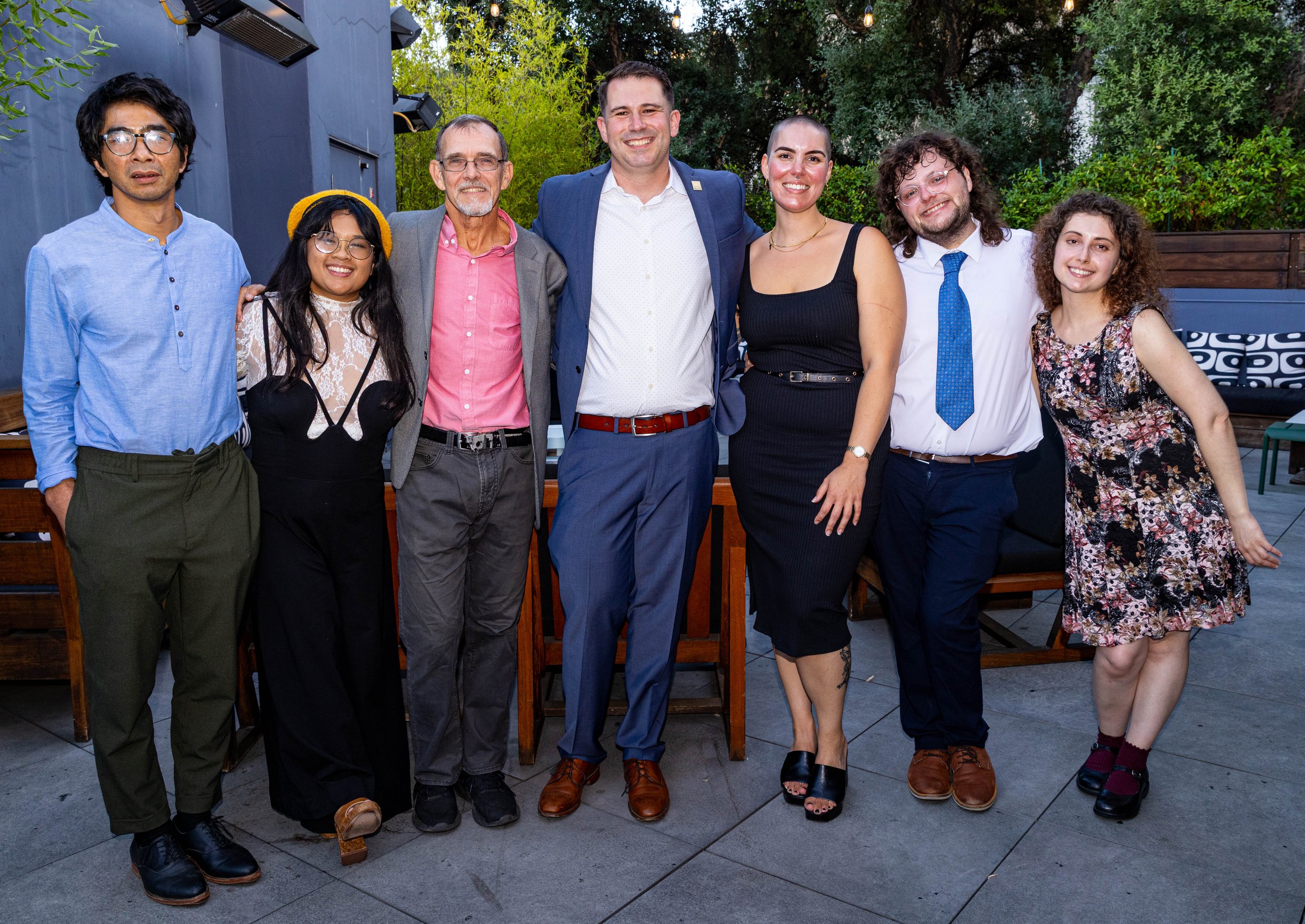
“In ten years, success would mean we have avoided significant climate, public health, and safety impacts from the waste sector, particularly for communities that have long borne the burden of living near landfills. Methane emissions would be dramatically reduced, air quality improved, and communities would have greater transparency and accountability around local facilities.”
What is the most impactful thing that state, local, or federal policymakers could do right now to scale up food and organic waste reduction efforts?
Policymakers can:
Provide sustained funding and technical support for local implementation of organics recycling and food recovery programs.
Strengthen methane monitoring requirements and improve transparency around landfill emissions data. Invest in waste prevention infrastructure — including compost markets, repair programs, and reuse systems.
Support policies that reduce food waste upstream, including standardized labeling and supply chain improvements.
If we are successful in our shared mission, what does California and the U.S. look like in 10 years?
In ten years, success would mean we have avoided significant climate, public health, and safety impacts from the waste sector, particularly for communities that have long borne the burden of living near landfills. Methane emissions would be dramatically reduced, air quality improved, and communities would have greater transparency and accountability around local facilities.
We would also see a fundamental shift in how resources move through our food system. Food that was once wasted would consistently reach people experiencing food insecurity. Food scraps and other organic materials would be transformed into compost and other beneficial products that build healthy soils, improve drought resilience, and strengthen agricultural productivity.
Communities would feel connected to this cycle, understanding that their kitchen scraps help grow the next season’s food. Instead of a linear take-make-dispose model, we would have a circular system that keeps nutrients in use, supports local economies, and creates good jobs in composting, food recovery, and resource management.
Ultimately, success looks like a system that protects communities, values resources, and treats materials not as waste but as part of a circular economy.
