
CARB Listened to Communities Suffering from Landfill Pollution. Now Every State Needs to Modernize Its Landfill Rules.
For years, people living next to landfills like Chiquita Canyon have been sounding alarm bells:
“Living next to the chemical and environmental disaster at Chiquita Canyon Landfill has been completely devastating on so many levels. We have witnessed both political corruption and corporate greed destroy the lives of so many in our community. We have been stripped of our basic human right to breathe clean air, and our quality of life has diminished.”
“One person after another told the board about ‘obscene’ odors they endure nearly every day, deteriorating health, nosebleeds, nonstop coughing, aggravated asthma, vomiting, tremors, headaches, dizziness, miscarriages, cancer. A father from the historically Black town of Val Verde said one night the smell and his family’s coughing were so bad, they drove to Walmart to sleep in the parking lot.”
"‘In addition to multiple new cancer causes just this year, known cancer causing chemicals like benzene and other chemicals have been causing health impacts like headaches, nausea, bloody noses, burning eyes, skin rashes, asthma, vertigo, vomiting, tremors, heart and breathing difficulties that require ER attention, and more,’" said Schiavo's office when reporting the survey's results.”
That’s because landfilled organic waste creates planet-warming methane, plus a cocktail of pollutants like benzene, hydrogen sulfide, and volatile organic compounds (VOCs). These pollutants are linked to asthma, heart disease, cancer, and other serious health harms. Communities near landfills often face higher rates of chronic illness and already struggle with polluted air and unsafe drinking water.
For years, community leaders and residents enduring harms from the Chiquita Canyon Landfill and others across the state have been filing complaints, packing public meetings, giving testimony, and organizing with health and environmental groups. All the while, methane leaks and toxic pollution continued, sometimes just hundreds of feet from homes.
On November 20, the California Air Resources Board (CARB) finally responded in a serious way — with a unanimous vote approving major updates to the state’s Landfill Methane Regulation (LMR). It’s the biggest landfill action California has taken in 15 years. And while it’s long overdue, it’s proof that regulators can act when residents demand it.
For state leaders who still haven’t updated landfill rules, there’s a clear message here: communities suffering from landfill pollution are not going away and you have both the tools and responsibility to act.
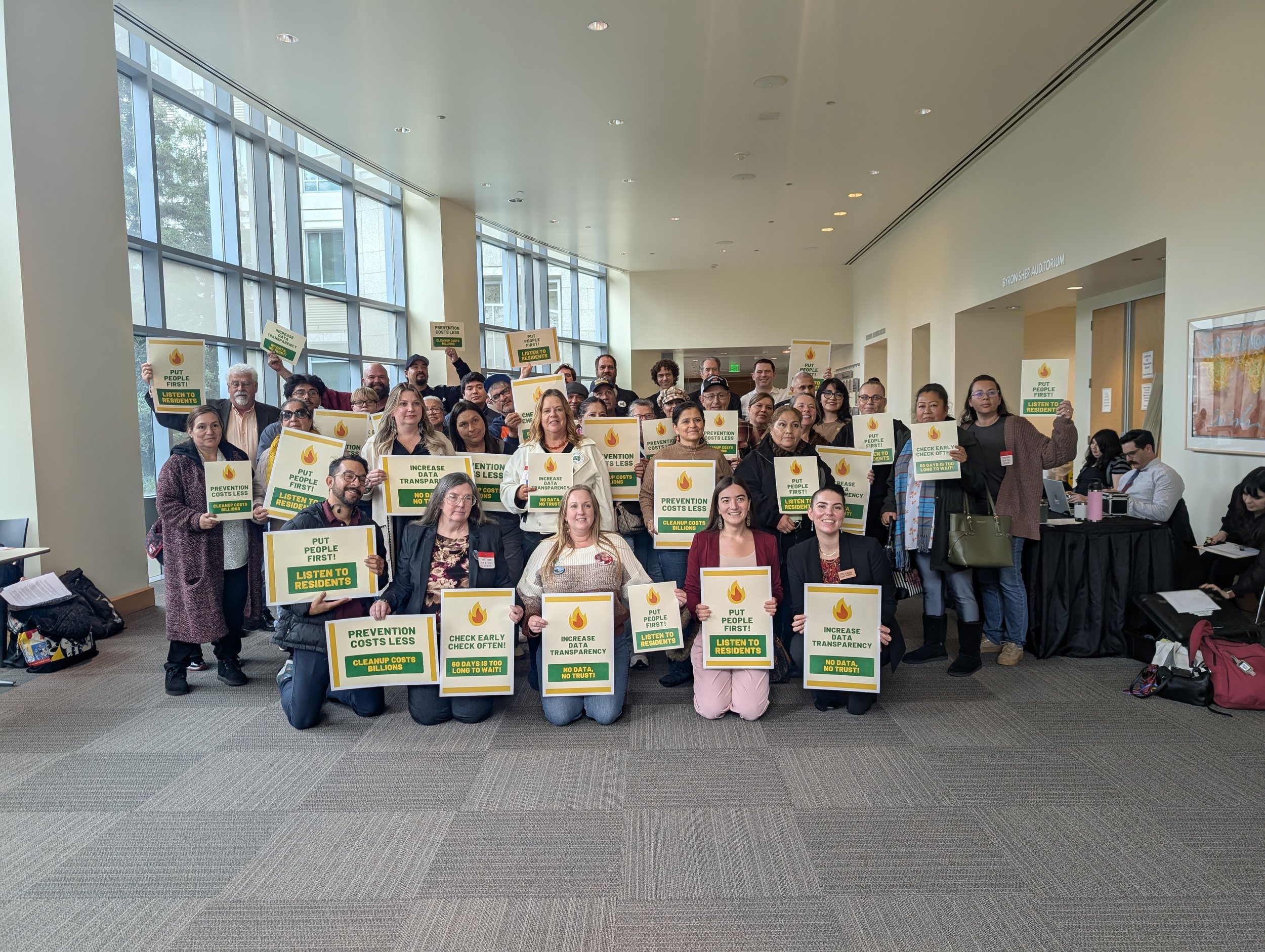
Impacted residents prepared to testify at the November 20 CARB meeting
What CARB Did After Residents Spoke Up
The last time California took major action on landfills, Instagram was brand new and the iPad was a novelty. Since then, technology to find and stop methane leaks has leapt forward. So has the evidence that current rules fail to protect people. In fall 2024, the U.S. EPA issued an enforcement alert warning that andfills are failing to properly monitor for and capture methane. The alert revealed widespread noncompliance by landfill operators. Many operators report few or no methane leaks, while EPA inspectors find dozens of leaks, sometimes at explosive levels.
Communities and advocates (props to Californians Against Waste, Central California Environmental Justice Network, California Communities Against Toxics, and so many more!) pushed CARB to respond to that reality. Federal policymakers called for action.
The updated rule takes several important steps:
1. Monitoring where the leaks actually are
Working face monitoring: For the first time, CARB will require monitoring in areas like the working face — the active dumping area — where a recent Carbon Mapper analysis found about 75% of detected methane emissions at many landfills. That exemption never made sense to nearby residents, and now it’s finally gone.
Super-emitter response: If satellites or aircraft detect a major methane plume, landfill operators are now required to investigate and fix it on a clear timeline, instead of treating it as optional. This responds directly to evidence that super-emitter plumes are widespread at landfills and often missed.
Instead of skipping whole areas, use available technology to find large methane emissions: The updated rule finally requires operators to use drones, sensors, or other advanced technologies in areas that are unsafe or impractical for people to walk — and this is a critical fix. For years, landfill operators routinely skipped entire sections of their sites because they were too steep, too unstable, or too dangerous for manual surface monitoring.
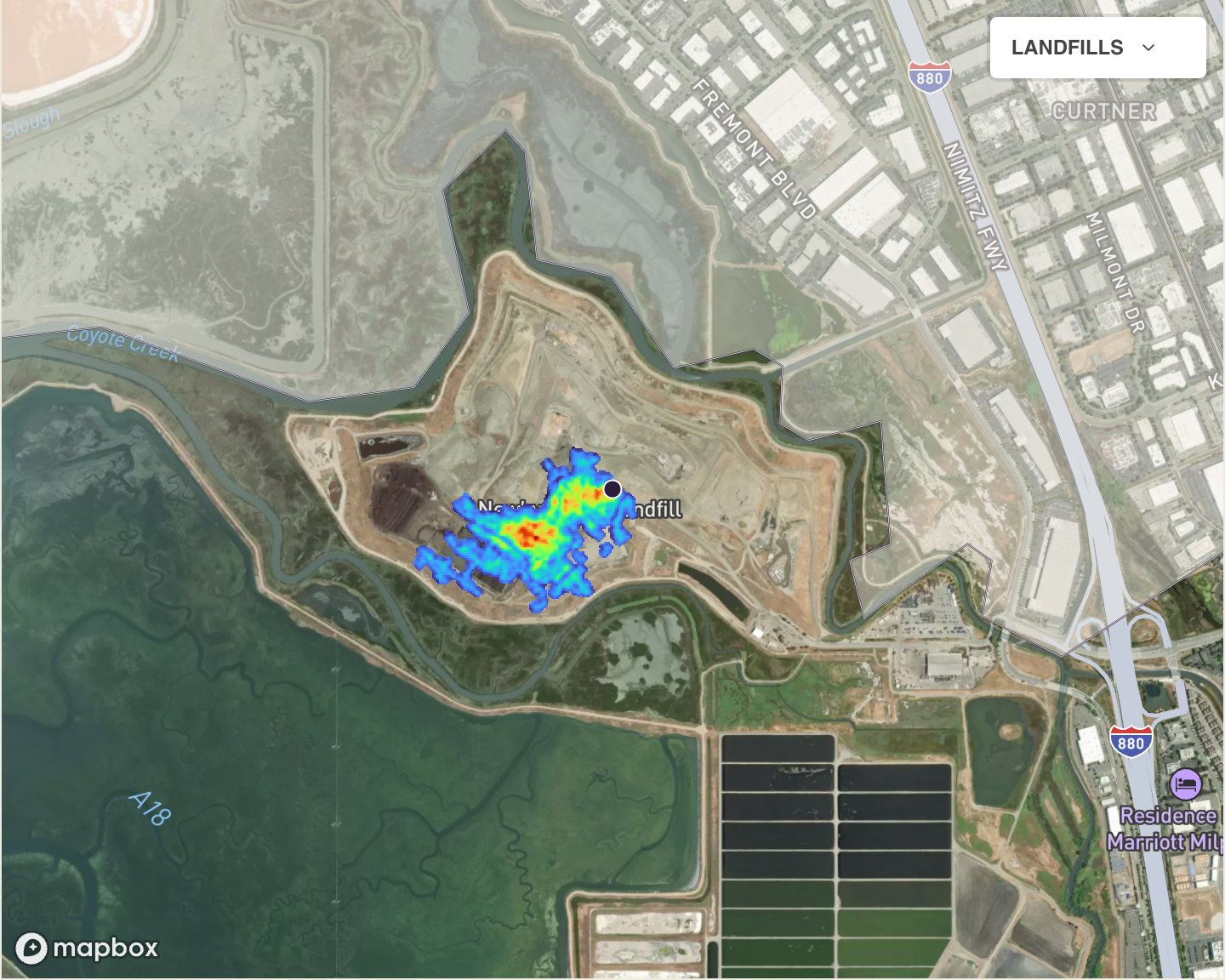
A methane plume detected over the Newby Island Landfill in Milpitas on April 6, 2022
2. Limiting turning off the entire gas collection system
CARB’s own research found that excessive downtime in gas collection and control systems was one of the top drivers of methane plumes. That’s logical since turning off the only system that captures methane gas means gas is not going to be captured. The updated rule:
Limits how long wells and other components can be offline (no more “mystery outages” stretching for weeks);
Caps the share of wells that can be offline at once;
Requires operators to notify CARB when they shut down parts of the system.
3. Improving fire prevention
Subsurface landfill fires are human health emergencies, not routine maintenance issues. Communities near sites like Chiquita Canyon know this better than anyone. Federal regulations that require landfills to monitor for fire warning signs like oxygen levels and temperature — but don’t require them to do anything if those alarms go off. It’s like having a smoke detector that beeps every day, and no one’s required to check for flames. California Communities Against Toxics has been working for years on the dangers of landfill toxins, leading on state legislation to address subsurface fires. Bloomberg News’ recent investigation into toxic landfills helped pull back the curtain on what communities have been living with for years. Their reporting made clear that landfill pollution isn’t a minor inconvenience — it’s a chronic public health threat that regulators have ignored for far too long.
The new rule:
Requires more robust temperature and oxygen monitoring at gas wells and combustion equipment.
Sets clearer steps for what operators must do when wells start running hot - so that catastrophic subsurface fires are prevented.
Frontline residents and experts pushed CARB to act on fires; the agency is finally recognizing that smoldering landfills are a health threat.
4. Strengthening accountability for gas collection
It’s game over if the gas collection system — a network of pipes underground that collect the gas — malfunctions. The rule also:
Requires leak monitoring and repair plans for gas components - this is essential because landfill gas collection systems are not static equipment sitting in a controlled environment — they are a sprawling network of buried pipes, valves, wells, seals, and fittings operating inside an unstable, constantly shifting mass of decomposing waste.
Clarifies that third-party gas-to-energy operators are fully responsible for compliance — closing a major loophole where companies could point fingers at each other when things went wrong,while people living near landfills got handed the consequences.
5. Basic transparency for communities
CARB is moving landfills into at least the twentieth century, requiring electronic submission of reports, GIS-based data reporting, and better recordkeeping — all important steps. And, most importantly, it will make key data public in an accessible form.
In most states, including California, right now you need to submit a public records request just to get access to the reports that the landfill operator has to submit to the state. That’s ridiculous in the 21st century, when most information lives on the internet.
Important Progress — and Clear Opportunities to Go Further
CARB’s update is a big step, but if you ask the people living next to landfills, it isn’t the finish line. State leaders elsewhere can — and should — learn from both the progress. Additional protections that states should incorporate include:
Institute fenceline monitoring to quickly spot harmful leaks
Residents want to know: “Is my family in harm’s way today?” Fenceline monitoring is one of the simplest ways to answer that question. Right now landfill operators only look for big methane leaks four times a year. Methane gas does not travel alone. If methane is escaping, so can invisible air toxins. Fenceline monitoring is relatively low-cost, widely available, and can detect big methane leaks at the property boundary in real time,enabling the landfill operator to trace back the issue and address it.
Require the use of actually effective surface monitoring technologies across the entire landfill
CARB acknowledges that drones, satellites, and other advanced tools offer “significant advantages.” But instead of making them the norm, the rule only requires them in dangerous-to-monitor areas. We know these technologies are already in use at landfills in states from Kansas to North Carolina and are cheaper than labor-intensive walking surveys.
What Californians Get: Big Benefits for Pennies — and Real Relief for Frontline Communities
California’s updated landfill methane rule delivers major, measurable benefits for California families,especially those who have been breathing landfill pollution for years. According to CARB’s analysis, the new rules will cut methane emissions by about 17,000 metric tons every year, equal to taking more than 111,000 vehicles off the road. Methane is one of the most potent climate pollutants we deal with; reducing it delivers almost instant climate relief.
And the dollars-and-cents story is just as compelling. CARB estimates these methane cuts will provide $56 million to $178 million in avoided climate damages over just the first three years. That means Californians get back four to fourteen times more in climate benefits than the rule costs to implement — and that doesn’t even count the unquantified additional benefits from better landfill covers, more rapid fire detection, or preventing toxic co-pollutants from drifting into nearby neighborhoods.
Meanwhile, the cost to implement the rule across the entire state? About $12.5 million in the first year and $12.3 million per year after that. That’s roughly 31 cents per person per year. the cost of a slice of bread —for protections that residents have spent years begging for.
Better monitoring, quicker fixes, safer gas systems, and fewer toxic exposures — all at a cost lower than a postage stamp. For frontline families living near places like Chiquita Canyon where odor complaints, headaches, respiratory problems, and fire risks have become daily realities, these improvements matter. For pennies per person, Californians get cleaner air, safer landfills, major climate benefits, and real relief for the communities that have been forced to live with landfill pollution for far too long.
A Call to State Leaders: Don’t Wait 15 Years
California’s rule is proof that regulators can respond when community members, advocates, and health experts push hard enough. It’s also proof that waiting a decade and a half between major updates leaves frontline communities vulnerable.
Other states don’t need to repeat that mistake. In fact, many states like Oregon, Maryland and Washington have already modernized basic landfill standards. The throughline is simple: when states update landfill rules with community health at the center, emissions go down, and people’s lives improve.
California’s updated landfill rule exists because communities living near landfills refused to accept pollution as normal. If you’re a regulator, legislator, or governor in a state that hasn’t revisited landfill standards in years, this is your moment to:
Put community health and justice at the heart of landfill rules
Require modern methane leak detection using remote technologies instead of depending on a flawed honor system of manual sporadic monitoring
Close loopholes that let landfills emit methane and co-pollutants for years
Make data and reports public and easily accessible
Communities living in the shadow of landfills have been begging for relief long enough. Now every state has a choice: wait for another generation to grow up breathing landfill pollution—or act today to protect people.
